
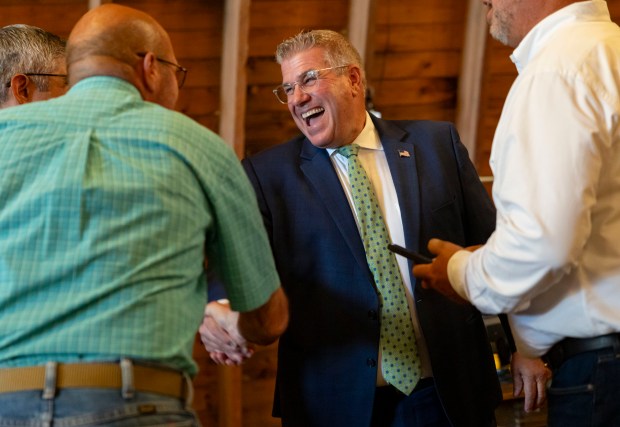
In Shirley, Illinois, the discussion around agriculture heated up as Governor JB Pritzker, a Democrat, and his Republican challenger, Darren Bailey, addressed the Illinois Agricultural Legislative Roundtable. Bailey, who has deep roots in farming, accused Pritzker of caring more about his dislike for former President Donald Trump than the welfare of Illinois. Pritzker countered by placing blame on the Trump administration for the economic difficulties faced by local farmers.
During the nearly hour-long event in rural central Illinois, Pritzker cited ongoing trade disputes and the situation in Iran as factors driving costs higher for essential farming needs like fertilizer and diesel fuel. He shifted from his customary critique of Trump to express agreement with the former president’s suggestion that oil companies should redirect some of their profits back to consumers. “Big oil companies are making unprecedented profits amidst these challenges,” Pritzker stated. “Trump himself remarked that these companies should return some of that gain. I find consensus with this view,” he added, noting his own call for major oil company executives to return profits to Illinois residents.
The forum, located approximately 140 miles southwest of Chicago, included appearances from Republican U.S. Senate hopeful Don Tracy. Meanwhile, Democratic Lt. Gov. Juliana Stratton, who’s in a Senate contest, was absent, engaged elsewhere at Martha’s Vineyard, prompting criticism from Tracy over what he perceived as misplaced priorities.
Bailey, well-known for his support of Trump, reassured the 50-person audience that he would advocate for agriculture, defending Trump’s tariffs on imports as a necessary measure to regain competitiveness. “There’s an evident conflict between JB Pritzker and President Trump,” Bailey argued. “The tariffs might lead to short-term challenges, but they hold promise for long-term benefits,” he asserted.
Bailey, who greeted attendees at the event, finds himself against significant odds in his race with Pritzker, whose resources far exceed Bailey’s own state campaign funds. By June, Pritzker’s campaign funds exceeded $3.1 million compared to under $128,000 for Bailey, mostly due to reduced backing from conservative donors.
Bailey leverages his rural base but must also attract voters from the heavily Democratic regions like Cook County to secure a victory. Unfortunately, personal tragedies have beset his campaign, as he mourns the loss of close family members in a helicopter crash. Despite this, reports suggest he has been residing part-time in Chicago for his gubernatorial effort.
Among the policy initiatives Bailey supports are adjustments to Illinois’ estate tax, impacting farms valued over $4 million, and he criticizes the state’s property taxes as excessively high. Pritzker, defending his economic track record, noted the financial support he has funneled to local agencies. “Bailey’s plan to cap property taxes might sound attractive,” Pritzker said, “yet it overlooks the financial support needed for parks, libraries, and schools.”
Within the Senate race, Tracy, a Springfield lawyer and co-owner of Dot Foods, faces similar challenges due to Stratton’s Democratic advantage and financial lead. Through June, campaign finance records showed Stratton with nearly $4.2 million compared to Tracy’s $374,000.
At the forum, Tracy introduced himself to the attendees, emphasizing the independence and innovation of Illinois farmers. “Farmers are among America’s most resilient,” he stated, challenging the notion of excessive regulation. Tracy also humorously highlighted Stratton’s absence, jesting about her possible difficulties in finding McLean County.
In a statement, Stratton’s campaign outlined that her commitments in Martha’s Vineyard included attending events with Sen. Raphael Warnock. They emphasized her ongoing commitment to agricultural issues in Illinois, noting upcoming meetings with farm groups.
Independent candidate Collin Corbett criticized the exclusion of non-party candidates from the event as unfair, highlighting the necessity of broad discussions addressing agricultural challenges.
The Illinois Agricultural Legislative Roundtable maintained their policy of engaging only established party candidates.