
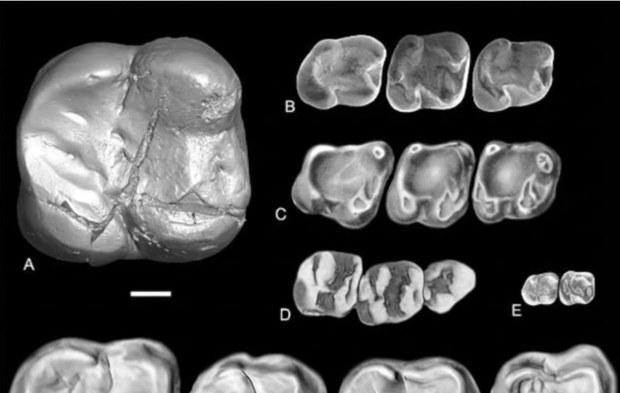
Scientists have discovered a massive rodent that lived 33 to 35 million years ago in what is now southern Thailand. This newly identified species is derived from two fossilized teeth. Weighing about 66 pounds, this ancient animal ranks among the largest known rodents from the Paleogene period. The findings, published in Scientific Reports, provide insights into the evolution of early rodents.
The fossils, a molar and an incisor, were unearthed in 2004 at a coal mine in Krabi province. Pannipa Tian, a geologist from Thailand’s Department of Mineral Resources, initially misidentified the large incisor as a bone. “At first, I thought it was a bone. I showed it to my supervisor, who told me it was a giant rat’s tooth,” Tian explained.
The Krabi basin is known for yielding fossils of various ancient species. However, at the time, the team lacked sufficient tools to identify the discovery. Collaboration between researchers from Thailand, France, and Canada has since allowed them to determine the species through an analysis of the teeth.
This rodent weighed approximately 30 kilograms, about half the size of a large capybara, the largest living rodent today. Although similar in size, the prehistoric rodent belonged to the extinct Ischyromyidae family. “It tells a lot about the diversity of life in the past,” Tian noted, suggesting that ancient rodents may have evolved in the region before spreading elsewhere.
The species, named Yakamys sirindhornae, honors Thailand’s Princess Sirindhorn, a supporter of scientific research. Despite this significant discovery, the rodent’s physical appearance, diet, and behavior remain speculative, as only two teeth have been found.
This discovery is not the largest rodent ever uncovered. In 2020, researchers identified a human-sized prehistoric rat in the Amazon. Uruguay scientists in 2008 revealed a rodent that weighed 1 ton, and in 2003, a 1,545-pound “Rat-zilla” fossil was found in South America.