
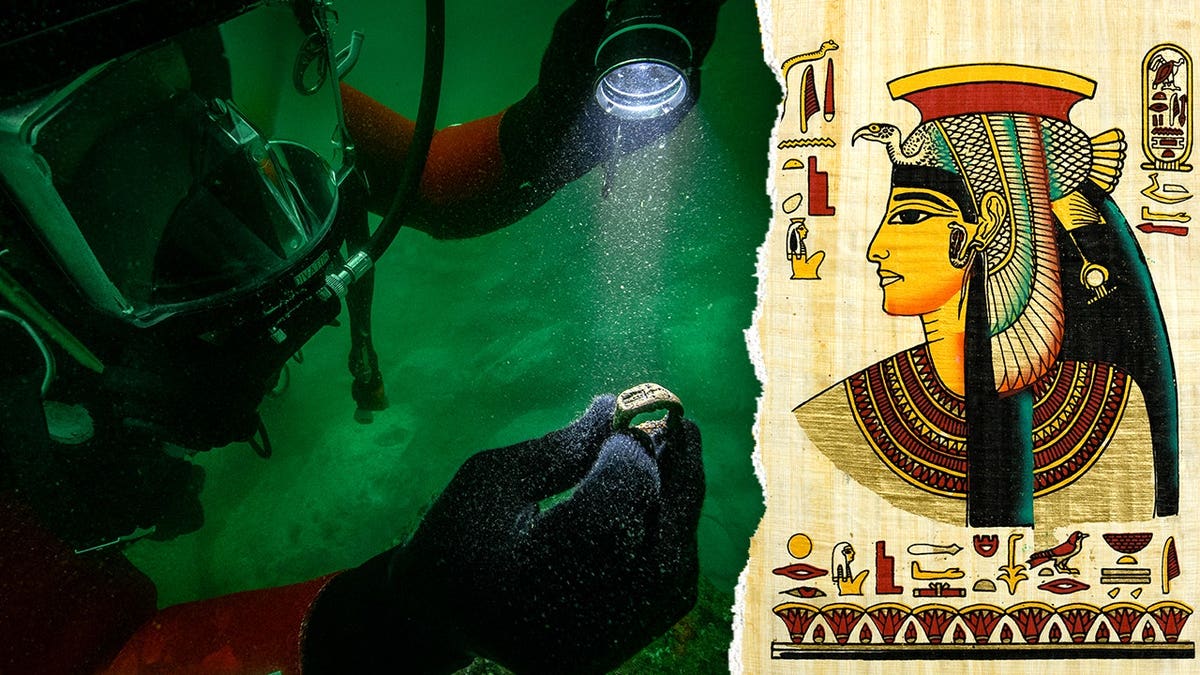
Archaeologists have recently made an intriguing discovery in Alexandria, Egypt. An ancient bronze ring has been found in a submerged harbor connected to Cleopatra, offering insights into a long-lost wonder of the ancient world. This announcement comes from the European Institute for Underwater Archaeology.
Significance of the Ring
The ring, known as a “perfect object” by experts, was located at the site of a royal palace on Antirhodos, an island in Alexandria’s ancient royal quarters linked to Cleopatra VII, Mark Antony, and Julius Caesar. The bronze ring depicts the Lighthouse of Alexandria, one of the Seven Wonders of the Ancient World.
This ring is the first known signet ring, a type of ring used to stamp seals, featuring the iconic landmark. Pictures shared by officials show the ring with a weathered appearance, a gold-colored surface, and a faint engraving of the lighthouse.
Historical Context
Constructed in the third century B.C., the Lighthouse of Alexandria guided ships for centuries until earthquakes led to its destruction, culminating in its final collapse around the 14th century. Although the exact age of the ring remains unknown, its design is said to be similar to that found on some second-century A.D. coins.
Underwater Excavation Challenges
The excavation process is meticulous, as noted by Franck Goddio, president of the European Institute for Underwater Archaeology, and Alexandra F. Morris, an ancient history lecturer at Queen’s University Belfast. The underwater site requires divers to carefully find, record, and lift the discovered artifacts.
It is suggested that the palace linked to Cleopatra VII might have served administrative functions, possibly overseeing operations at the Lighthouse of Alexandria.
Broader Implications
Morris has indicated that the ring, possibly from the Ptolemaic or Roman periods, underscores the lighthouse’s enduring significance to Alexandria. She noted, “This lighthouse has now been shrunk down to sit on someone’s finger and used to sign official paperwork,” highlighting its symbolic representation long after its construction.
Beyond historical relevance, the ring could aid in making Alexandria’s underwater history more accessible. Potential replicas or models could allow more tactile engagement with the site, enhancing public understanding.