
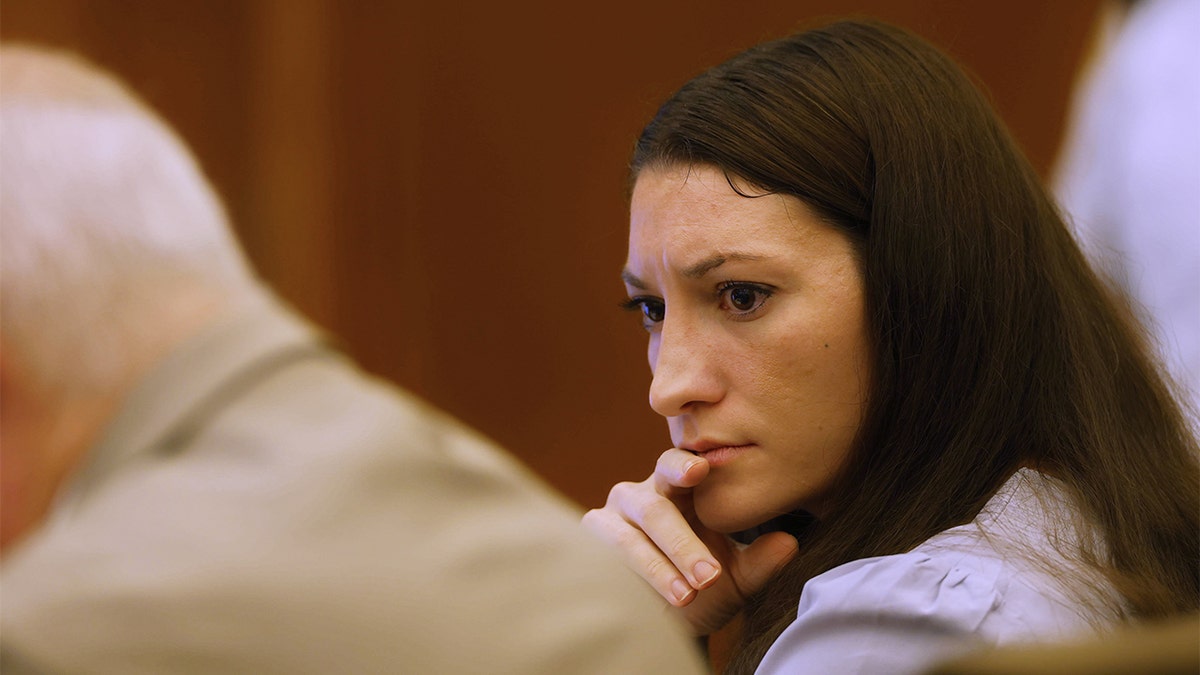
Lindsay Clancy participated in court proceedings, affirming, “Yes, Your Honor,” as she consented to allow prosecutors to treat specific forensic facts as established. This agreement preceded a state police trooper’s disclosure that no usable fingerprints were recovered from a knife or exercise bands.
These developments brought focus to the central matter in the Massachusetts mother’s murder trial: whether Clancy was criminally responsible when her children were found dead in their Duxbury home.
Discussion on Evidence Stipulation
Prior to the jury’s entry, Judge William Sullivan interrogated Clancy about a stipulation regarding evidence.
“You understand that by signing the stipulation, you’re agreeing that the Commonwealth does not have to prove these certain facts that are contained in the stipulation,” Sullivan stated.
Clancy responded affirmatively, “Yes, Your Honor.” She assured the court no one had coerced her into accepting the stipulation, which she entered into knowingly and voluntarily.
Implications of the Agreement
Defense attorney Kevin Reddington emphasized that the agreement eliminates the need for prosecutors to call numerous witnesses solely to confirm the chain of custody for blood, bodily fluids, exercise bands, and DNA evidence.
The stipulation does not constitute a guilty plea, nor does it admit Clancy’s criminal responsibility for the deaths of her children: Cora, 5, Dawson, 3, and Callan, 8 months.
Margaret McLean, a former prosecutor, noted that the agreement allows the defense to divert jury attention from the nature of the acts to Clancy’s mental state.
Mental State Focus
McLean clarified that Clancy’s responses in court do not reflect her mental condition on the crime day.
“She sounded rational. She understands what she’s doing,” McLean observed. “But the prosecution must prove her sanity beyond reasonable doubt at the crime time.”
Crime Scene Evidence Collection
Massachusetts State Police Trooper Jonathan O’Loughlin testified about the knife and exercise bands collected at Clancy’s home. He noted the knife had a friction-ridge impression, but it was inadequate for identification.
“There was not enough characteristics or minutia to do any comparison,” O’Loughlin said.
Similarly, the exercise bands produced no impressions viable for comparison.
Considerations for Jurors
McLean suggested that the absence of identifiable prints could lead jurors to question whether gloves were used or if items were wiped, potentially interpreting the lack of prints as evidence of premeditation.
The defense advised jurors against speculating on evidence that isn’t present. McLean cautioned, “They can use common sense in deliberation but mustn’t speculate on non-evidence.”