
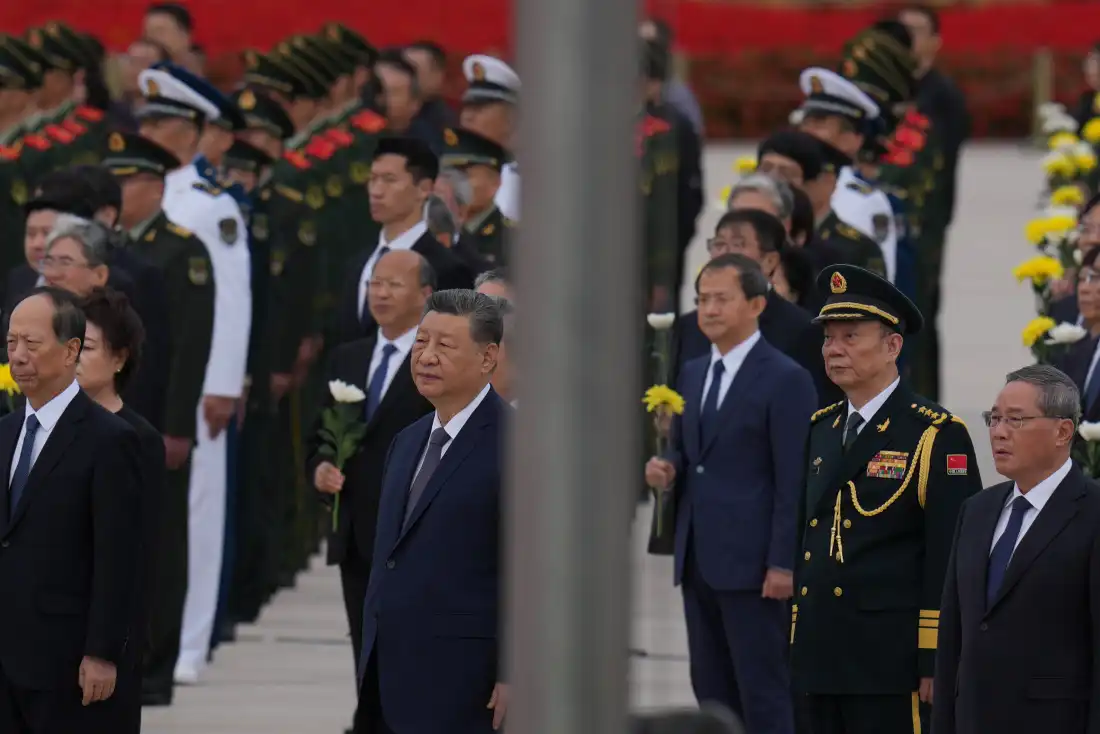
On September 30, 2026, Chinese President Xi Jinping, along with Zhang Shengmin, Vice Chairman of the Central Military Commission, attended a ceremony in Beijing’s Tiananmen Square to honor fallen national heroes. This event marked Martyrs’ Day, commemorating those who sacrificed for the nation.
In a notable development, China’s top leaders elevated Zhang Shengmin, the sole remaining general on the commission overseeing the military, to the Politburo. This entity stands as the principal governing body of the Communist Party. The elevation occurred during a closed-door meeting that lasted four days, highlighting the leaders’ emphasis on strengthening self-governance, discipline, and anti-corruption efforts within the party.
The meeting transpired nearly a year before President Xi is anticipated to secure a fourth five-year term as the party’s leader. The election of Gen. Zhang Shengmin to the Politburo follows Xi’s purging of two other senior military officials, leaving Zhang as the commission’s only member apart from Xi. This shift also resulted in the absence of People’s Liberation Army representatives within the Politburo.
Gen. Zhang Shengmin holds a critical role in overseeing internal military discipline, serving as deputy secretary of the CMC Commission for Discipline Inspection. The party’s resolution summary noted the increasingly challenging tasks at hand, such as safeguarding national sovereignty, security, and development interests. It emphasized the necessity of ramping up efforts to eliminate corruption and maintain ideological purity.
The party plans to enhance its governance capabilities by maintaining its progressive nature, purity, and its bonds with the general populace. Since Xi came to power in 2012, he has been aggressively pursuing an anti-corruption campaign, which has persisted for over a decade. Analysts note that the focus now includes underperforming officials.
Party members revisited recent purges of prominent figures and military officials, affirming personnel changes. These changes were discussed during the plenum meeting, revealing broader-than-anticipated purges. Neil Thomas, a senior fellow at Asia Policy, noted an attendance rate of 74 percent, marked as the lowest since former leader Mao Zedong’s era, known for frequent political purges.