
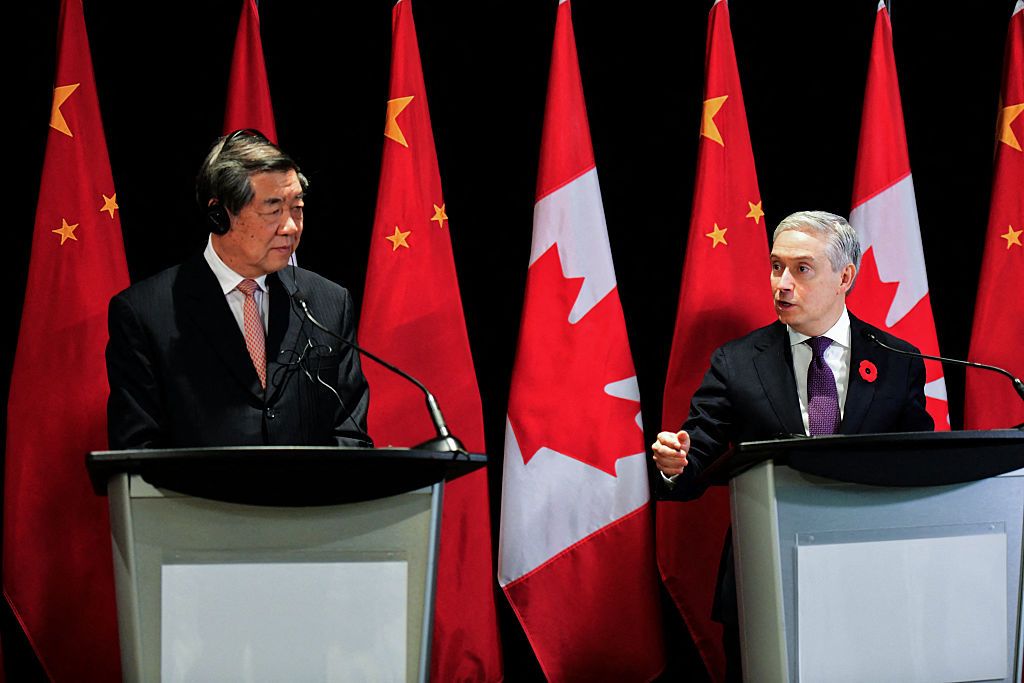
Canada has entered into new economic agreements with China as part of efforts to ease trade tensions with the United States. These agreements were announced after discussions held in Vancouver, and they aim to enhance financial cooperation between the two countries. Canada’s Prime Minister, Mark Carney, is set to attend the Asia-Pacific Economic Cooperation (APEC) summit in Shenzhen.
Finance Minister François-Philippe Champagne and International Trade Minister Maninder Sidhu welcomed He Lifeng, China’s vice-premier, to Vancouver for negotiations. Champagne remarked on the importance of maintaining open dialogue and advancing economic cooperation with China. The discussions focused on expanding trade and investment and deepening financial collaboration.
Both nations agreed to extend a trade deal until 2028. China will maintain lower tariffs on Canadian products like canola meal, peas, lobster, and crab. In exchange, Canada will continue allowing certain Chinese steel and aluminum products without additional tariffs. This agreement aims to support Canadian agriculture and seafood businesses while facilitating access to Chinese metals.
Mark Carney pointed out that the United States retracted a proposal requiring U.S. approval of Canadian trade deals with other nations. Meanwhile, President Donald Trump indicated that a deal with Canada is on the horizon, although substantial differences remain.
The discussions resulted in three agreements covering cooperation between finance ministries, financial regulators, and central banks. These include closer dialogue on economic policy and a bilateral currency-swap arrangement. Both countries are pursuing more access to financial services markets.
This initiative is part of Carney’s strategy to reduce Canada’s reliance on the U.S. by expanding trade with other nations. Champagne emphasized the strategic necessity of engaging with China, Canada’s second-largest trading partner and the world’s second-largest economy.
Philippe Rheault from the China Institute said the Canadian government is committed to broadened engagement with China.
During Carney’s January visit to Beijing, a strategic partnership was announced, easing trade disputes affecting Canadian agricultural exports. For instance, China suspended a 100 percent tariff on Canadian canola meal in March, although some restrictions remain.
The easing of trade barriers has led to increased Canadian exports. Canola meal exports to China grew from $104 million to $277 million, with pea exports rising from $76 million to $245 million. Lobster exports increased by 57 percent, supporting over 600,000 Canadian jobs.
Bilateral trade reached $89 billion last year, with Canadian exports to China at $25 billion and imports at $64 billion. The Canadian government aims to increase exports to China by 50 percent by 2030.
U.S. Trade Relations
Trade talks with the U.S. remain unresolved. A Canadian official stated that while progress is slow, the discussions are ongoing. Washington recently withdrew a demand for final approval over Canada’s trade decisions, among other issues.
Tariffs on lumber, steel, aluminum, and automobiles are major sticking points. Foreign Minister Anita Anand stated that easing trade frictions with the U.S. is a priority post-midterm elections.
Anand highlighted that Canada signed over 20 agreements last year, positioning itself as the only G7 nation with a free trade agreement with every group member. The goal is to double non-U.S. trade over the next decade.
Canada’s Tariff Adjustments
Canada has announced tariff changes on U.S. goods, extending relief for some imports but preparing to reimpose duties on domestically manufacturable items. The program, extended to June 2028, helps businesses avoid retaliatory tariffs on difficult-to-source U.S. products.
However, Canada will withdraw some tariff exemptions for American goods with viable local alternatives. U.S.-made trailers and certain aluminum products will soon be subject to tariffs.
The changes aim to protect Canadian manufacturers and minimize costs for businesses relying on U.S. supplies. Over a year, $10 billion in tariffs were assessed, with $6.30 billion relieved or omitted, resulting in $3.7 billion in net revenue.
Trade Minister Dominic LeBlanc commented on the support given to Canadian companies while promoting Canadian-made goods and services.