
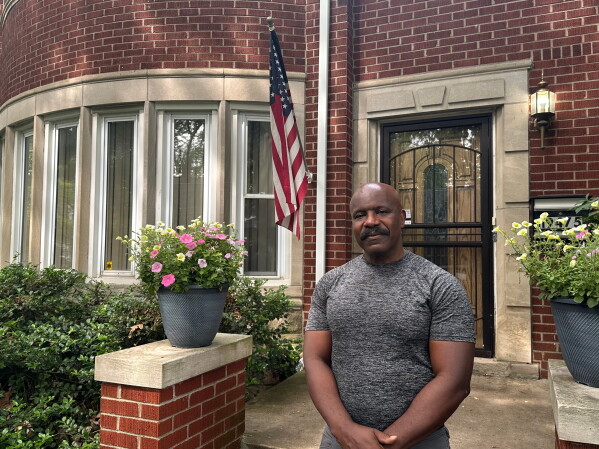
The American flag evokes different emotions and interpretations among individuals. Jerry Esters, living in Detroit, proudly displays the flag as a symbol of opportunities and success. Yvonne Pistochini, however, refuses to let the flag cast its shadow over her home, believing it doesn’t represent the country she experienced while growing up.
Both Esters and Pistochini are Black. Esters sees the flag as a representation of the progress his family made over generations, while Pistochini views it as a misrepresentation of patriotism.
A recent survey conducted by The Associated Press-NORC Center for Public Affairs Research reveals that Americans are divided over the flag based on politics, age, and race approaches. The survey results include opinions from a diverse group across different demographics.
The survey suggests that older, white adults, particularly Republicans, are inclined to display and view the flag as unifying. In contrast, younger Democrats and Black adults are less likely to fly the flag and view it as exclusionary.
The survey, conducted from April 16-20 with 2,596 adults, revealed that approximately half of U.S. adults display the flag regularly or during holidays. Notably, around 70% of Republicans and nearly 60% of Americans aged 60 and older fly the flag during holidays. Meanwhile, about 60% of Democrats and independents say they never fly the flag, with 75% of Democrats under 45 holding the same sentiment.
Adopting different perspectives, Esters, a retired clay sculptor, flies multiple flags as a testament to the struggles endured by his family. He recalls his great-great-grandmother, born into slavery, and sees his accomplishments as fulfilling her dreams.
In contrast, Pistochini criticizes conflating flag flying with patriotism, believing it ignores political divisions and inequity. She argues that genuine patriotism would remedy societal issues.
Ben Gaskins, chair of political science at Lewis & Clark College, reinforces that the flag holds significant meaning for many, particularly older, white, conservative Americans. It plays a central role in their identity.
Nancy Hansen, a retired Customs and Border Protection clerk, equates the flag with freedom—freedom to choose where to live and raise children. Her views are reflected in Culvertson, Montana, where the American Legion posts flags annually.
Similarly, Linda and Greg Cunningham from Pontiac, Michigan, view the flag as a representation of freedom. They oppose politicizing the flag, associating it instead with national prosperity.
The survey states that 47% of participants view the flag as unifying, while 16% find it divisive, and 36% consider it neither. Differences in perception exist among racial groups with only 22% of Black adults considering it unifying, contrasted by 55% of white adults.
For some, the flag is seen as a painful reminder of unfulfilled potential for Black, Indigenous, and other people of color. Paul Walthour, a retired advertising agency creative director, occasionally flies the flag from his Minneapolis-area cabin as a declaration of pride and unity. However, he acknowledges its growing role as a divider.
Williams, Sanders, and Parwani contributed to this article from varied locations, bringing diverse perspectives to the discussion of the AP-NORC poll, which has a 2.6 percentage point margin of error.