
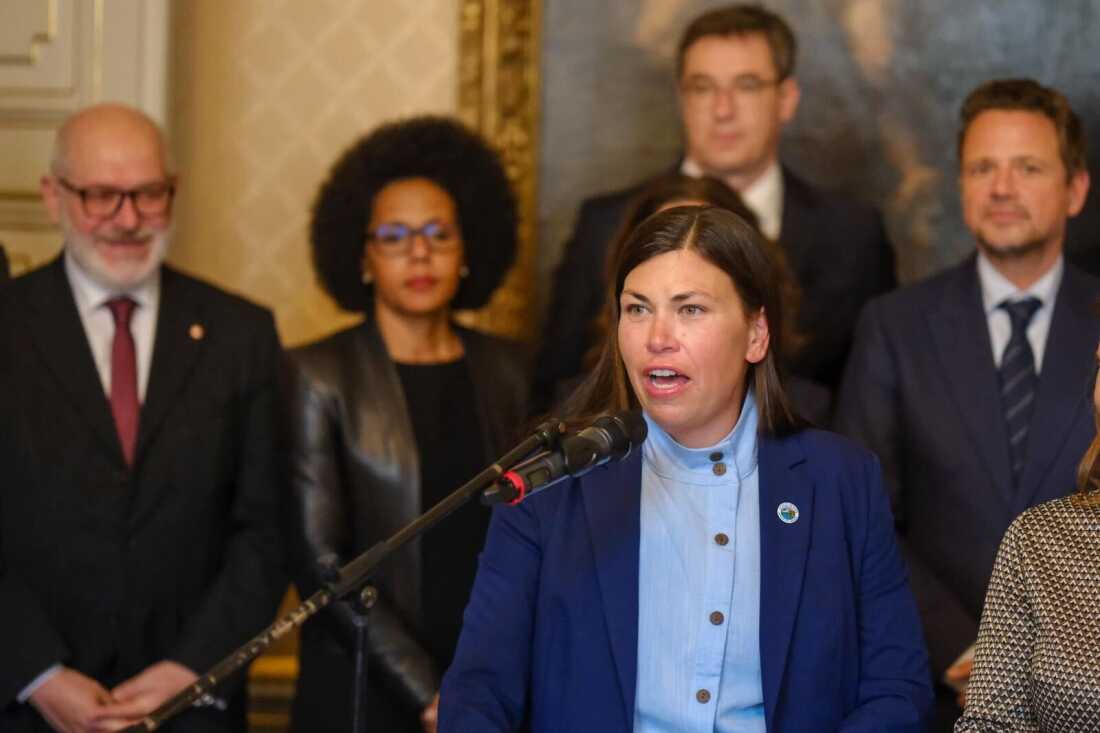
Mayor Lacey Beaty of Beaverton, Oregon, recently joined the Pact of Free Cities meeting in Bratislava, Slovakia. She was one of several U.S. city leaders attending the event. Leaders such as Omar Al-Rawi of Vienna, Audrey Pulvar of Paris, Gergely Karácsony of Budapest, and Rafał Trzaskowski of Warsaw also participated. This initiative is aimed at cooperating with European cities to promote democratic values and resist authoritarianism.
Right-wing populists in the U.S., including President Trump, have established alliances with similar movements in Europe. For example, Trump maintained a close relationship with Hungary’s former Prime Minister, Viktor Orbán. Now, a group of 10 mayors from progressive U.S. cities such as Boston, Chicago, San Antonio, and Cincinnati is reciprocating this collaboration through the Pact of Free Cities. They aim to exchange strategies with their European counterparts to protect democracy.
Cincinnati Mayor Aftab Pureval expressed his support for the pact. He noted concerns over the Trump administration’s impact on democratic institutions and relationships with Europe. U.S. cities participating in the meeting hope to learn new approaches to uphold progressive values despite facing challenges from opposing national governments.
The Pact of Free Cities began in 2019, founded by the mayors of Bratislava, Budapest, Prague, and Warsaw. They aim to uphold progressive community values against hostile national governments. During the latest meeting, Budapest Mayor Gergely Karácsony shared strategies that contributed to former Prime Minister Viktor Orbán’s electoral defeat. He highlighted a key moment when the Hungarian government attempted to ban the Budapest Pride parade, spurring widespread public support for LGBTQ rights and democratic freedom.
Karácsony noted that redirecting public attention from symbolic issues to defending fundamental freedoms played a significant role. By making the Pride parade about free speech and assembly, Budapest citizens defied government intimidation. This defiance helped to reveal Orbán’s political vulnerabilities.
Mayor Beaty from Beaverton also cited similar challenges faced by U.S. cities due to federal funding cuts related to political disagreements, such as those done by the Trump administration in response to policies like diversity, equity, and inclusion (DEI). Mayor Karácsony shared how Budapest tackled similar threats by visibly countering the government’s pressures through public messaging campaigns.
The White House has critiqued the Pact of Free Cities, with spokeswoman Abigail Jackson commenting that Democrat mayors should focus more on local safety than what they view as political distractions. However, the affinity between politicians globally isn’t new. For example, the Conservative Political Action Conference (CPAC) has long fostered connections with European right-wing populists.
CPAC Chairman Matt Schlapp acknowledged insights gained from these relationships, such as those learned from Nigel Farage during Brexit. Schlapp perceived similarities in conversations about immigration between the U.K. and U.S., often challenging prevailing narratives within the political left.
CPAC’s involvement with Viktor Orbán included annual meetings in Budapest. While some question whether European mayors can gain much from American counterparts due to U.S.-specific issues like crime and homelessness, the potential for transatlantic exchange remains significant. Schlapp opines that efforts to organize such dialogues might offer valuable grassroots insights.