
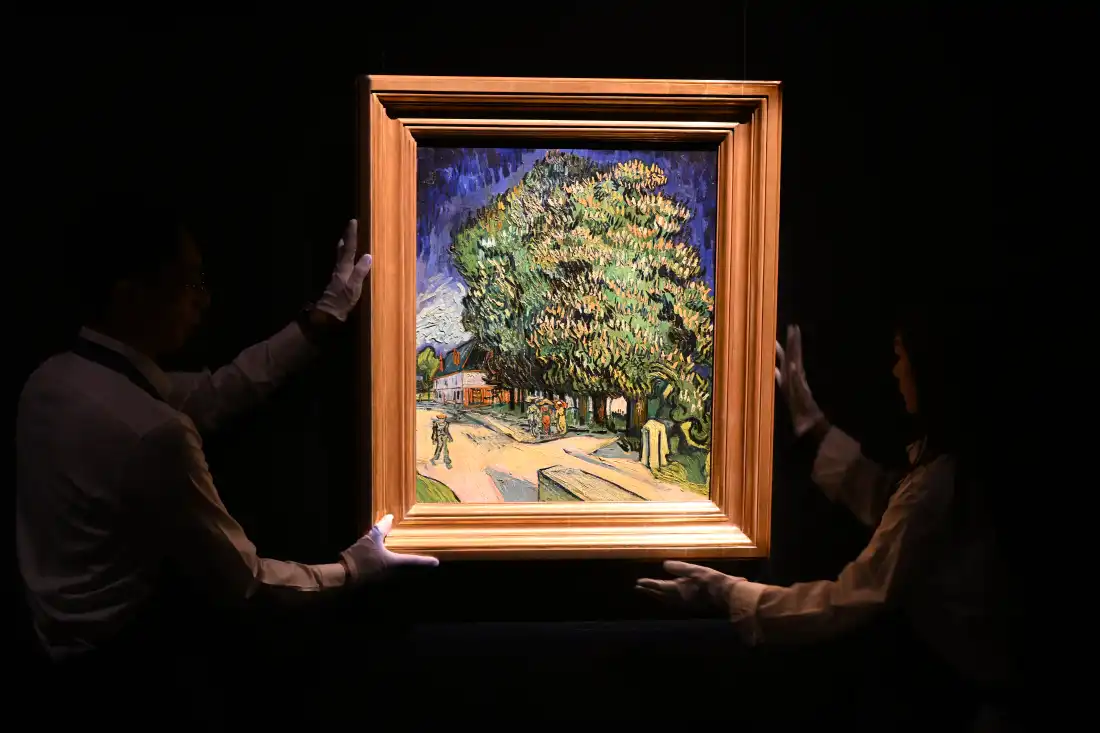
A Vincent van Gogh painting titled Châtaigniers en Fleurs (Blossoming Chestnut Trees in English), painted in 1890, could achieve $180 million at Sotheby’s auction in New York. This sale might set a record for the celebrated Dutch artist. The painting’s vibrant blues, yellows, and greens add to its allure.
Behind this much-anticipated auction, however, is a darker history. This piece of art was once owned by Samuel and Hedwig Fischer. They were a German Jewish couple who faced Nazi persecution in the 1930s. Samuel Fischer established a publishing house that worked with notable authors such as Thomas Mann and Hermann Hesse.
In 1936, financial pressures due to Nazi oppression forced the family to sell the painting through an Amsterdam gallery.
The auction proceeds now due to a last-minute agreement between the current owners and the Fischers’ descendants. While the descendants claim the painting was sold under duress because of the prevailing Nazi persecution, the specifics of their agreement remain confidential.
Christopher A. Marinello, who specializes in recovering lost and stolen art and leads Art Recovery International, commented that such claims can be challenging. Although these cases are sometimes more difficult to prove than direct seizures by the Nazis, they hold significant weight.
“They’re a little bit harder to prove, but they certainly carry the same amount of weight,” Marinello explained.
He illustrated an art market often hesitant to address its past, recalling clients needing to repurchase their own artworks post-World War II. Marinello also shared stories of dealers assuming the original owners died during the Holocaust.
Sotheby’s has not disclosed the agreement’s terms due to confidentiality policies. Marinello discussed these complexities further with NPR’s A Martínez, highlighting the ongoing struggles with Nazi-era forced sales and the art market’s prolonged reckoning with Holocaust impacts.