
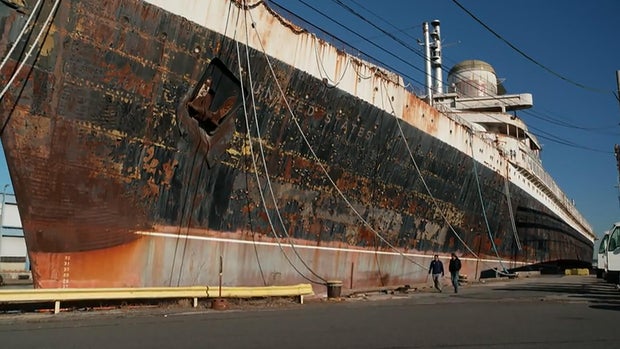
The SS United States once dominated the North Atlantic with her speed and elegance. On her maiden voyage in 1952, she set a record for transatlantic crossings, reaching speeds over 40 miles per hour. This ship, which measured five city blocks long and stood 12 stories high, transported four U.S. presidents, celebrities, and countless voyagers in style during her nearly twenty-year career. However, by 1969, the allure of air travel ushered in her retirement, leaving her docked in Philadelphia for almost 30 years.
Susan Gibbs, president of the SS United States Conservancy, recalls her significance as an American symbol. Her grandfather, William Francis Gibbs, designed the ship with U.S. military funding, enabling her rapid conversion to a troop ship if needed. Although stripped of much of her grandeur, the ship retains significant historical value.
Though ideas to repurpose her were numerous, few materialized until Alex Fogg proposed to transform her into an artificial reef. Fogg, Okaloosa County’s natural resources chief, envisioned creating the world’s largest intentionally-sunk artificial reef. This idea meant she required extensive preparation, including environmental remediation and structural adjustments for sinking.
Jennifer Adams, director of tourism for Okaloosa County, perceived the venture as a potential tourist attraction. Her interest in acquiring the SS United States stemmed from its historical value, despite challenges, such as addressing 1950s environmental contaminants and acknowledging the ship’s passionate fan base.
Even as she prepared to leave Philadelphia, the SS United States gathered admirers for a farewell cruise organized by the Conservancy. Devotees, like Linda Sylva and Joe Beaman, recalled cherished memories onboard, while others, such as Jeffrey Smith, sought a chance to bid farewell.
In preparation for her new role, the ship underwent extensive work in Mobile, Alabama, to remove contaminants and create openings for water flow. Plans call for her to be scuttled about 20 nautical miles off Florida’s coast, forming a new underwater habitat. Meanwhile, her iconic funnels will be featured alongside other relics in a museum planned by the Conservancy.
This transformation of the SS United States pays tribute to her legacy, offering a place for new life beneath the waves. As Linda Sylva poignantly remarked, “What a perfect place for her to rest.”