
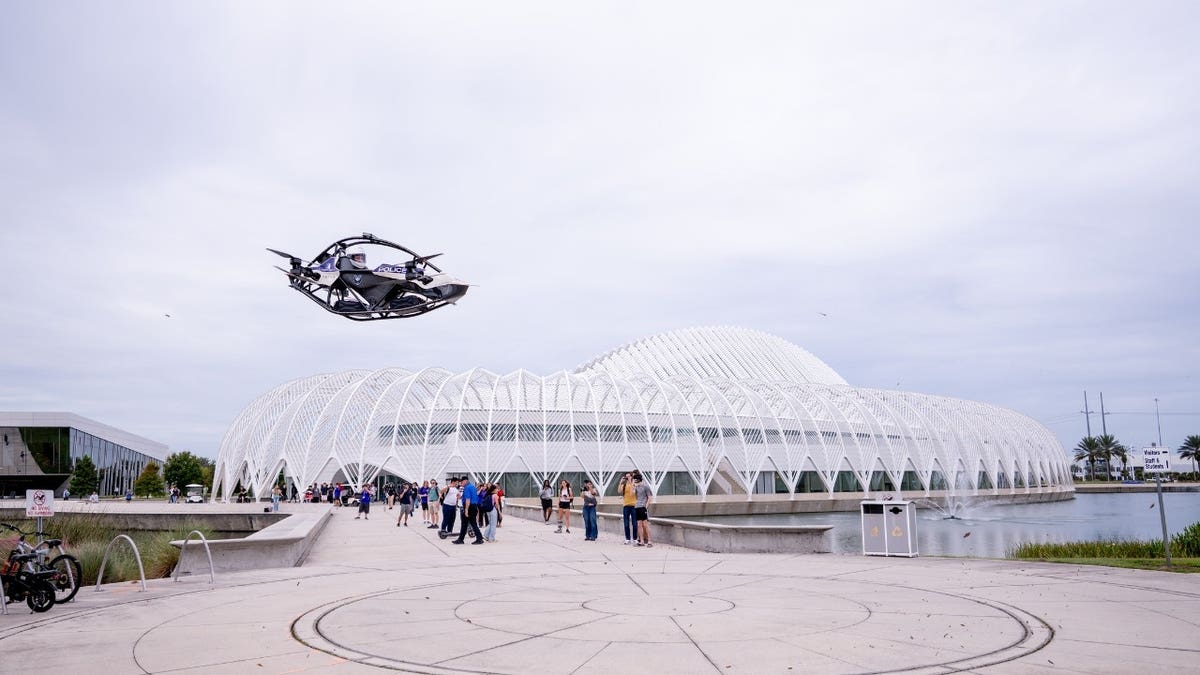
Introduction of Astro: An Electric Aircraft Innovation
You are probably familiar with the sight of police cars in your neighborhood or helicopters flying overhead during emergencies. Imagine if an officer could respond to an emergency in a small, electric aircraft resembling a large drone. This concept is nearing reality at Florida Polytechnic University. The university’s police department in Lakeland has unveiled a flying patrol vehicle, dubbed Astro, manufactured by Jetson. Jetson is known for their Jetson ONE personal flying machine, and Astro represents the first U.S. law enforcement agency to incorporate this type of piloted electric aircraft.
Astro requires authorization from the Federal Aviation Administration (FAA) before it can be used for police patrols. Here’s how Astro operates and why its introduction could transform emergency response.
Astro’s Capabilities
Astro gets its name from the dog in The Jetsons’ cartoon series. The aircraft is equipped with electric vertical takeoff and landing technology, known as eVTOL. This feature permits vertical lift without the need for a runway. Unlike conventional police helicopters, Astro offers easier transport and storage due to its compact frame and foldable design.
Eight electric motors drive Astro’s eight propellers, controlled via a four-axis joystick. The Jetson ONE aircraft was selected by Florida Polytechnic University to assess its potential for police work. As of summer 2026, police personnel, including Police Chief Aaron Murray, have completed flight training. Jetson identifies Astro by its registration number, N911FP, which signifies emergency services and Florida Polytechnic University.
Astro is primarily a standard Jetson ONE, with added police lights. Officers use handheld radios and action camera mounts on the aircraft, with future plans for a pilot-controlled searchlight.
Performance Limits and Potential
Astro’s specifications indicate it can reach speeds of 63 mph, suitable for short campus missions. However, its battery life only allows for approximately 20 minutes of flight time per charge, making it ideal for brief missions rather than extended patrols. Recharging takes around 90 minutes with a 240-volt connection or three hours via a household outlet. Officers can swap batteries for quicker turnaround times between flights.
The vehicle supports a maximum weight of 210 pounds, including the pilot, police gear, and emergency supplies. This limit might restrict equipment haul. Jetson emphasizes safety features like the ability to maintain flight if a motor fails, an automatic landing system, and a ballistic parachute for emergencies.
Exploring Emergency Use with Astro
Florida Polytechnic University intends to assess Astro’s utility for reaching locations that are difficult for traditional vehicles during emergencies, like post-storm scenarios. Roads could flood or be blocked, yet, once conditions permit, Astro’s vertical takeoff might help survey damage.
Police Chief Aaron Murray sees Astro as a tool for campus monitoring and accessing hard-to-reach areas. The university hopes to collaborate with regional law enforcement for potential emergency missions. However, Astro carries solely the pilot, posing capacity limitations for rescue missions.
Regulatory Challenges and Research Opportunities
Before Astro can regularly function in police operations, FAA approval is essential. The Jetson ONE was designed as a recreational aircraft under Part 103 ultralight rules, which limit its operational uses. Jetson states that additional FAA Part 91 authorization is needed for police missions. As of October, the approval process was in its final stages, anticipated by November or December.
Beyond police work, Astro acts as a research platform for students in the university’s aerospace engineering program. This offers students hands-on experience with electric aircraft technology. Faculty and students plan to harness flight data for research and projects, exploring the small aircraft’s use in specialized missions.
Florida is expanding its participation in advanced air mobility research, with the SunTrax facility’s dedicated aerial test track.
The Future of Flying Police Vehicles
Astro presents new prospects for law enforcement considering alternatives to traditional helicopters, which require substantial resources. While electric aircraft could offer a reduced-cost option, Jetson notes several limitations, like short flight time and battery constraints.
More police departments might adopt such technology; however, weather, airspace restrictions, and single-seat design will impact functionality compared to drones. Nevertheless, Jetson views the police acquisition as a step towards extending personal electric aircraft into professional settings.
The company reports that production for 2026 and 2027 is sold out, with orders for 2028 at the listed price of $148,000. Astro is expected at the UP.Summit at Kennedy Space Center.
Public-Safety Technology Developments
For now, Astro offers glimpses of public safety agencies utilizing small electric aircraft. The probable uses involve monitoring post-storm environments or aiding searches for missing individuals. Yet, practical evidence of Astro’s potential must be demonstrated in actual operations.
Privacy concerns add another layer of complexity to police use of aerial technology. Citizens’ whereabouts and data collection remain areas of attention parallel to the technology’s advantages.
Florida Polytechnic University has the chance to study this approach to emergency response amidst necessary federal authorizations.
In summary, while flying patrol vehicles may not be commonplace yet, Astro signifies a potential shift in public-safety engagement. It’s crucial to understand privacy implications as the technology develops.