
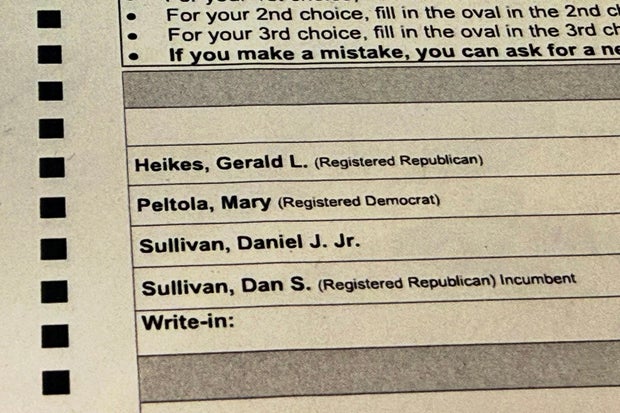
By November 2, 2026, voters in Alaska are heading to the polls for significant elections, including a Senate race that has captured widespread attention. This is partly due to the presence of a candidate with nearly the same name as the sitting senator, Dan Sullivan. Alaska’s unique election system has also been under scrutiny since the state implemented a top-four nonpartisan primary and ranked choice voting.
Understanding Ranked Choice Voting
Ranked choice voting was introduced in Alaska in 2022. This system allows voters to rank candidates in order of preference, instead of selecting just one candidate. If a candidate receives more than 50% of votes as the top choice, they win immediately. However, if no candidate achieves this majority, the candidate with the least votes is eliminated. Votes for the eliminated candidate are then redistributed according to voters’ next preferences. This process continues until a candidate secures a majority.
Imagine a scenario where 100 people vote in a Senate race. Candidate A is the top choice for 50 voters, Candidate B for 40, Candidate C for 7, and Candidate D for 3. Since no candidate reaches a majority in the first round, Candidate D is eliminated. If their votes go to Candidate A, it results in a win for Candidate A with 51 votes. Otherwise, the counting process continues.
Alaska Senate Candidates
The Senate race could sway control in Washington. Voters will choose from four candidates: Sen. Dan S. Sullivan, a GOP incumbent, Daniel J. Sullivan, Gerald Heikes, and Mary Peltola. Sen. Sullivan, a Marine veteran with experience in the Bush administration, faces competition primarily from Peltola. She was the first Democrat to represent Alaska in the House in 50 years. Daniel J. Sullivan, a former teacher, entered the race, causing legal disputes over his ballot eligibility.
In the open Senate primary in August, Peltola led with 49.5% of the vote, followed by Sen. Sullivan at 41.4%. Daniel J. Sullivan received 2.5%. The similar names raise concerns of voter confusion, prompting efforts by the Justice Department to intervene. Recently, a federal judge dismissed a lawsuit by the Trump administration aimed at blocking election certification if Peltola wins, stating the government lacks the legal right to sue. An appeal is planned.
Reports suggest political operatives linked to Peltola aimed to recruit Daniel J. Sullivan to draw voters away from the senator. Peltola has denied involvement.
Counting Duration in Alaska’s System
Experts caution that conducting Alaska’s election may take time due to geographical challenges and mail ballot counts, with some ballots tabulated up to 15 days post-Election Day. Ranked choice tabulation rounds begin afterward, if needed, potentially extending the process. Election officials aim to certify results by November 25, mirroring 2022 when Peltola’s term was finalized by November 30.