
The question of whether artificial intelligence (AI) could replace doctors has garnered significant attention. Laura Ingraham recently explored this topic, highlighting a public hospital CEO’s plan to use AI for breast cancer screening, primarily to cut costs. Dr. Marc Siegel, a senior medical analyst, believes AI can enhance healthcare but emphasizes the critical role of human doctors in patient interaction and oversight.
The Potential of AI in Difficult Diagnoses
Have you ever left a doctor’s appointment confused about your symptoms? Microsoft claims its AI system can help unravel complex medical puzzles. A study in Science showed that Microsoft’s AI diagnosed 83% of challenging cases accurately, a stark comparison to the 36% accuracy rate by doctors with access to reference materials. However, this research took place within simulations where doctors weren’t specialists working together.
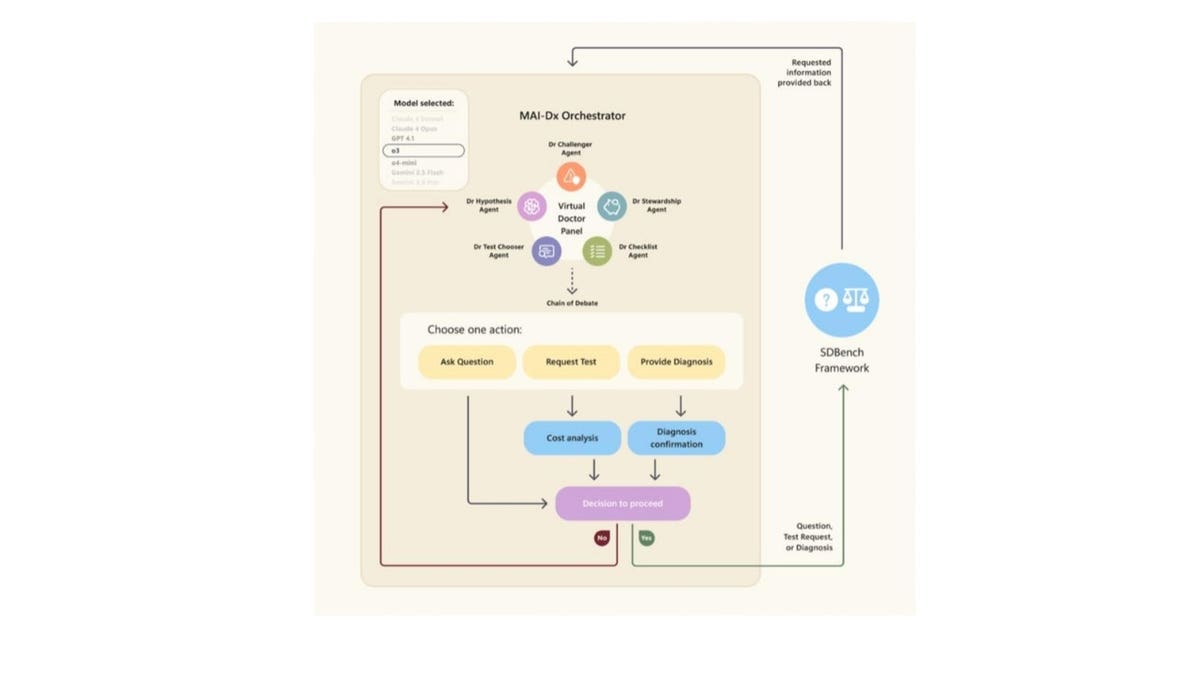
The findings prompt reflection on AI’s potential transformation of healthcare. Microsoft’s system, known as the MAI Diagnostic Orchestrator (MAI-DxO), employs multiple AI agents that collaborate as a medical panel might do. Initially, the AI starts with limited data, posing further questions and considering necessary tests to improve diagnosis.
How AI Outperformed Generalist Physicians
The study used 304 difficult cases from The New England Journal of Medicine, focusing on rare diseases that challenge experienced doctors. The Microsoft AI diagnosed 83% of these accurately, whereas generalist doctors attained 36% accuracy with reference materials and 22% without. However, testing involved AI evaluating from case reports, not real-time consultations.
Despite these figures, real patient care involves unpredictable elements like patient feedback and incomplete medical records. Diagnosis involves not just identifying a condition but also deciding on treatment and considering patient-specific factors. Furthermore, Microsoft’s researchers were involved, making independent evaluation crucial before adopting this AI in hospitals.
The system showed potential, but AI remains a supplement rather than a replacement. Findings currently derive from simulations, meaning real-world applications need extensive testing and research.
Comparisons with Other AI Systems
Microsoft’s AI differs from AI like ChatGPT. Experiments with models by OpenAI, Google, and others revealed notable results. OpenAI’s GPT-5, on its own, solved 79% of complex cases. With Microsoft’s orchestration, accuracy rose to 83%, and with GPT-5.5, to 87%. Despite significant performance, AI’s role remains limited to augmenting professional decisions rather than replacing specialists.
Microsoft envisions greater roles for AI, such as “medical superintelligence,” aiming to outperform clinical teams in reasoning and coordination. Collaborations with institutions like Mayo Clinic suggest ambitions beyond the current study’s capabilities.
AI and Cost Implications
AI’s use in cost-effective diagnosis is appealing. Microsoft’s system, in the study, achieved high accuracy while potentially reducing testing expenses. However, some configurations aiming for accuracy carried higher costs. While promising, real-world verification is necessary to confirm these savings and ensure the AI system’s cost-effectiveness in practical usage.
Real-world Testing Initiatives
Microsoft plans to partner with Beth Israel Deaconess Medical Center to test MAI-DxO in clinical settings, ensuring AI suggestions align with physician evaluations. Doctors retain responsibility for treatment, with AI playing a supportive role. The study’s outcomes will inform AI’s practical viability in healthcare.
AI’s role in healthcare continues to evolve, with pivotal evaluations necessary to determine its reliability alongside doctors. Google’s conversational AI trials showed similar potential, with AI-generated insights helping physicians prepare for consultations.
The Future of AI in Healthcare
Currently, Microsoft’s AI remains a research tool. It offers promising insights into healthcare’s future, with potential as a powerful assistant for doctors to consider complex and overlooked aspects of patient care. Progress hinges on ensuring patient records’ security and the transparent use of AI-generated advice.
Individuals seeking AI’s benefits should consult medical professionals after using AI, ensuring that AI complements rather than dictates healthcare decisions. Clear understanding and safe handling of medical data remain critical as we integrate AI technology into healthcare.