
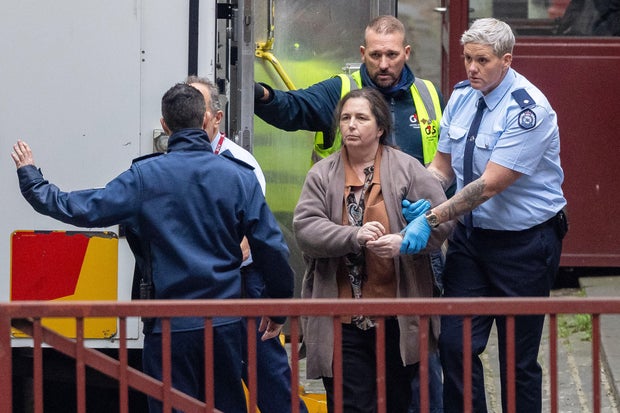
An Australian appeals court on Friday ruled that Erin Patterson, a triple-murderer, will remain in prison for life due to her role in poisoning four relatives of her estranged husband with death cap mushrooms. The judges dismissed her appeal and supported increasing the severity of her 33-year nonparole sentence. This decision ensures she will not be released.
Justice Stephen McLeish, speaking for the three judges, stated, “This offending was extraordinarily cold and calculated and stands to be denounced in the strongest terms.” The court decided the crime’s “shocking criminality” warranted life imprisonment without parole.
Patterson’s crime was only the second instance of a woman receiving a life sentence without parole in Australia. The first case involved Katherine Knight, incarcerated in 2001 for the murder of her partner.
Patterson hosted a meal in July 2023 at her rural home in Leongatha, where three relatives died after consuming dishes containing death cap mushrooms. She maintained that the inclusion of the mushrooms was accidental. Death caps are responsible for 90% of global lethal mushroom poisonings.
Patterson received life sentences for three murders and 25 years for attempted murder. The deaths attracted global media attention, leading to adaptations like a six-episode Paramount+ series starring Melanie Lynskey as Erin Patterson.
The case began with the quick deaths of Patterson’s parents-in-law, Don and Gail Patterson, and Gail’s sister, Heather Wilkinson. Heather’s husband, Ian Wilkinson, survived but needed weeks of hospital care. Erin Patterson faced conviction for his attempted murder.
Prosecutors argued against parole eligibility at an August appeal, emphasizing the “calculated criminality” of Patterson’s actions. Justice McLeish noted her three-week intent to murder, including deceptive actions like faking a cancer diagnosis to explain her children’s absence at the lunch.
Ian Wilkinson shared that Erin Patterson had falsely claimed needing advice on disclosing her diagnosis, compounding his grief after his wife’s death from poisoning.
Patterson destroyed evidence, denied mushroom foraging, and misrepresented their origin. Her actions were viewed as a breach of trust. She watched the verdict remotely from the high-security Gordon Unit of Melbourne’s Dame Phyllis Frost Centre women’s prison, where she is considered at risk.
Trial judge Christopher Bale suggested Patterson might face solitary confinement for years. Her estranged husband, Simon Patterson, declined the meal invitation, fearing it was a murder attempt. Pretrial evidence highlighted his suspicions.