
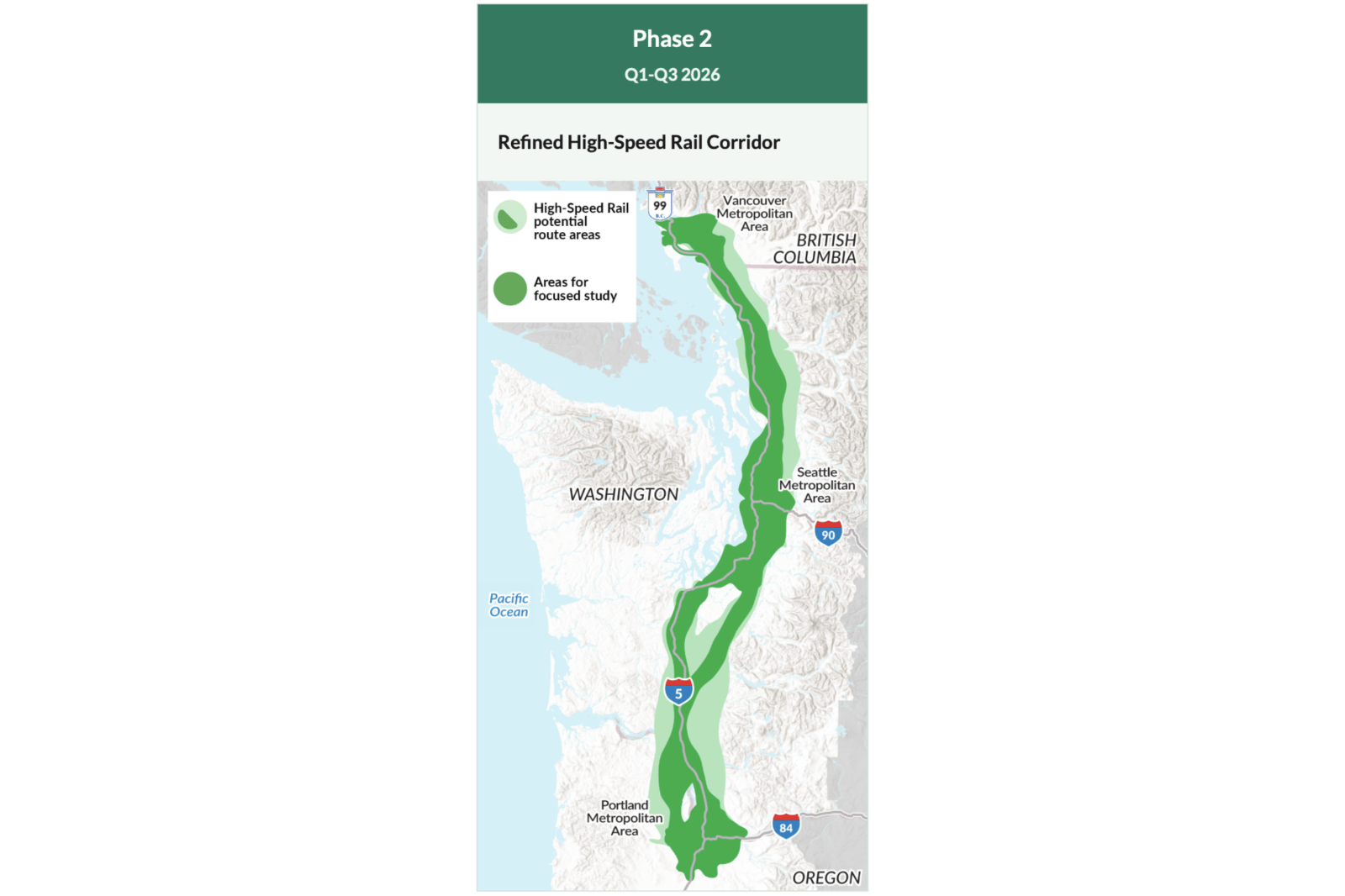
A comprehensive plan for a high-speed railway aims to connect major metropolitan areas in the Pacific Northwest, spanning two U.S. states and Canada. This plan envisions linking Portland, Oregon; Seattle, Washington; and Vancouver, British Columbia, through the proposed Cascadia High-Speed Rail system. The Washington State Department of Transportation (WSDOT) has released a conceptual map depicting the potential corridor.
Public Engagement and Feedback
The project is still in its early phases. No definitive route or stations have been determined. WSDOT is actively seeking public input. Residents, businesses, and travelers in the region can provide feedback through an online survey available until November 13. The feedback collected will significantly influence planning decisions for the area’s future transportation system.
Plan Objectives
The railway project aims to enhance connections among key Pacific Northwest cities. It seeks to establish a high-speed link from Portland to Vancouver, crossing the U.S.-Canada border. The project involves collaboration among WSDOT, the Oregon Department of Transportation, Oregon Metro, and British Columbia’s Ministry of Transportation and Transit. This effort forms part of WSDOT’s broader Cascadia High-Speed Rail and I-5 Program, which includes improvements to the Interstate 5 highway.
In December 2024, the Federal Railroad Administration granted WSDOT $49.7 million to develop a Service Development Plan. The Washington State Legislature supplemented this with $5.5 million. This phase of project development will continue through 2028.
Potential Stops and Routes
While Portland, Seattle, and Vancouver are central to the plan, specific train stops remain undefined. WSDOT’s Service Development Plan will explore potential routes, service options, the number of stops, and train frequencies. It will also address governance and financing considerations. Completion of the development plan is anticipated by 2028, but no specific route or station selections will occur at this stage.
Reasons for the Initiative
The projected growth in the Pacific Northwest underpins the railway proposal. WSDOT anticipates a population increase of 3.4 million in the Cascadia megaregion by 2050. This growth includes expansions in technology, aerospace, health care, and logistics. Currently, transportation links are under strain, with I-5 anticipated to face heightened congestion. By 2050, 80% of I-5 in Washington could experience medium to high congestion, a rise from 59% today. In Portland, severe congestion is projected for 78% of I-5 by 2045.
WSDOT maintains that no single transportation mode can meet the future demand. Highways, rail, public transit, aviation, and other forms must operate cohesively.
Learnings from California’s Experience
The scope of Cascadia’s project remains in planning, highlighting challenges similar to California’s high-speed rail. California’s Central Valley has seen ongoing construction yet the full San Francisco-Los Angeles/Anaheim plan remains unfinished. The California High-Speed Rail Authority prioritizes a Merced-to-Bakersfield segment, aiming to commence passenger service by 2033. As of July 2026, $8.10 billion had been spent on construction there, along with 66 completed structures and 90 miles of guideway.
To manage costs, California streamlined station designs and infrastructure. Cascadia’s future construction phase involves assessing economic and technical feasibility, exploring routes, examining public needs, and confirming high-speed rail’s viability.