
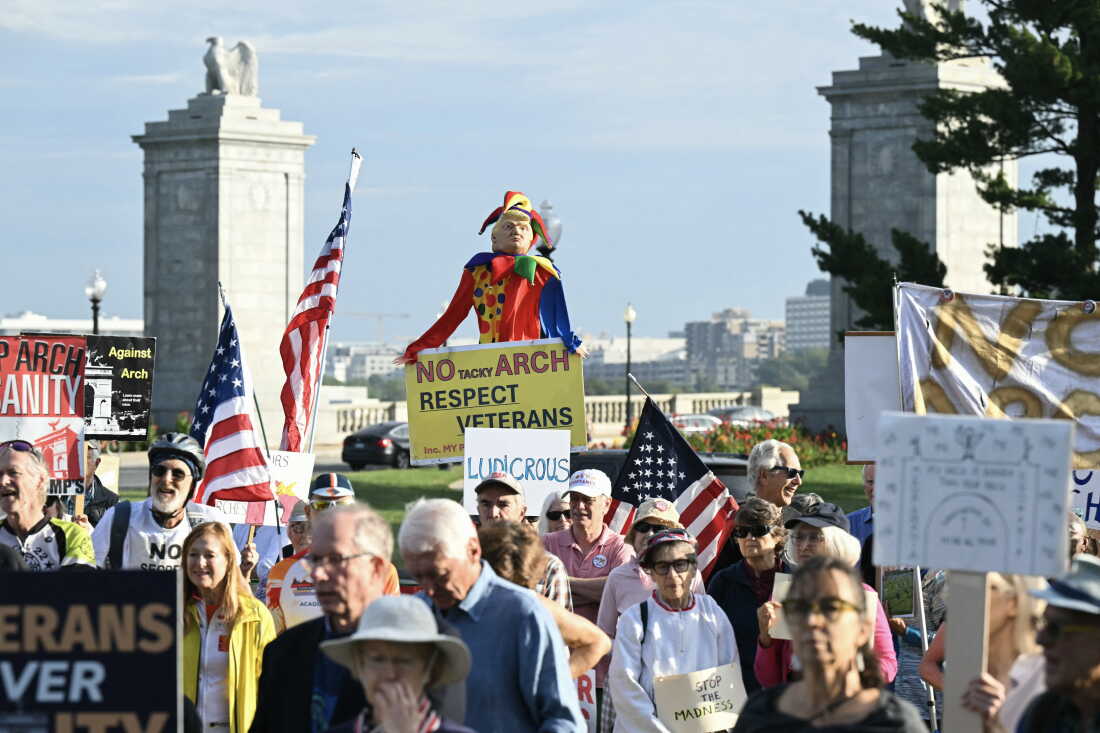
Demonstrators gathered Thursday morning to protest President Trump’s proposed arch on the bridge connecting the National Mall to Arlington National Cemetery. Located at Memorial Circle in Washington, D.C., the protest occurred during rush hour and attracted activists, veterans, retirees, and lawmakers.
Participants spoke out against the arch’s scale, cost, lack of Congressional approval, and its intrusion on nearby Arlington National Cemetery. A retired Army veteran, Jon Gundersen, emphasized its unsuitability as a monument and cited concerns over the arch’s size, which would be 32 times taller than the mockup presented at the protest.
“It’s the wrong monument, in the wrong place, at the wrong time, dedicated to the wrong man,” Gundersen declared, further voicing the sentiment shared by many present.
The protest, branded as “Vets over Vanity,” was organized partly by Public Citizen, which is leading the lawsuit against the arch. Gundersen expressed encouragement at the support from various political affiliations.
Senator Tammy Duckworth criticized the arch, highlighting its potential disrespect towards individuals resting at Arlington and its inappropriate connection to President Trump. Duckworth suggested that honoring veterans should focus on improving their services rather than constructing monuments.
The White House contends that the arch would enhance the visitor experience at the cemetery, serving as a visual reminder of American heroes’ sacrifices. However, critics argue that the funds should be directed towards tangible benefits for veterans.
Concerns were also raised regarding aviation safety in light of the arch’s proximity to airport runways. Amendments to the proposed use of the arch for housing drones and snipers further fueled opposition at the protest.
Speakers like Rep. Don Beyer voiced skepticism about the reasoning behind the arch, considering it a misguided national security proposal. Efforts to seek clarity or responses from governmental agencies regarding the military aspect remain unanswered.
The opposition continues among those wary of the arch’s federal approval process, which advances despite protests and legal actions. A halted review process by the Advisory Council on Historic Preservation also intensified discontent.
Charles Birnbaum, from The Cultural Landscape Foundation, voiced concern over the truncated review process which bypasses customary negotiations between stakeholders. His reflections suggest an undermining of public participation in historic decision-making.
As procedural routes to delay the arch become challenging, political actions might provide alternatives. Discussions around a bipartisan permitting reform bill threaten to weaken protections for historic sites, adding urgency to activism.
Efforts to block funding for the construction were rejected, but protests indicate readiness to challenge the project directly if Congressional actions fail. Commentators anticipate a shift in political dynamics with upcoming elections potentially affecting the project’s future.