
The Proposed Structure and Its Controversy
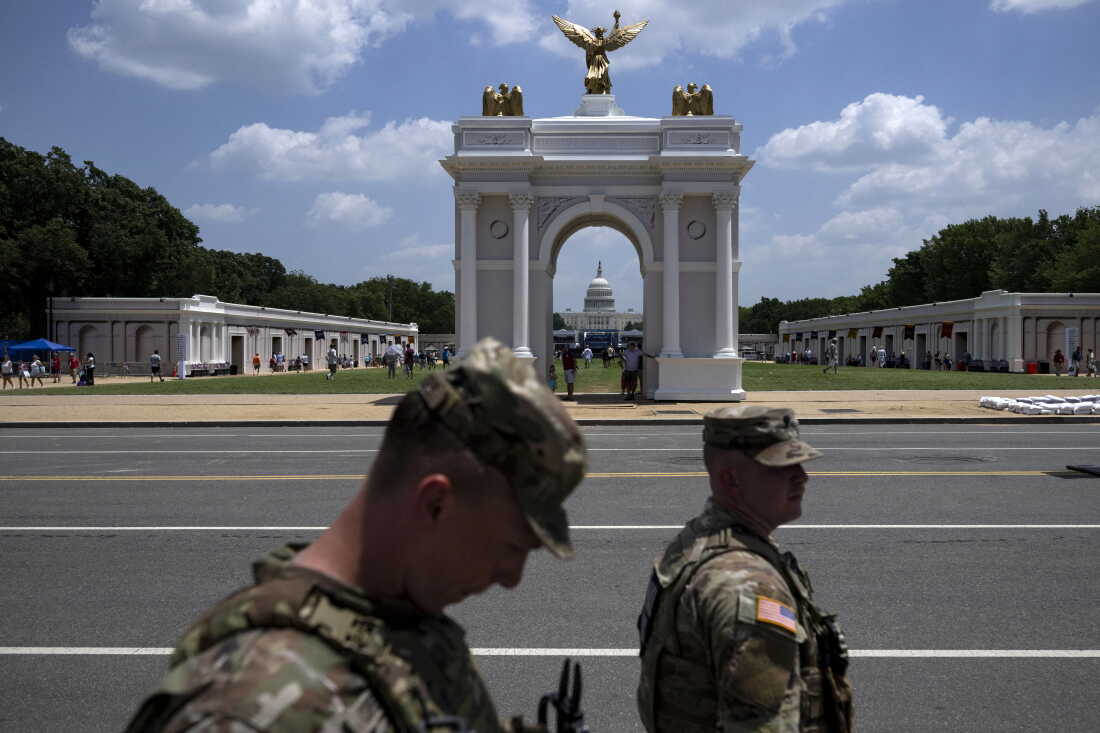
Members of the National Guard were seen walking near a replica of President Trump’s envisioned arch at the Great American State Fair in Washington, D.C., in July. This replica is a part of Trump’s weekend announcement about the proposed D.C. arch that aims to function as a “top grade Military Complex.” The announcement caused further debate regarding the contentious structure and its approval process.
Trump communicated on Truth Social that the 250-foot arch would house and deploy drones and snipers, both on the roof and plaza areas. It was initially presented in October as an homage to Trump himself, but later described by the administration as honoring the United States’ 250th anniversary and serving as a tourist attraction.
Official Plans and Approval Challenges
The White House has stated that the arch, located at Memorial Circle, will be an iconic landmark globally. Renderings from the National Park Service highlighted amenities like an observation deck with views of Arlington National Cemetery and potentially a cafe and gift shop. Approval for these aspects came from the Commission of Fine Arts in May. However, the military focus was unexpected, only mentioned earlier this month when Interior Secretary Doug Burgum talked about excavation work for the “Great Triumphal Arch and Military Observation Deck.” This resulted in pushback and a judge’s intervention due to pending approval from the National Capital Planning Commission and historical preservation reviews.
Historic preservation groups are concerned with the rapid process, especially given Trump’s shift in project focus. Charles Birnbaum, CEO of the Cultural Landscape Foundation, expressed that the arch’s use as a military site significantly changes the nature of what was initially proposed.
Feedback and Reevaluation
The National Park Service requested preservation groups to offer feedback regarding its Memorandum of Agreement by the following Monday. Birnbaum and others deemed the agreement “dead on arrival” and pointed out the need for additional security measures if the arch became a fortified site.
Federal agencies like the White House, Interior Department, and National Park Service remained silent on further proposal submissions. Meanwhile, the Federal Aviation Administration concluded that the structure wouldn’t disrupt airspace but did not consider military drones, as noted by Rep. Don Beyer of Virginia.
Legal and Safety Concerns
Beyer criticized the potential for drones in D.C.’s airport landing path as unsafe and impractical, suggesting the FAA’s evaluation would become irrelevant if military drones are involved. Legal issues also surround the arch due to its questionable compliance with building height regulations and a lawsuit from Vietnam veterans over the lack of Congressional approval, citing a 1925 law.
Public Citizen Litigation Group lawyer Nicolas Sansone stated the new military justification doesn’t address the construction’s illegality. Trump claimed the conversion to a military complex was requested by the U.S. military. However, Harold Hongju Koh, an international law teacher at Yale, found this pretext weak.
Koh argued against the necessity of the arch for security, urging Trump to conduct a classified briefing if threats are genuine. He criticized Trump’s tendency to use national security arguments across various projects to bolster legal claims.
Implications and Future Steps
While the arch faces scrutiny, Trump continues to justify its construction on security grounds, similar to prior arguments for a White House ballroom. The Supreme Court recently ruled for construction based on legal standing, not project legality.
Experts like Mark Cancian from the Center for Strategic International Studies doubt the arch’s need for drones and snipers, especially given its proximity to the Pentagon and Joint Base Myer-Henderson Hall. Koh speculated the administration’s urgency is tied to pre-election concerns and potential legislative challenge shifts.
Lawmakers, including five Democrats and one Independent, petitioned Burgum to cease work due to legality issues and adverse effects on historical sites like Arlington National Cemetery. They criticized prioritizing Trump’s ego over preserving memorial sites.