
During former President Joe Biden’s administration, Janet McCabe served as the deputy administrator of the U.S. Environmental Protection Agency (EPA), working on developing greenhouse gas regulations for power plants. Now, under President Donald Trump, the EPA is working to dismantle these regulations.
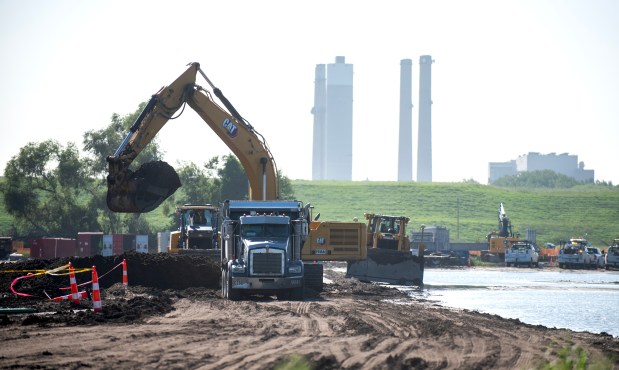
Initial construction is underway at a data center site, with the towers of NIPSCO’s R.M. Schahfer Generating Station in Wheatfield, Indiana as a backdrop. McCabe expressed concern over the Trump administration’s efforts to weaken and potentially undermine the federal government’s ability to address public health threats.
The EPA’s recent actions are part of a broader federal trend that unsettles environmental and utility experts who worry about the potential impacts on American citizens’ health, environment, and economy. On September 14, EPA Administrator Lee Zeldin announced the repeal of most of the Biden-era greenhouse gas emissions requirements for power plants.
McCabe and Hana Vizcarra, deputy managing attorney for national climate at Earthjustice, expected such moves due to past actions under President Trump. The power sector, a significant greenhouse gas emitter, may significantly increase its climate impact due to these repeals, according to Vizcarra.
The EPA claims the latest action will save $310 billion, proposing the removal of greenhouse gas standards to save $370 million in compliance costs. Zeldin argues this move will reduce electricity costs and promote energy independence. However, experts warn that prioritizing coal could result in higher utility bills for Americans.
Kerwin Olson, executive director of the Citizens Action Coalition, notes that wind and solar energy have become the cheapest forms of energy. He criticizes the continued reliance on coal, highlighting its impact on health and environmental sustainability.
Environmental and energy experts express concerns over the potential increase in pollution and utility costs, especially in areas like Northwest Indiana, where utility bills are already high. Ashley Williams from Just Transition Northwest Indiana emphasizes the potential public health ramifications of deregulation, which previously projected preventing numerous premature deaths and asthma attacks.
State Rep. Earl Harris stresses the disproportionate impact of these measures on economically disadvantaged and Black communities. A report indicated that Black Americans are more likely to live near coal plants, highlighting the environmental justice concerns.
In December, an emergency order kept NIPSCO’s R.M. Schahfer Generating Station operational beyond its planned retirement. Legal challenges have arisen, questioning the legality of keeping coal plants running and related costs. Federal court rulings are putting pressure on the Department of Energy to reconsider these orders.
These developments have sparked criticism and legal actions from environmental groups, urging adherence to existing laws and increased scrutiny on emergency orders favoring coal plant operations.