
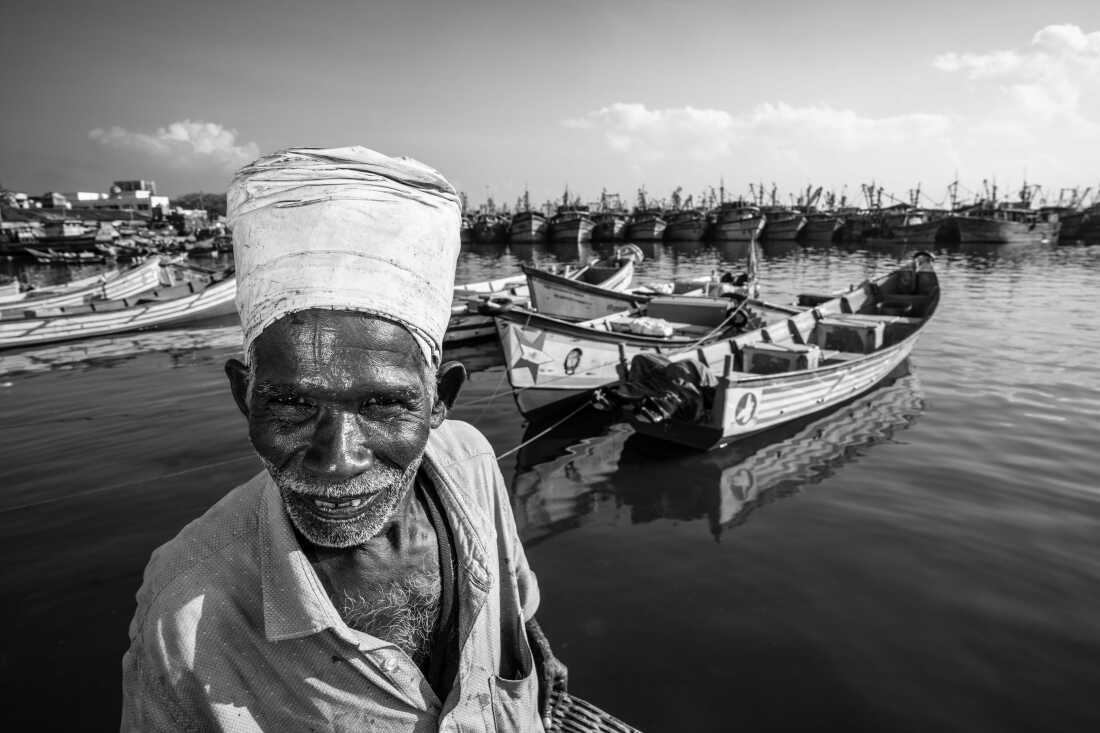
Pavadairayan, a 60-year-old migrant laborer, works as a ‘basket man’ at Kasimedu Fishing Harbour in Chennai, India. He carries fish in a basket on his head from boats to the auction house. His workday begins at 2 a.m. and ends around 7 a.m. Navigating slimy and wet pathways, Pavadairayan carries baskets weighing about 35 pounds over a third of a mile. He repeats this trip 40 or 50 times each shift for the daily auction that starts at 4 a.m.
Basket men like Pavadairayan face challenges. Supervisors can deduct pay and impose fines if they believe fish are missing. Despite earning only about $5 a day, Pavadairayan enjoys having the rest of the day free. He spends his mornings resting. Many of his peers take on other jobs, but he prefers to enjoy a full belly and the sea breeze.
Pavadairayan says, “Sleeping with a full belly under open skies, a salt sea breeze fanning your face: that’s what I call heaven.”
A Smuggler’s Story
Nandu Kumar, a 65-year-old former fisherman, now sells fish on the shore. He used to smuggle imported alcohol and cigarettes in his boat during the 1980s, when India had high import duties. Smuggling was lucrative until economic reforms in 1991.
In 2010, Kumar faced tragedy. His son-in-law, who struggled with alcoholism, drowned. Later, Kumar’s daughter, unable to cope, took her life. Kumar took responsibility for his grandchildren and shifted to selling fish to ensure a steady income.
Today, he runs a successful fish shop. Reflecting on the harsh fishing life, he notes the toll on the body and the temptation to use alcohol for relief.
A Risky Business
Bhagat Singh, a researcher and social worker, emphasizes the risky nature of fishing as a livelihood. Workers and fishermen often earn barely enough to survive. Poor catches or illnesses can easily push families into poverty. With little government support, their labor goes unnoticed.
Fishermen at Kasimedu earn around $200 a month with successful catches. Many young people seek other jobs for stability. Yet, some eventually return to fishing, drawn by their need for independence.
The Power of the Sea
Nizamuddin, 25, is among the few younger fishermen at Kasimedu. He wears a wetsuit and engages in various tasks, including repairing nets and hauling fish. Although aware of other career paths, he finds fulfillment in his work, supporting his family and helping his brothers through school.
Nizamuddin says, “It’s a hard life but I wasn’t very good at studying. This is the only work I know and it has helped my family survive.”
Kumar, now a fish vendor, acknowledges the sea’s hold on those who have worked there. Despite the challenges, he cherishes the unpredictability and excitement of the fishing life.
In quiet moments, Kumar observes fishermen returning and remembers the exhilaration of life at sea.