
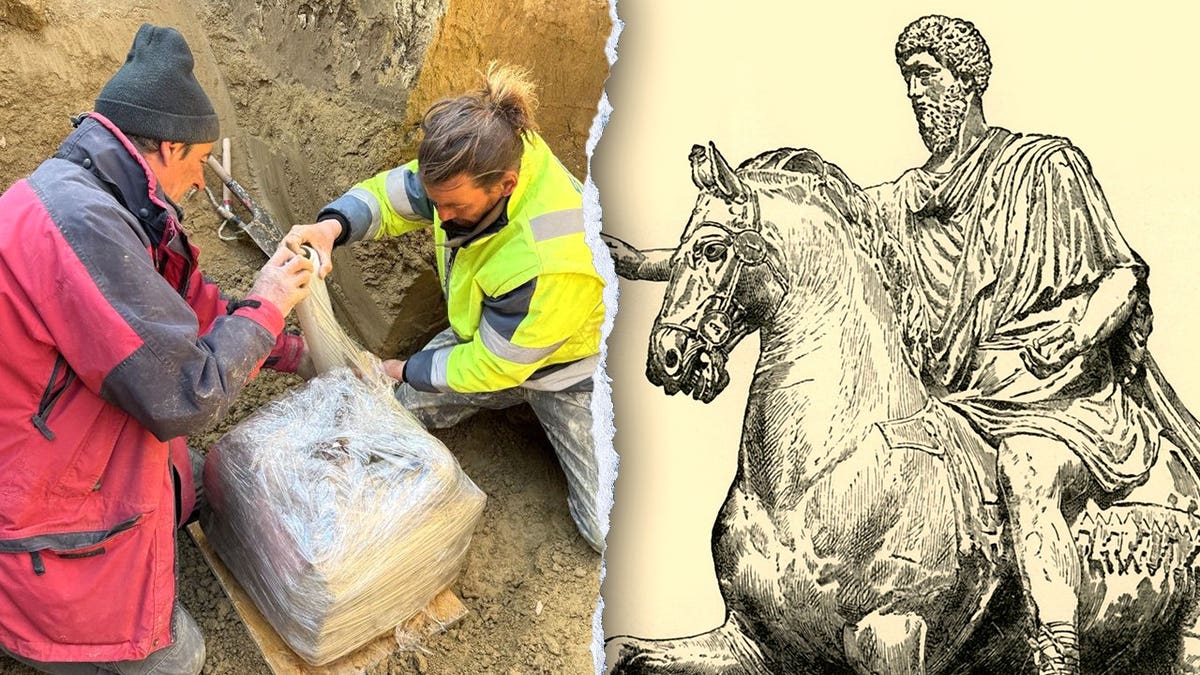
An ancient Roman military camp linked to the reign of a legendary emperor has been discovered in Slovakia. The site includes soldiers’ remains, weapons, and armor. This find near Šurany in western Slovakia was made public by the Institute of Archaeology of the Slovak Academy of Sciences (SAS) earlier this summer.
The excavation took place before the construction of an industrial park and covered about 370 acres. The camp dates back to the second century A.D., coinciding with the reign of Marcus Aurelius. It likely served during the Marcomannic Wars, conflicts involving Germanic tribes along Rome’s northern frontier.
Marcus Aurelius ruled Rome from 161 to 180 A.D. He is known both as an emperor and a Stoic philosopher, famous for his writings in “Meditations.” The Šurany discovery follows the earlier identification of a Roman camp in the Hron River area near Želiezovce, believed to be where Aurelius wrote parts of his “Meditations.”
This marks the first Roman military camp found in Slovakia’s Nitra region. Unlike similar camps, the site does not have the typical rectangular design. Instead, it exhibits an irregular layout while retaining typical Roman marching camp features.
“It contains all the characteristic defensive features of a Roman marching camp, including five entrance gates, fortifications, and a clavicula, a distinctive gate design featuring a curved ditch and rampart,” said officials.
This discovery includes the first identification of a clavicula gate in Slovakia. Archaeologists uncovered human skeletal remains along with weapons, armor, and everyday items in the camp. Complete skeletons and scattered bones were located in storage pits, wells, and shallow graves.
Despite the camp’s abandonment following a Roman-Germanic conflict, the identity of the deceased is uncertain. Lead archaeologist Marek Vojteček indicated many skeletons might belong to Roman soldiers, shedding light on Roman actions north of the Danube in the late second century.
Numerous pieces of Roman military equipment were found, including spears, arrowheads, helmet fragments, armor, legionary belt fittings, coins, and caligae military sandals identified by preserved iron hobnails. Additionally, items like an axe, knife, and gaming dice were recovered.
The ongoing research process at the site is expected to take years. Matej Ruttkay, director of the Institute of Archaeology, emphasized the discovery’s significance, stating it offers insight into Roman activities beyond Slovakia’s present borders. It highlights circumstances surrounding the camp’s abandonment after a military confrontation.
This discovery contributes to a series of Roman findings throughout Central Europe in recent years. Previously, in Vienna, a mass grave beneath a soccer field was uncovered, believed to contain Roman soldiers and Germanic tribesmen. A notable find in Switzerland included an ancient Roman building’s remains, discovered after an unusual arrangement of stones and bricks was spotted.