
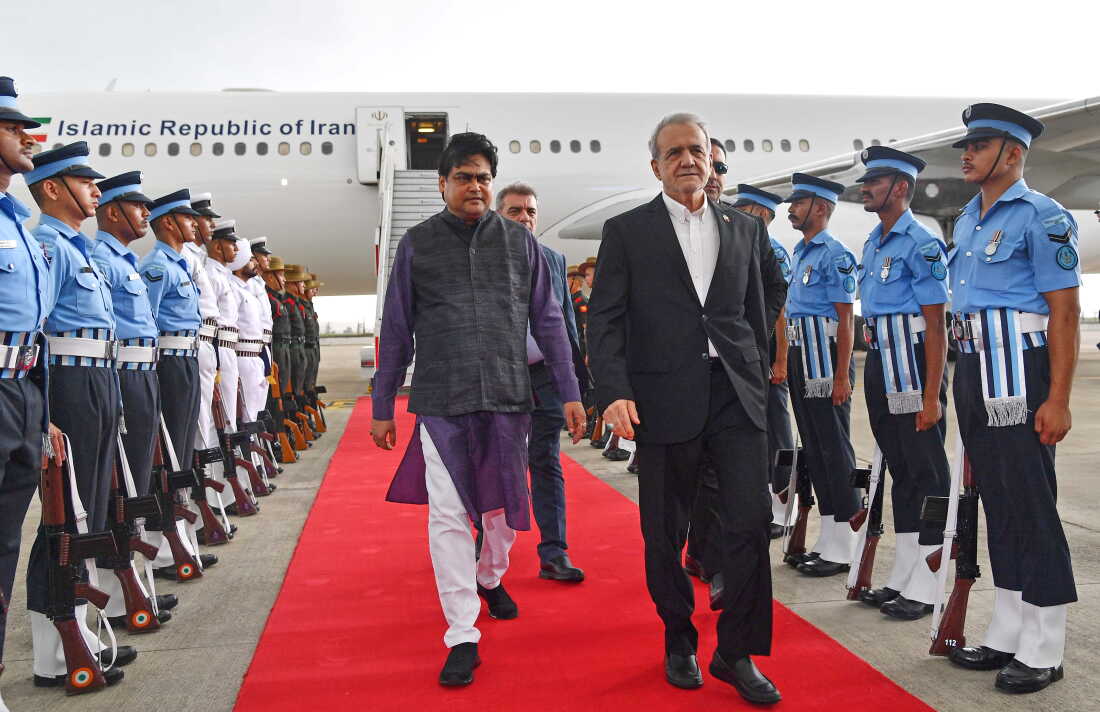
The BRICS summit in New Delhi gathers global leaders to address critical issues affecting emerging and developing countries. Hosted by Indian Prime Minister Narendra Modi on Saturday, the event welcomes Russian President Vladimir Putin, Chinese President Xi Jinping, Iranian President Masoud Pezeshkian, and other leaders from the BRICS alliance.
The summit’s agenda includes discussions on trade, investment, global conflicts, and efforts to enhance the bloc’s role in global affairs. Amidst ongoing wars in Ukraine and the Middle East, along with escalating U.S.-China tensions, the summit stands as a test of BRICS’ capacity to unite countries with diverse geopolitical interests.
“BRICS is not against anyone and is open to cooperation worldwide,” stated Russian President Vladimir Putin during the BRICS Business Forum in New Delhi.
The security for the summit is tight, with thousands of police and paramilitary personnel deployed across New Delhi. Traffic is also restricted around key areas.
Expansion and Goals of BRICS
Founded in 2006 by Brazil, Russia, India, and China, BRICS expanded in 2010 to include South Africa and now consists of 11 members. Together, these countries represent approximately half of the world’s population and a substantial portion of global economic output.
The leaders are set to discuss economic cooperation, energy, food security, technology, and reforms to global institutions. An important focus will be reducing dependence on the U.S. dollar in trade and payments, promoting use of national currencies among members, and searching for alternatives to Western-dominated financial systems.
China and Russia’s Strategic Moves
Both China and Russia view BRICS as a platform to challenge Western influence, especially from the United States, by fostering stronger relationships among developing economies. China aims to use BRICS to increase its leverage within the group and counterbalance U.S. power. Chinese Foreign Ministry spokesperson Mao Ning noted that President Xi will cover international issues and strategies for enhancing cooperation.
Iran, facing extensive sanctions and a U.S. blockade, supports measures to mitigate reliance on Western financial systems. Iranian President Masoud Pezeshkian advocates trading in national currencies among BRICS countries, emphasizing that it is a vital step forward.
India’s Diplomatic Balancing Act
For India, the summit underscores its complex diplomatic balancing act between Russia and Iran, while nurturing ties with the U.S. and Europe. Despite conflicts in Ukraine and tensions between Iran and the U.S., India maintains strong ties with both Moscow and Tehran.
Prime Minister Modi met separately with Putin and Pezeshkian prior to the summit, demonstrating India’s attempt to sustain strategic partnerships. India also seeks to improve relations with China, with Modi and Xi scheduled for talks during the summit. The outcome of these discussions could potentially lead to improved diplomatic relations following previous border tensions.
The challenge for India will be obtaining a joint statement from summit leaders. Challenges were evident in May, when BRICS foreign ministers were unable to agree on a joint statement concerning the Iran conflict, leading India to issue a chair’s summary instead.
As the Iran war evolves, sparked by U.S.-Israeli strikes, tensions among Saudi Arabia and Yemen’s Houthi rebels rise. BRICS unity may face pressure as countries navigate differing views on the conflict and interactions with the U.S.