
A raid on a Chicago apartment complex by the Trump administration has been under scrutiny for months. Initially, officials claimed that the violent Venezuelan gang, Tren de Aragua, had taken over the building. Despite these assertions, no evidence supported their claims.
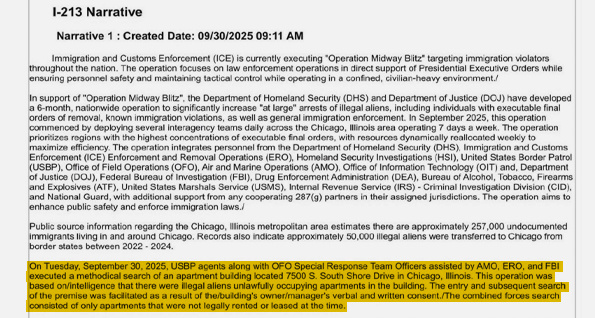
Newly released documents reveal the real reason behind the operation: allegations of illegal squatting by immigrants. These records show the landlord allowed federal officials to search the property. Arrest records from two of the 37 immigrants detained provide insight into the operation. The agents entered with the landlord’s consent, focusing on units not leased legally at the time.
Attorneys involved in a lawsuit against the government argue this operation was about immigrants unlawfully occupying apartments. Mark Fleming from the National Immigrant Justice Center criticized the government’s narrative.
The Department of Homeland Security did not link the raid to Tren de Aragua in their records, yet officials cited gang activity as justification. Despite claims that two arrestees were gang members, no evidence was provided. ProPublica’s investigative reports also found no substantial evidence supporting the government’s assertions.
ProPublica interviewed 15 detained immigrants, none of whom admitted gang affiliation. While criminal activity occurred at the complex, no one reported gang ties.
The controversy extends to a federal consent decree that restricts warrantless arrests. This decree is still contested by the government. Government attorneys admitted improper arrests of immigrants last year. Following a court order, administrative arrest records are under scrutiny by immigrant rights attorneys.
Allegations of racial discrimination have arisen, with state officials launching an investigation into the potential use of federal agents to displace Black and Hispanic tenants. Building owner Trinity Flood and management company Strength in Management are central to these allegations. Resident Jean Carlos Antonio Colmenares Pérez expressed anger over the landlord’s role in the raid.
Tenant Daniel José Henríquez Rojas shared his distress over the family’s treatment. The raid had severe consequences for families, separating them and leading to deportations. Johandry José Andrade Jiménez was also deported, and his wife now struggles to care for their children alone.
The building, home to many African American and Venezuelan tenants, had long-standing issues. Some tenants stopped paying rent due to poor conditions. However, several Venezuelans claimed to pay rent, even if unknowingly to unauthorized managers.
Flood, facing a foreclosure lawsuit, stated her company invested heavily in repairing the building. Despite this, conditions worsened after the raid, resulting in the appointment of a new management company and an order for residents to vacate.