
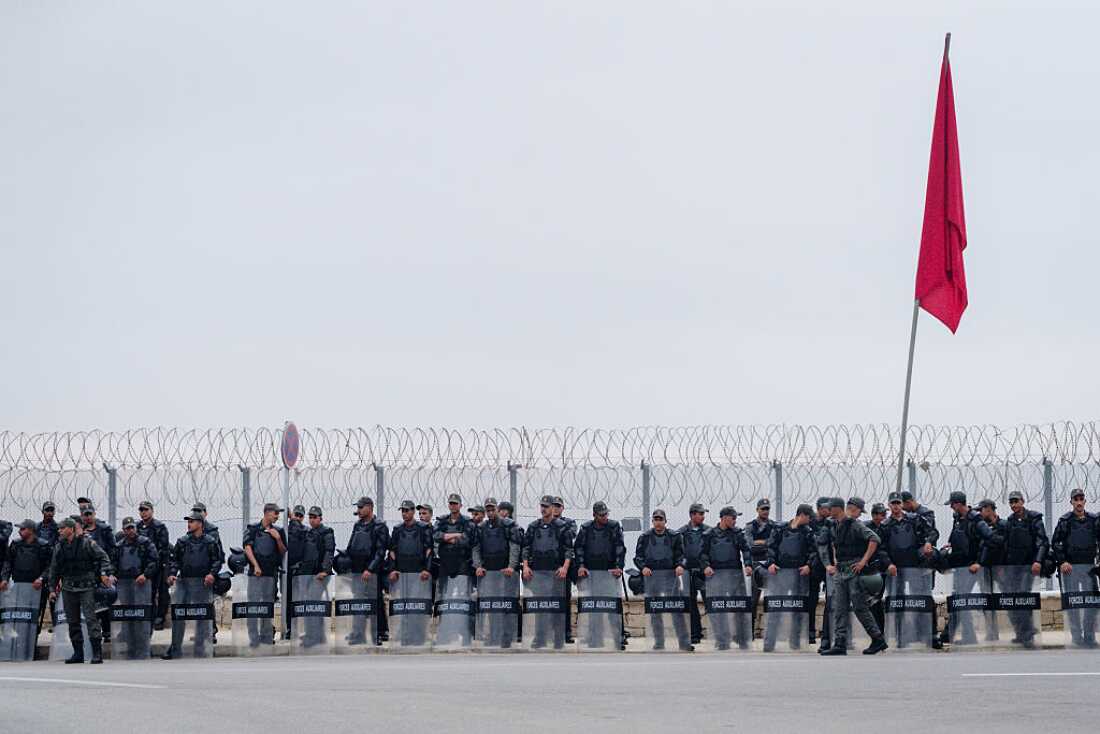
SEVILLE, Spain — An extensive police and military presence is stationed at the border between Morocco and Spain as of August 15, 2026 in Fnideq, Morocco, following the recent crisis.
In the wake of the mass border crossing on July 30, where over 140 individuals lost their lives, Spain is working to address the situation. Reports indicate that most of the more than 70,000 migrants who entered Ceuta the week of July 27 have returned to Morocco voluntarily. However, a significant number of migrants, including many minors, remain in Ceuta.
Local residents are adapting to these circumstances. Some provide essential aid like food and shelter, while others form neighborhood watch groups. Juanjo Coronado, a local, avoids leaving home due to safety concerns.
The influx caught Spanish leaders by surprise as they dealt with major wildfires. It also stirred debate within the European Union. Leaders like President Donald Trump and Italian Prime Minister Georgia Meloni regarded it as a major concern for anti-immigration efforts worldwide. For long-time residents of Ceuta, such as Teresa Pardo and Juanjo Coronado, border issues are familiar, but they agree this event was extraordinary. Pardo describes a sense of helplessness, citing shortages in supermarkets that have severely affected daily life.
There are limits on basic goods like bread, and residents, including young adults, notify family about their safety amidst the tension.
Despite the challenges, past experiences offer hope for recovery. José Bautista, a researcher with the non-profit porCausa, details a recurring pattern. Initially, Morocco allows a crisis, negotiates with Spain, and later positions itself as the solution. This played out recently as Moroccan law enforcement successfully prevented a rumored mass crossing into Ceuta.
Ceuta and Melilla, both Spanish territories for centuries, experience these tensions regularly. Despite their location, residents strongly prefer Spanish sovereignty over Morocco’s claims. Previously characterized by a steady movement of people, the areas are now isolated by complex border systems established in the 1990s.
Bautista describes these regions as test cases for global migration control. A few powerful companies profit significantly from the border infrastructure, further exporting their technologies worldwide.
Acknowledging these dynamics, European countries increasingly depend on neighboring states to handle migration enforcement. Morocco holds significant sway in regional matters, capitalizing on its geopolitical position.
Soraya Aybar Laafou, a journalist and political scientist, observed social media activity foreshadowing the events of July 30. Many young Moroccans discussed crossing the border, an interest that quickly escalated into action.
Despite prior awareness, Moroccan law enforcement seemed unexpectedly absent on July 30 when thousands crossed into Ceuta without hindrance. The Spanish and Moroccan governments later blamed human trafficking networks and recent judicial decisions for the crisis.
Interviewing young Moroccans revealed varied motivations for crossing. While necessity drove many, others cited adventure and curiosity as their reasons. Unfortunately, this pursuit of exploration resulted in widespread chaos and tragedy.
Journalist Barbara Ayuso’s reporting highlighted discrepancies in the official figures regarding migrant numbers remaining in Ceuta. She noted abysmal conditions and a minimal official response, sparking local protests. Citizens, already struggling with scarcity and security issues, blame government officials for inaction.
The crisis places Spain in a tight spot. Any action against Morocco, perceived as a misstep, could disrupt diplomatic relations. Yet, the demands from Ceuta’s residents underscore the urgent need for government intervention.
Recent reports linked the crisis to geopolitical tensions involving a spyware scandal. Journalist Ignacio Cembrero, targeted by Moroccan intelligence with Pegasus spyware, implicated Morocco’s decision to allow migrant crossings as a retaliatory gesture. The expansive use of Pegasus tarnished Morocco’s international standing, suggesting deeper political motivations affected the external handling of the border situation.
The complex interplay of national interests, assumed espionage, and migration politics means unraveling the full story of Ceuta’s crisis remains challenging. Though direct evidence is elusive, the incident underlines the broader tension between Europe and its border management strategy.
As authorities work to reestablish stability, the focus remains on addressing the immediate humanitarian needs of those affected in Ceuta, while broader geopolitical issues persist.