
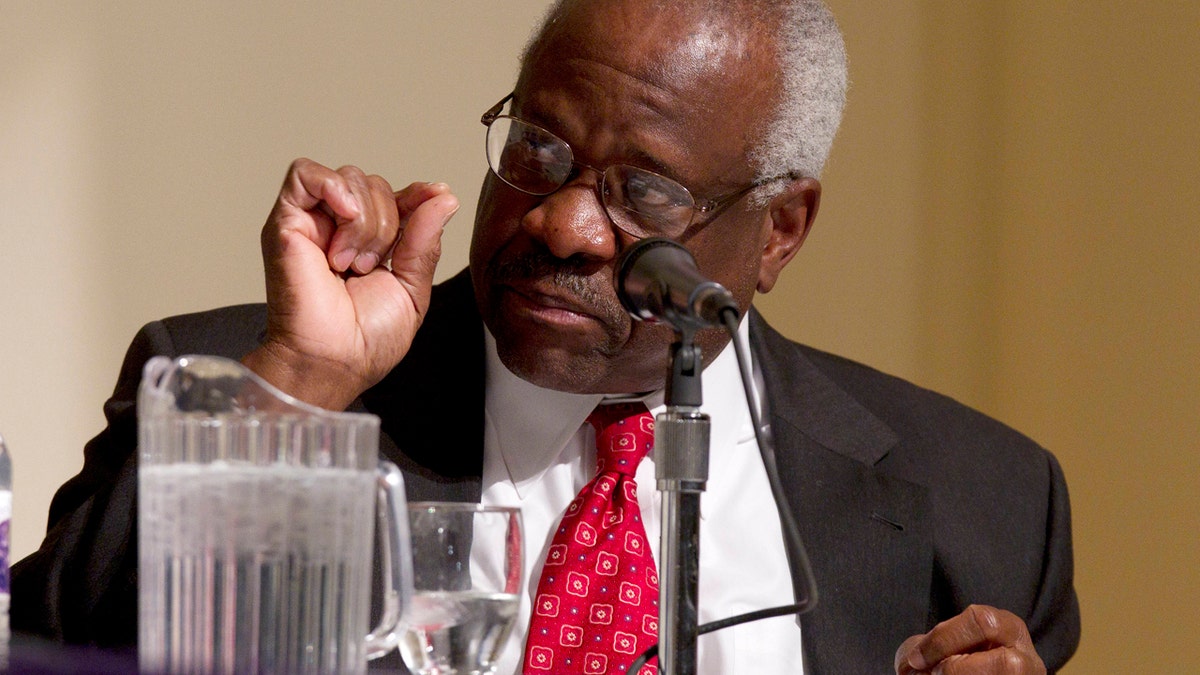
Supreme Court Justice Clarence Thomas recently commented on the challenges faced by conservatives at certain law schools and colleges. In an on-stage discussion with Peter Robinson at the Hoover Institute, Thomas expressed that some institutions, like Stanford Law School, seem to be “off limits” to conservatives.
“I have never been to Stanford Law School,” Thomas revealed, noting that conservative thought leaders often find themselves unwelcome at such institutions. “That’s the reality,” he added. “There’s certain places that are just presumptively off limits.” Though he has visited Yale Law School, Thomas stressed this issue persists across many academic settings.
Amid accusations from conservative commentators regarding liberal indoctrination on campuses, Thomas shared concerns that American economist Thomas Sowell’s influential ideas might be inaccessible to students. He highlighted YouTube as a crucial platform for students to access these views.
“What these kids are getting is all that stuff [that] is not there,” Thomas said, emphasizing the importance of alternative sources for unfiltered ideas.
Contrary to Thomas’ claims, a spokesperson from Stanford Law School stated they would welcome his presence. “We would be honored to host Justice Thomas,” a statement read, emphasizing the school’s willingness for engagement. Stanford Law has been hosting members of the judiciary, as noted by Professor Michael McConnell.
However, recent events suggest a pattern of disruptions faced by conservative speakers on campus. For instance, Judge Stuart Kyle Duncan’s 2023 visit faced significant student protest. Duncan, who serves on the U.S. Court of Appeals for the Fifth Circuit, intended to discuss topics like “Covid, Guns, and Twitter,” but faced backlash mainly from LGBTQ-affiliated students.
Groups like OutLaw and IRATE pressured the Federalist Society, the hosting organization, to cancel or virtualize the event. When the event proceeded, about 90 law students actively protested, impeding Duncan’s speech. DEI administrator Tirien Steinbach intervened, acknowledging the tension between free speech and perceived harm.
This incident led Stanford’s leadership to apologize to Duncan and implement mandatory training for students. President Marc Tessier-Lavigne and Dean Jenny Martinez clarified the school’s stance: protest is allowed, but obstructing an invited speaker conflicts with policy.
Earlier incidents further reflect this ideological divide. Three years ago, then-Texas Solicitor General Kyle Hawkins faced a walkout organized by 12 student groups due to his role in DACA-related litigation. The protest resulted in most of the audience exiting just five minutes into Hawkins’ address.
While Thomas did not specifically reference these incidents in his speech, nor confirm invitations from Stanford, his remarks indicate an increasing difficulty for conservative engagement in prestigious academic institutions.
Elaine Mallon reports on national politics for Fox News Digital and Fox Business.