
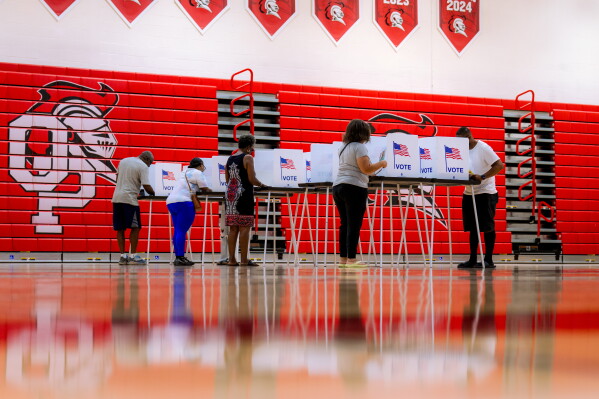
Across the United States, Democratic voters have participated in primaries in numbers not seen in decades. This increase in voter turnout across several states brings optimism for the party’s prospects in the upcoming November elections, where control of Congress is at stake.
In Wisconsin, Tuesday’s primary saw nearly 800,000 ballots cast by Democrats, the highest total for a midterm in over 20 years. Michigan recorded 1.5 million voting in the Democratic primary the week before, setting a new midterm record for the state. The enthusiasm for Democratic turnout is evident beyond these states, with earlier surges noticed in Texas and Georgia, regions with competitive Senate races slated for the fall. This trend offers Democrats strong momentum heading into the midterms, despite usual disadvantages faced by the president’s party.
Political context adds to this dynamic, as President Donald Trump’s low approval ratings and challenges like persistent inflation and an unpopular conflict with Iran weigh in. “The big news is that Democrats are getting huge turnouts,” noted David Axelrod, a former adviser to Democratic President Barack Obama.
Competitive Democratic primaries have played a role in the burgeoning voter turnout, enticing party supporters to engage more actively. By contrast, Republican turnout remained consistent with historical patterns, especially in Michigan, even amidst competitive primaries.
The relationship between primary turnout and general election outcomes isn’t straightforward. Republicans are preparing to energize their base in the fall, leveraging a significant fundraising edge over Democrats. Mike Marinella, spokesman for the National Republican Congressional Committee, stated, “House Republicans are entering November with the money, momentum, stronger candidates, and a battle-tested operation.”
While the pattern of increased Democratic turnout extends to several states, the scale varied. In Wisconsin, over 790,000 voted in the Democratic primary for governor, about 22% of registered voters. Michigan’s recent Democratic Senate primary drew over 1.5 million voters, making up slightly more than 18% of the registered electorate. Both turnout figures represent the highest midterm rates since at least 2002. In Minnesota, the Democratic turnout was comparable to the 2018 midterms, marking successive highs within the century.
Republican turnout remained average, with around 11% participation for their governor’s race in Michigan and approximately 14% for Wisconsin’s primary. Ted Goodman of the Michigan GOP emphasized the GOP’s strategy to emphasize clear contrasts with Democratic candidates, highlighting perceived extremism among opposing nominees.
Earlier primaries in Georgia and Texas also demonstrated significant Democratic turnout rates. Over 1 million participated in Georgia’s May Democratic primary, about 13% of registered voters. Texas saw 2.3 million turnouts for the Democratic Senate primary in March, accounting for just over 12% of registered voters.
The competition in primaries seems to have fueled overall Democratic engagement, though maintaining unity may pose challenges post-primary victories. Corwin Smidt, a political science professor at Michigan State University, warned against relying on primary turnouts as a predictor for November outcomes. He attributes the turnout increases to recent election patterns fostering habitual voting behaviors, along with the spotlight on particular candidates sparking voter interest.
In Michigan, high campaign spending aided engagement, exemplified by the competitive race where Abdul El-Sayed narrowly defeated Rep. Haley Stevens. This campaign drew national interest and mobilized young and university voters. Yet, diverging candidate preferences hinted at potential challenges for consolidating party unity.
In Wisconsin, continuous candidate shifts shaped the gubernatorial primary, driving participation. Despite victories, unity efforts were necessary, as rivalries left marks. Democratic leaders quickly organized unity events post-primary to bolster general election collaboration.
Sen. Bernie Sanders expressed confidence in Democrats overcoming differences for general elections, believing the importance of confronting Trump will foster alignment. Despite optimism, Democrats must contend with a challenging congressional map that has recently favored Republicans through re-drawn districts. A slim Democratic margin in both chambers adds to the stakes.
Shrinking numbers of competitive races, coupled with a Republican-controlled majority in both the House and Senate, underscores the favorable GOP positioning. Political analysts like Smidt suggest Democrats need motivation similar to the Republicans in prior cycles to expand their competitive map effectively.