
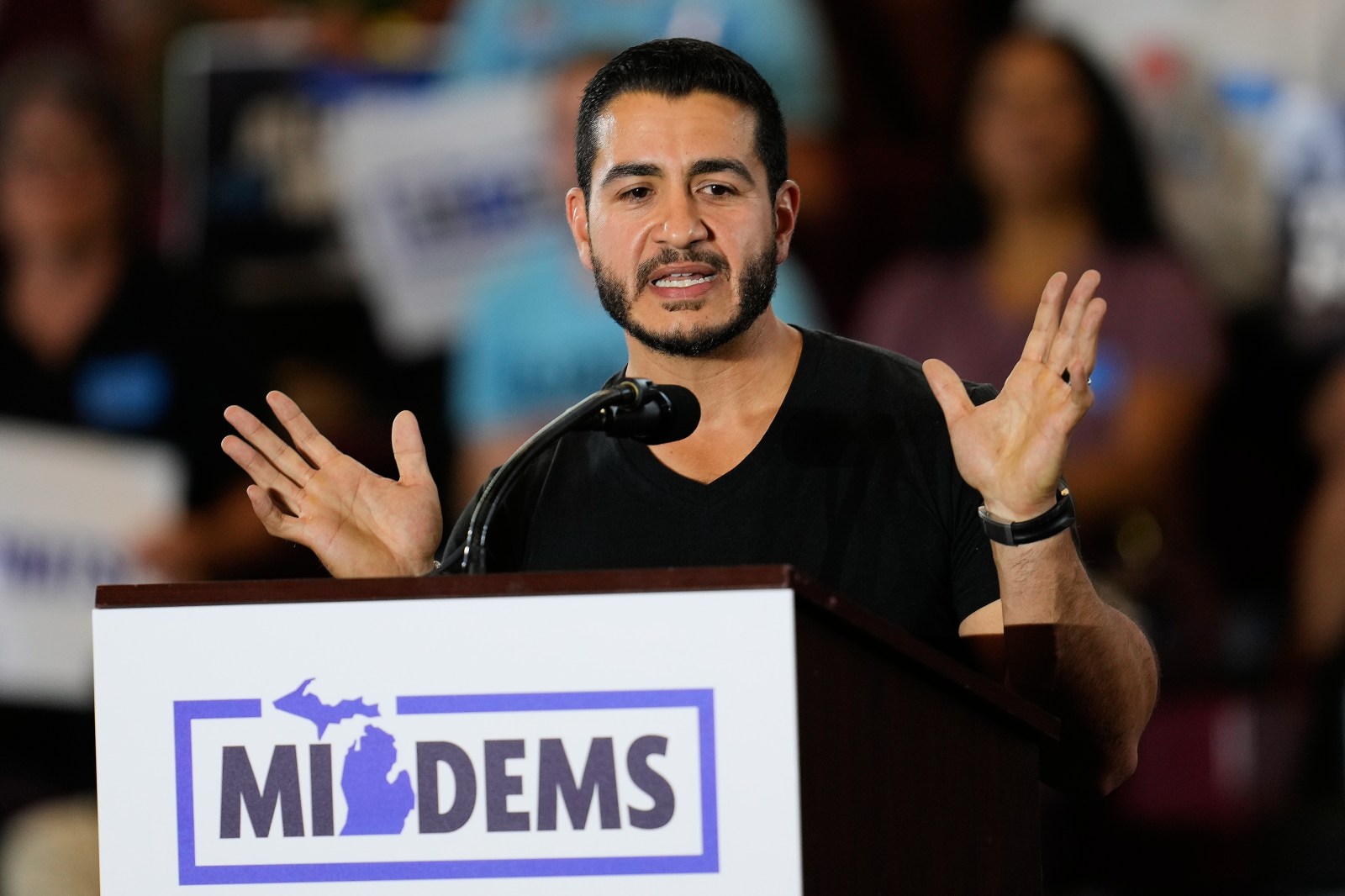
Some Republicans have expressed concern over Michigan Senate candidate Abdul El-Sayed, citing his Muslim faith as a potential threat to American values. Representative Nancy Mace from South Carolina issued statements targeting Muslim public officials, alleging they are a hidden risk to their constituents. Mace wrote on X, ‘Every single Muslim holding public office in America is a trojan horse, and a threat to both national security and our republic. We refuse to be silent.’
Mace, serving in the House since 2021, later singled out El-Sayed, a Democrat running to be the first Muslim U.S. senator. During a CNN interview, Mace discussed the potential outcomes of his election. She questioned how future generations might be affected, alluding to cultural changes she fears could occur.
President Donald Trump contributed to the controversy by posting a photograph on Truth Social. He juxtaposed an image of El-Sayed and his wife, Dr. Sarah Jukaku, with himself and first lady Melania Trump, labeling them as ‘Two VERY DIFFERENT America’s.’ El-Sayed responded in an interview with CNN’s Jake Tapper, asserting that he and his wife represent genuine love and care for each other, in contrast to what he described as Trump’s commercial interests.
The Council on American-Islamic Relations (CAIR) condemned Trump’s post. They insisted it was an attack on the diversity that forms America’s foundation. CAIR Director Nihad Awad highlighted the equality of Americans, regardless of descent or religious attire, and called for the removal of the discriminatory post.
El-Sayed has downplayed his faith with respect to governance, emphasizing his focus on serving Michigan residents. He stated to Newsweek his priority is being the best senator for Michigan, not being ‘the first’ of any distinction. El-Sayed, a former public health official, reflected on his faith’s influence in a 2017 interview, expressing his commitment to building a just world for all.
The discussion on identity continued in 2018 during El-Sayed’s gubernatorial run. He described his political movement as a return to government ‘for the people and by the people,’ seeking to address public dissatisfaction with current governance.
In recent developments, El-Sayed noted a conversation with former President Barack Obama, suggesting party unification efforts are ongoing. His opponent, Mike Rogers, a former congressman, appeals to Democrats feeling alienated by the party’s progressive direction. Despite these dynamics, El-Sayed observed a growing unity among Michigan Democrats centered on shared goals.