
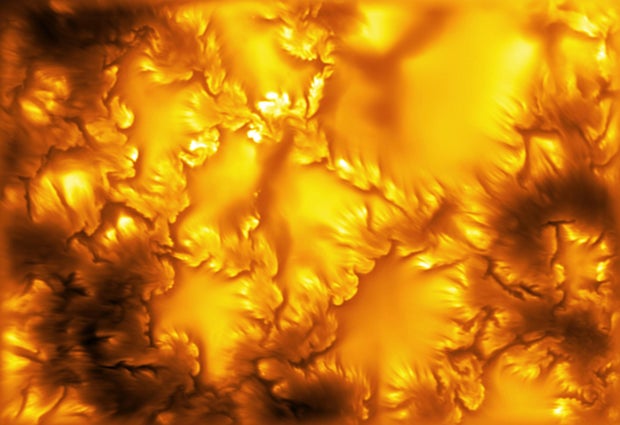
Researchers have captured the clearest images of the sun’s surface, revealing a fascinating and active landscape. The National Science Foundation’s Daniel K. Inouye Solar Telescope, located in Maui, Hawaii, enabled this achievement.
Viewing the sun without the right protection is hazardous. However, this new telescope allowed scientists to examine its fiery surface securely. Their primary aim was to adjust the telescope’s settings and evaluate its capabilities. Yet, when they reviewed the images, they found they had captured the sun’s luminous outer layer in unprecedented detail.
The photos displayed unique feathery designs spreading across the surface. According to the NSF’s National Solar Observatory, the images exposed a solar terrain never before observed. These patterns included small, dynamic swirls along the edges of magnetic zones.
This reminded solar physicist Ruizhu Chen of Van Gogh’s Starry Night.
The sun’s surface showed signs of instability from magnetized plasma pieces moving at varying speeds. This is known as the Kelvin-Helmholtz instability (KHI), a concept understood in fluid movement.
Although KHI has been detected on Earth and planets like Jupiter and Saturn, study co-author Friedrich Wöger noted that such detailed observation on the solar surface is unprecedented. Dr. David Boboltz, deputy director at the National Solar Observatory, emphasized that this discovery, supported by numerical simulation analysis, marks a significant advance in understanding solar and stellar plasma dynamics.
The study was published in the journal Nature on Wednesday.
Understanding the sun’s processes helps scientists trace enormous energy eruptions called coronal mass ejections that can reach Earth. Upon impact, these eruptions might cause solar storms, affecting GPS systems and creating stunning auroras.
Dr. Jacqueline Keane, NSF program director, stressed that comprehending the dynamic space weather influencing Earth requires observing the small processes driving it.
The NSF Inouye Solar Telescope combines a large four-meter mirror with advanced optics and instruments, offering the necessary resolution to unveil these delicate particulars for the first time. Such capabilities enable discoveries previously unattainable.
The achievements of this telescope bring scientists closer to unlocking more secrets of the sun.