
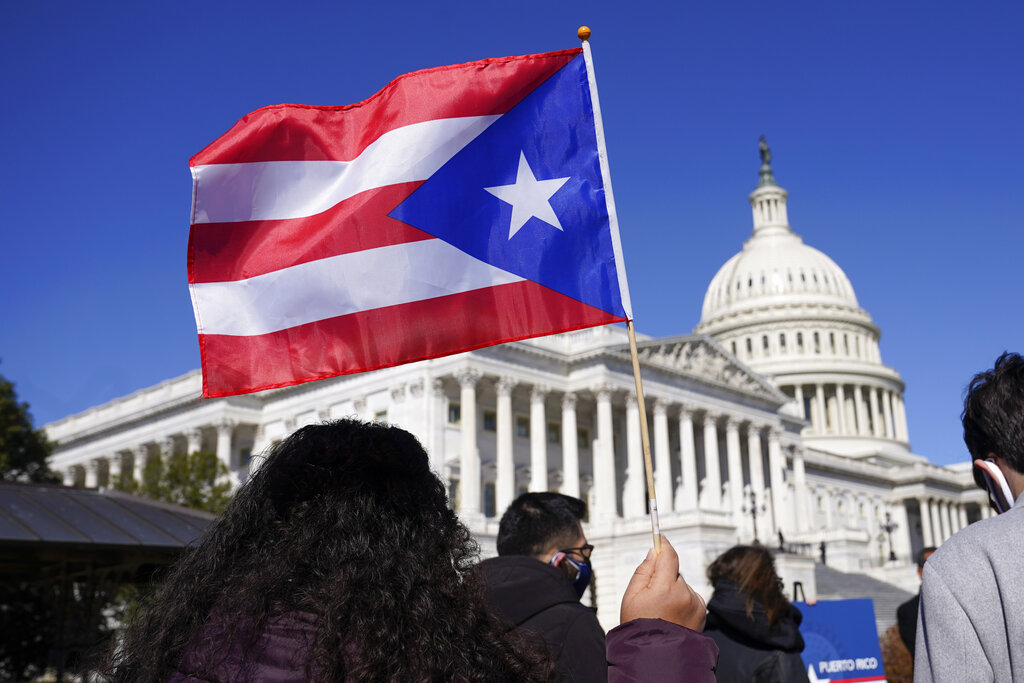
In March 2021, on Capitol Hill in Washington, a woman waved the Puerto Rican flag during a news conference about Puerto Rican statehood. The U.S. House passed a bill to allow Puerto Rico a binding referendum on statehood or independence. Yet, the bill’s chances in the Senate are slim.
Historically, midterm elections often cost the ruling party seats in Congress. This November may follow suit, challenging Republicans to maintain their U.S. House majority. Republicans face the task of understanding Puerto Ricans, the second-largest Hispanic voting bloc in the U.S. To gain their support, Republicans must cease opposing Puerto Rican statehood.
On July 15, the Puerto Rico Statehood Council shared a poll by McLaughlin and Associates, linked to President Trump, on Hispanic and Puerto Rican voters. The poll found 68% of Hispanic voters and 71% of Puerto Ricans favor statehood. Republicans could benefit politically by supporting statehood.
Notably, 78% of Republican Puerto Rican voters favor statehood, with only 13% opposing. More Republican Puerto Ricans support statehood than Democrats, at 69%. This alignment indicates common conservative values. Additionally, 68% of Republican Puerto Ricans are more likely to vote for statehood-supporting candidates. The poll reveals a key insight: statehood impacts Republican voters more than Democratic ones.
Republican voices like Sen. Mitch McConnell’s might find these results surprising, but they reflect reality. Puerto Rico’s leading political figures, including the governor, Senate President, and House Speaker, are Republicans. Puerto Ricans share Republican values such as military strength, a free Venezuela, tough-on-crime policies, and traditional family values. These beliefs extend to Puerto Ricans living in the 50 states.
The Republican challenge in winning Puerto Rican voters lies not in ideology but in resistance to statehood by some party leaders. This opposition grants Democrats an opportunity to appear receptive to Puerto Rican concerns.
Winning Puerto Rican voters extends beyond the six million living in the U.S., especially in states like Pennsylvania, Georgia, North Carolina, Texas, Florida, and New York. Control of the House could hinge on Puerto Rican votes, as demonstrated in Pennsylvania’s 7th District. This district, with a substantial Puerto Rican population, remains highly competitive. Puerto Rican votes could determine the outcome, as seen in the narrow victory of Rep. Ryan Mackenzie (R-Pa.) in 2024.
As Cook Political Report notes, 12 out of 38 swing House districts have a Hispanic population of at least 20%. Engaging Puerto Ricans could help Republicans secure crucial seats. Republicans don’t need to make statehood a central campaign theme; they should stop opposing it. With figures like Kamala Harris and DNC Chair Ken Martin supporting statehood, Democrats might capitalize on this stance.
If Republicans ignore the issue, Democrats may capitalize when in full control of Washington, targeting voters who initially favored Republican support.
José Fuentes, a former attorney general of Puerto Rico, currently chairs the Puerto Rico Statehood Council.