
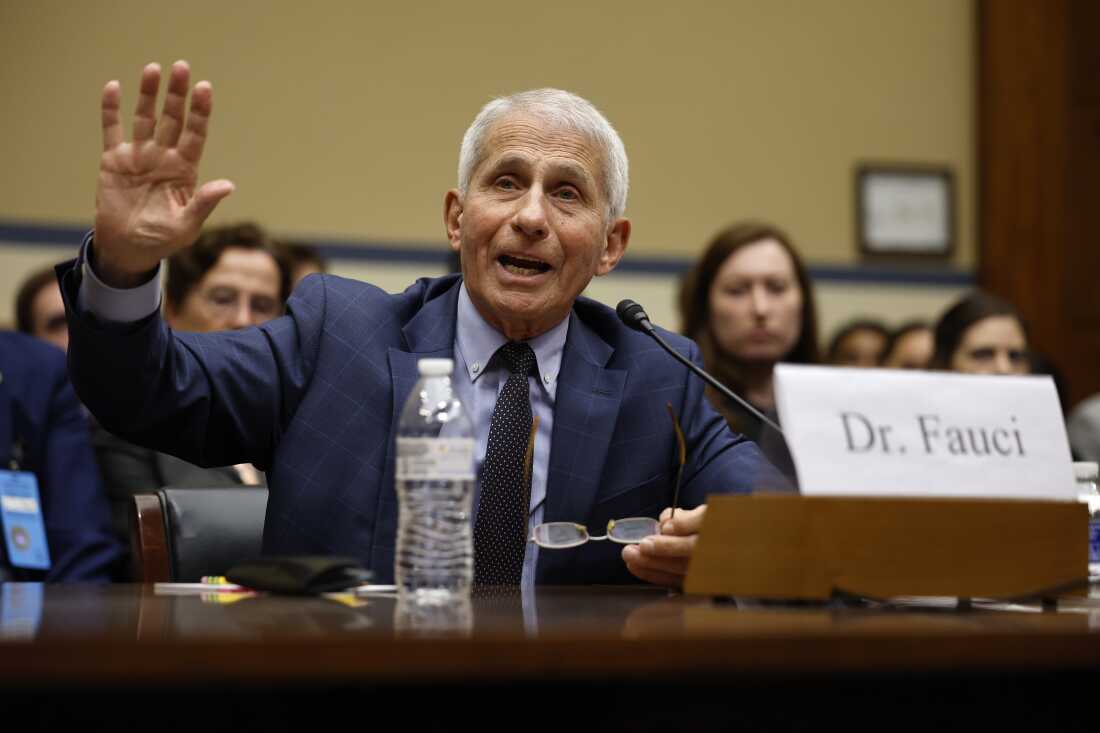
Dr. Anthony Fauci, the former Director of the National Institute of Allergy and Infectious Diseases, faced scrutiny from Sen. Rand Paul, R-Ky., who released a set of diary entries attributed to Fauci during the COVID-19 pandemic. The 1,141-page document, briefly available online, underscores the ongoing disagreements between Fauci and some politicians regarding the origins of the coronavirus.
Fauci’s Testimonies and Paul’s Investigation
These diary entries surface as Fauci is set to appear before the Senate Homeland Security and Governmental Affairs Committee, chaired by Paul. They aim to question Fauci on his knowledge during the pandemic’s early stages. Paul and Fauci have publicly differed for years on how the pandemic began. Fauci retired from NIAID at the end of 2022, but Paul continues to examine the origins of COVID-19 and related research funding.
Paul’s release of the diary entries on X highlighted discrepancies between Fauci’s public and private communications. Fauci and Paul declined NPR’s request for comments on the entries.
The Origins Debate
The crux of their disagreement revolves around the virus’s origins. Fauci has maintained that scientific evidence supports a zoonotic spillover event. This is where the virus moved from animals to humans, with the Wuhan wet market often cited as a potential amplification point.
Virologist Felicia Goodrum supports this view, noting that despite the market being cleared before sampling, initial genetic data ties cases to the market, not the Wuhan Institute of Virology.
Conversely, Paul suggests a possible lab-engineered origin. In prior hearings, he mentioned that while certainty is lacking, some evidence indicates a lab origin. This stance aligns with a 2024 report by a Republican Subcommittee, concluding a lab leak was likely and hinting at NIH funding potentially aiding research at the Wuhan lab on viral enhancement.
Robert Garry, a virologist, contests the lab leak theory, citing a lack of evidence and no matching precursor virus identified at the Wuhan lab or elsewhere that could’ve become SARS-CoV-2.
Insights From the Diary
Key diary entries include one from January 26, 2020, where Fauci notes an early infection unrelated to the market and describes the market as an amplifier. Paul interpreted this as Fauci having dismissed the market’s role privately, while still suggesting an animal-to-human transmission in the same entry.
Another notable entry from February 1, 2020, lists researchers debating COVID-19’s origins, with only few supporting a natural origin. This meeting, according to Goodrum, occurred when limited data was available, influencing scientists’ initial conclusions, which evolved with new evidence.
Goodrum emphasizes that scientific understanding progresses with new data, and Fauci needed to reassure a panicked public during the pandemic’s emergence, potentially differing from private discussions.
The Upcoming Hearing
In the upcoming hearing, Paul is expected to question Fauci on the diary’s revelations. Fauci’s responses might reflect previous clarifications about his and his colleagues’ evolving understanding during the pandemic.
Fauci has previously dismissed conspiracy theories linking him to the virus’s origin, calling them a waste of time. In contrast, Paul argues that pursuing these questions serves as oversight.