
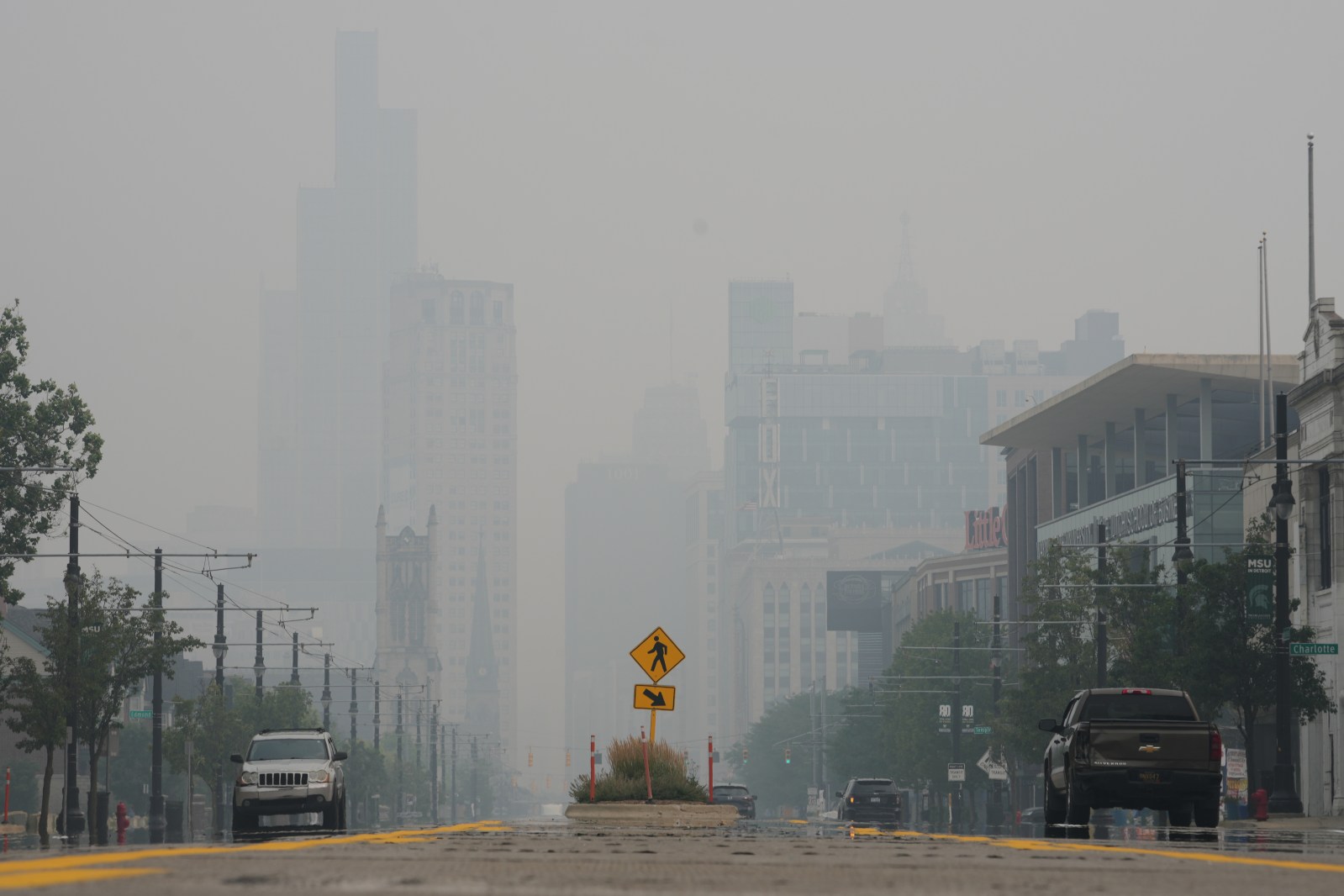
U.S. Cities Top Global Air Quality Index
On Friday, three U.S. cities reached the top of the global rankings for worst air quality, driven by smoke from Canadian wildfires across the Midwest and Northeast. Detroit recorded a ‘very unhealthy’ air quality index reading of 240, marking it as the city with the worst air quality among those tracked by IQAir, a Swiss air-quality firm. Closely following Detroit were Chicago and Washington, D.C., with readings of 199 and 172, respectively. New York City ranked eighth, with an index of 131.
Global Air Quality Comparisons
Outside the U.S., Kinshasa in the Democratic Republic of the Congo, New Delhi, India, and Jakarta, Indonesia, faced high pollution levels. Kinshasa had an air quality index of 186; New Delhi stood at 163, continuing to bear high pollution levels as noted by its previous status as the world’s most polluted city in 2025. Jakarta registered an index of 144, indicating ‘unhealthy for sensitive groups.’
The Challenge of PM2.5 Pollution
PM2.5 is commonly highlighted in air quality reports due to its small size and pervasive presence. It arises from numerous pollution sources including vehicles, industrial emissions, wildfires, and household activities. This microscopic pollutant penetrates indoor environments and can infiltrate deep into the lungs and bloodstream, posing serious health risks.
Current Forecasts and Responses
The National Weather Service noted hazardous air quality in Detroit from continuous wildfire smoke. Conditions were expected to improve following changes in wind direction. Canadian wildfire smoke migrated from northern Ontario across the Great Lakes into the Midwest and Northeast, impacting air quality far from its origin.
Officials urged people in affected regions to stay indoors or wear high-quality masks. In New York City, outdoor events were canceled and measures such as cooling centers and mask distribution were implemented to mitigate the situation.
Advisories and Mask Guidance
Dense-smoke advisories highlighted poor visibility in areas like Lake Huron, Lake St. Clair, and Michigan waters of Lake Erie. Detroit’s air-quality alert was extended through Friday night due to persistent smoke.
Health experts advise using N95 or KN95 respirators to protect against wildfire smoke particles. Dr. Tyler Evans emphasized that only well-fitting respirators effectively filter microscopic particles present in smoke, unlike loose-fitting masks.
The Public Health Agency of Canada concurs, advising respirators that fit snugly without gaps. They recommend avoiding respirator use during sleep and caution against usage for very young children, those with breathing difficulties, or individuals requiring assistance to remove the mask.
Overall, the first line of defense includes limiting outdoor exposure and maintaining clean indoor air when possible.