
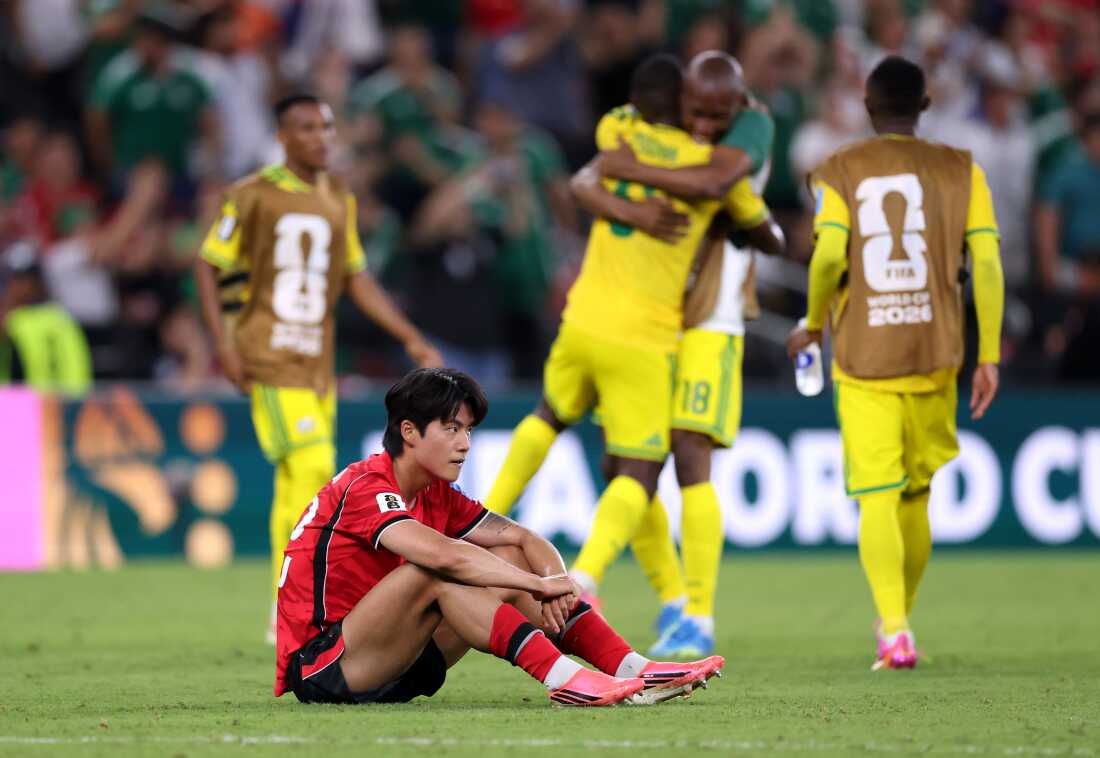
Seol Young-woo (#22) from South Korea reacts after the team’s 0-1 loss to South Africa at the 2026 World Cup in Guadalupe, Mexico. Photo provided by Luke Hales/Getty Images.
For a brief moment, it seemed this summer would favor Asia. The 2026 World Cup began with South Korea’s thrilling victory over the Czech Republic. The Asian teams remained unbeaten for the next four days, mostly through draws. However, luck shifted on the tournament’s sixth day, and Asia faced substantial defeats. Nine teams from the Asian Football Confederation (AFC) participated due to the World Cup’s expanded format. Sadly, seven teams—South Korea, Iran, Iraq, Jordan, Qatar, Saudi Arabia, and Uzbekistan—faced elimination after the group stage. Australia and Japan exited after the round of 32, making the AFC the first major confederation to see all its teams eliminated. New Zealand, representing the Oceania Football Confederation, faced similar fate in the group stage.
Teammates on Japan’s national team react after their World Cup match against Brazil in Houston on June 29. Brazil won 2-1. Image credited to Ronaldo Schemidt/AFP via Getty Images.
The outcome was disappointing not only for individual countries but also for Asian football as a whole. Despite more Asian players participating in European club football and increased investment in the sport across Asia, AFC teams managed only three wins in 29 matches. For the sixth consecutive World Cup, no AFC team advanced in the knockout round. Paul Williams, co-founder of the online news outlet The Asian Game, states, “Asian football can be competitive, but there’s still a gap to bridge between Asia and the rest of the world.” This raises questions about what’s holding teams back and whether Asia might soon have its moment in the World Cup.
Analyzing Asia’s World Cup Performance
South Korea, positioned as the second-highest ranked squad in its group, was particularly disappointing among AFC teams. Following their initial win, the Taeguk Warriors appeared increasingly disorganized and failed in subsequent games against Mexico and South Africa.
A banner reading “South Korea football is dead” is held by people waiting for South Korea’s head coach Hong Myung-bo’s arrival at Seoul-Incheon International Airport in Incheon on June 30. The team’s best World Cup finish was in 2002, placing fourth. Image credited to Jade Gao/AFP via Getty Images.
Sports journalist Han June from South Korea, founder of Football-Asian.com, explains, “Many reasons led to the Korean national team’s failure. The team lacked unity, effective tactics, and strategy.” Following accusations of favoritism and cronyism in appointing coach Hong Myung-bo, South Korean President Lee Jae Myung called for an investigation. Both Hong and Chung Mong-gyu, head of the Korea Football Association, resigned.
Expectations also fell short for Qatar and Saudi Arabia despite substantial investments in football. World Cup newcomers Jordan and Uzbekistan did not win but created memorable moments, like Jordan scoring against Argentina and Uzbekistan against Colombia. Iraq drew an unlucky group against Senegal, France, and Norway. Japan, after advancing to the round of 32, faced the challenge of competing against Brazil.
Iran faced significant challenges due to the U.S. conflict, which suspended their domestic football league and restricted travel, affecting their training and preparation. Arya Nourizadeh, Iranian-Canadian and co-host of the podcast Asian Football Show, notes, “Iran was probably the most underprepared due to external factors.” Despite strength displayed in three draws, it was insufficient to advance.
Passion and Struggle in Asian Football
The challenges faced by Asian teams are not due to a lack of passion. Countries from Singapore to Indonesia have a deep history and love for football, rooted in European colonialism. Particularly among Gulf nations, football’s market is rapidly growing, according to Abdullah Al-Arian, editor of Football in the Middle East: State, Society, and the Beautiful Game.
A drone show displays “Welcome to Saudi 34” as Saudi Arabia is announced as the host for the 2034 World Cup in Riyadh, Saudi Arabia. Image provided by Christophe Viseux/Getty Images for Saudi Arabian Football Federation.
Ben Weinberg, a former sports researcher from Germany, points out that despite football’s deep roots, its professionalization began relatively late in many Asian countries. Since its formation in 1954, the AFC has evolved from managing competitions to actively developing the sport in the region, overseeing 47 member associations from China to Australia, presenting unique challenges.
Weinberg questions if the AFC should elevate football standards across all nations or concentrate on the leading nations. “Investing broadly might reduce resources for high-performance programs,” he explains. Ultimately, national associations are responsible for player and coach development.
Seeking International Experience
Journalists suggest Asian teams should seek international experience for both players and national teams. European leagues have welcomed Asian athletes, but Paul Williams from The Asian Game urges for more engagement outside Asia. “Players improve by gaining international experience, training, and playing against the best players,” he says.
Portugal’s Cristiano Ronaldo competes with Uzbekistan’s Abdukodir Khusanov during the World Cup match between Portugal and Uzbekistan in Houston. Khusanov was first to compete in the Premier League from Uzbekistan. Image credited to Paul Ellis/AFP via Getty Images.
Nourizadeh supports more games between AFC member nations, suggesting the confederation’s newly introduced Nations League could boost competition and be beneficial for developing teams.
Future Prospects for Asian Teams
Despite challenges, the AFC continues growing in strength, with increased potential from Asian teams. Yet, similar growth occurs globally. As levels of quality rise, Nourizadeh hopes teams adapt positively.
Japan offers promising prospects, the nation has set its sights on winning the World Cup by 2050. Having defeated Germany and Spain, Japan aims for greater achievements in the knockout stage.
Kaishu Sano (#24) from Japan celebrates scoring against Brazil during Japan’s match in Houston. Image credited to Lars Baron/Getty Images.
Japan developed a 100-year strategy to boost football, expanding professional clubs and investing in youth programs. Williams regards this approach as a blueprint for others, advocating investment in grassroots, coaching, and embracing patience. Although a nation outside Europe or South America winning the World Cup may take time, Williams believes it’s an endeavor worth pursuing. “The group stage represents worldwide unity and diversity,” he notes. “A future where African, Asian or other non-traditional teams win will offer an exciting and refreshing twist.”