
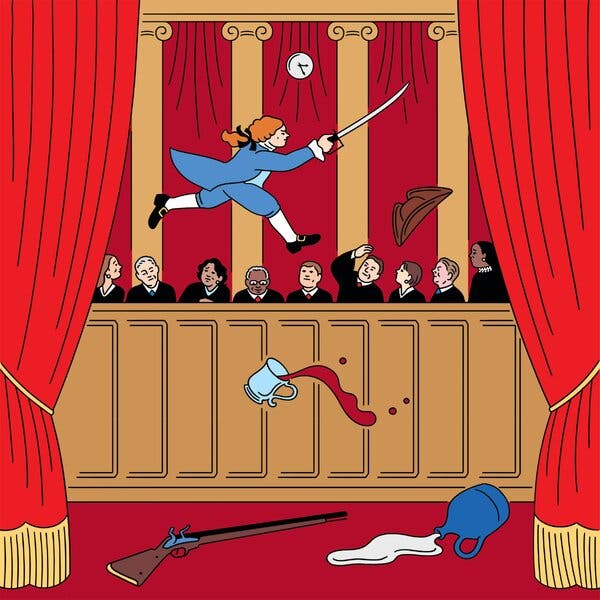
Linda Greenhouse, Pulitzer Prize winner and notable Supreme Court reporter, delves into the controversies surrounding the Supreme Court’s reliance on ‘originalism’ during a confounding term. Originalism, a constitutional interpretation method rooted in historical context, emerged prominently during the Reagan era, favored by conservatives aiming to restrict judicial discretion. Justice Brett Kavanaugh articulated its principle by asserting history is less subjective than policy. He argued ‘history and tradition,’ rather than current realities, should guide the Second Amendment’s interpretation.
Greenhouse raises pertinent questions about history’s objectivity. To illustrate, consider a hypothetical scenario involving a young man from Dallas, who maintains a job and, like many Texans, keeps a firearm at home while occasionally using marijuana. His actions collide with federal Section 922(g)(3), criminalizing gun ownership by an ‘unlawful user’ of controlled substances, with potential imprisonment up to 15 years.
Prosecutors, adhering to Supreme Court precedent, must base arguments on historical traditions. Yet, in pivotal decisions like the 2022 Bruen ruling, historical traditions don’t relate to the regulation’s adoption timeframe. Instead, they require parallels from the country’s founding era or, controversially, from the 1868 adoption of the 14th Amendment incorporating the Bill of Rights into state governance. Given marijuana’s absence in America during those times, the government faces a challenge.
Government lawyers, creatively tasked, identify ‘habitual drunkard’ laws from the 18th and 19th centuries, where obviously inebriated individuals were confined away from access to firearms. Is this the government’s strongest historical analogy for a modern gun regulation?
Greenhouse’s exploration invites reflection on whether originalism adequately guides the interpretation of laws amid evolving societal contexts.