
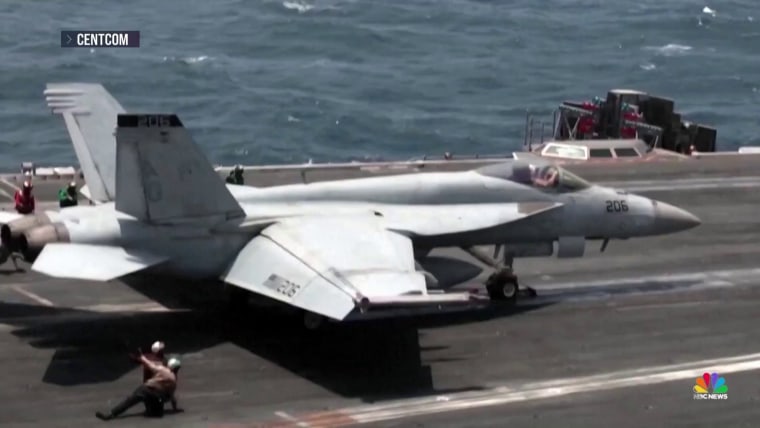
The U.S. military reinstated a blockade on Iranian ports early Wednesday. This move comes in response to Tehran’s aggression towards ships in the Strait of Hormuz. The blockage has triggered more strikes on countries hosting U.S. forces, unraveling an interim agreement meant to halt the conflict.
Iran has conducted a series of retaliatory strikes across the Middle East. Both nations are vying for control of the crucial waterway, where a significant portion of global oil and natural gas trade occurs. This situation raises the risk of further escalating into a full-scale war.
The Iranian Health Ministry reported over 260 injuries from the overnight strikes, indicating heightened intensity. More than 30 fatalities have occurred recently, noted by Iranian government spokesperson Fatemeh Mohajerani.
The U.S. first imposed the blockade in April and later lifted it in June, following an interim deal on issues like Iran’s nuclear ambitions. However, talks have stalled as tensions over the Strait have worsened.
“The export of oil and gas from the region will be either for everyone or for no one,” declared Iran’s paramilitary Revolutionary Guard.
President Donald Trump reinstituted the blockade on Monday, initially announcing a 20% fee for ships passing through the waterway. He reversed this plan after receiving requests from Persian Gulf allies.
Following the blockade’s reinstatement, the U.S. launched strikes over seven hours, targeting dozens of sites, according to Central Command.
Bahrain and Kuwait received missile alerts following Iranian attacks, a frequent occurrence straining ceasefire efforts. Jordan claimed to have intercepted three Iranian missiles. Iran took responsibility for these attacks.
U.S. Navy Adm. Brad Cooper affirmed that Iran had launched numerous missiles and drones at Gulf Arab countries. “U.S. forces are holding Iran accountable for unwarranted aggression,” Cooper stated.
Trump told Fox News that more strikes on Iran are imminent unless discussions resume. The U.S. has already targeted bridges.
The region hosts 19 U.S. warships, including two aircraft carriers, with additional military aircraft deployed across the Middle East.
The conflict began on February 28, when the U.S. and Israel initiated war efforts against Iran. Tehran responded by attacking ships, pushing oil prices higher.
Iran has attacked ships on a route overseen by the U.S. near Oman, which contributed to the recent violence. Any plans to forcibly reopen the Strait would require extensive military resources, experts suggest.
Iran’s U.N. ambassador, Amir Saeid Iravani, criticized the U.S. actions as aggressive.
“The U.S. is the aggressor, not the victim,” Iravani wrote to the U.N., according to IRNA.
Trump discussed alternative economic arrangements with regional leaders. He expressed preference for investment over collecting tolls at the strait.
Plans to impose fees would contradict longstanding American policies. The U.S. has consistently vowed to keep the strait toll-free.
Iran acknowledged recent U.S. strikes but reported no casualties or damages. In Iran, cities like Bushehr, Ahvaz, and Bandar Abbas experienced significant explosions, per state media reports.
The possibility of Gulf Arab states responding to Iran’s actions without public acknowledgment looms.
Kuwait reported that an Iranian attack injured four of its naval personnel.
The interim deal stipulated a fee-free passage through the strait for 60 days, but future arrangements remain disputed. Iran insists on its right to manage traffic and fees.
Oil prices showed fluctuations, briefly peaking at over $87 for Brent crude before settling after Trump’s announcements.
Regional mediators continue efforts to bring the U.S. and Iran back to negotiations.