
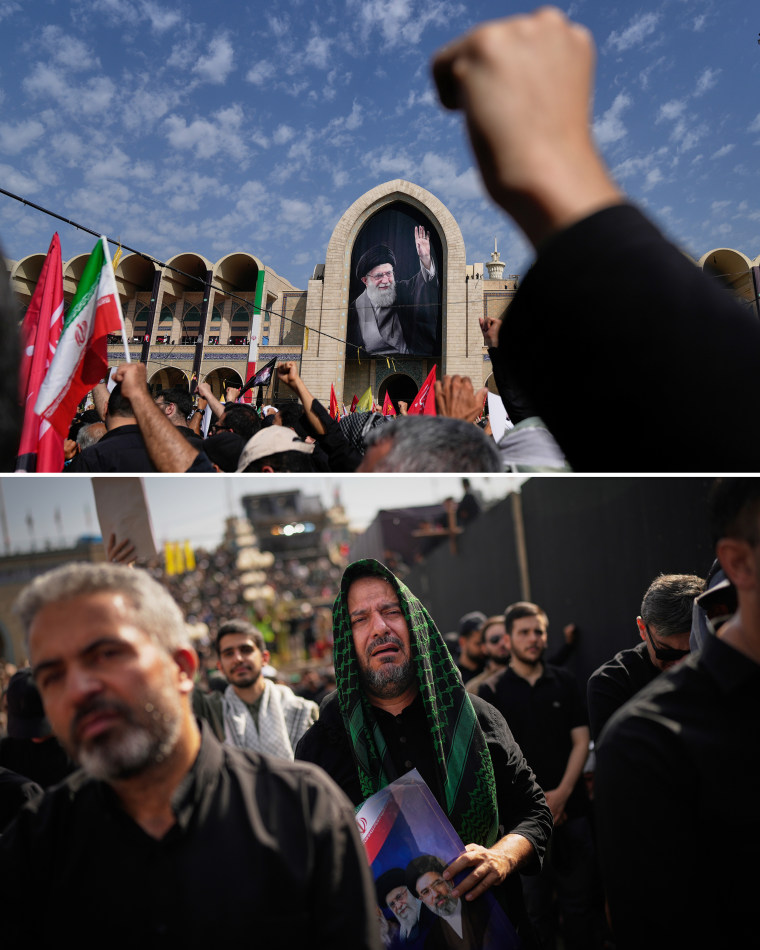
In Tehran, Iran, the funeral procession for former Supreme Leader Ayatollah Ali Khamenei began on a significant scale on Saturday. This marks the start of a weeklong mourning period designed to demonstrate the strength and resilience of the Islamic Republic.
The 86-year-old Khamenei’s coffin lay cloaked in the Iranian flag and covered with his black turban. It was placed inside a glass case at the Grand Mosalla, a major mosque and prayer complex in the center of the city. Alongside it were four coffins of his family, victims of the war against the U.S. and Israel, initiated four months ago.
Mourners, clad in black, assembled on streets during early hours, responding to calls from national leaders to gather en masse. As daylight emerged, their numbers swelled to tens of thousands, filling the courtyard of the Grand Mosalla, where a large banner depicting Khamenei was displayed. Many attendees expressed their grief vocally and carried Iranian flags, indicative of rising national sentiment amid ongoing conflict.
Altaf Qadri reported from the Imam Khomeini Mosalla Grand Mosque, noting closed roads forcing attendees to proceed on foot. Loudspeakers played religious songs across Tehran, where streets were decorated with giant portraits of Khamenei. Supporters arrived from various parts of the country, waving national rather than religious flags.
Some footage captured chants for vengeance against those responsible for Khamenei’s death. The temperature hit 93 degrees, prompting use of water mist from rooftops to cool mourners.
Larger gatherings are anticipated for Monday when Khamenei’s casket proceeds through Tehran. Organizers estimate 15 to 20 million may participate, potentially marking one of the largest state leader funerals globally.
Despite Khamenei’s death, which postponed official proceedings, his son Mojtaba succeeds him. Mojtaba, possibly injured in the attack, remains out of public view and is reportedly not attending the events.
On Friday, key figures, including Iran’s Parliament Speaker Mohammad Bagher Ghalibaf, senior military leaders, and foreign dignitaries visited the Ayatollah’s body. Ghalibaf encouraged a massive turnout as a testament of Iran’s enduring spirit against oppression.
Foreign dignitaries, including ex-Russian President Dmitry Medvedev and delegations from nations such as China, Turkey, and Saudi Arabia, attended these initial ceremonies as reported by the Islamic Republic News Agency.
With reopening to the public, security remains a priority. Funeral ceremonies for prominent figures in Iran have faced militant threats previously. For instance, in an anniversary event for Gen. Qassem Soleimani in 2024, an Islamic State attack resulted in 84 casualties in Kerman, central Iran.
Tehran Mayor Alireza Zakani noted potential attendance could reach 20 million. Events will continue in Qom, the heart of Iranian religious education, and in Iraq, housing key Shiite sites. This extension highlights the Islamic Revolutionary Guard Corps’ regional influence.
Khamenei’s burial is slated for Thursday in Mashhad, home to Iran’s most significant Shiite shrine.
Article contributions by Richard Engel, Babak Dehghanpisheh, and Freddie Clayton.