
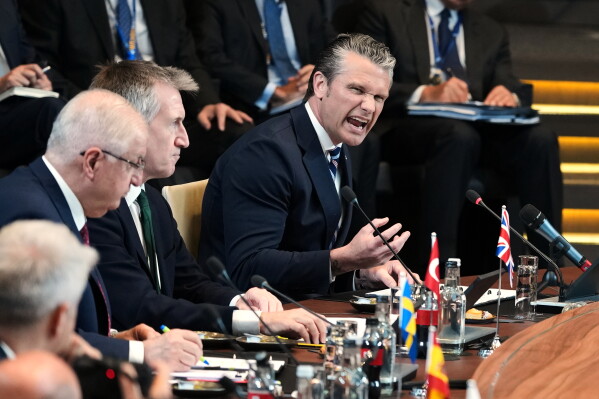
In Brussels, after U.S. Defense Secretary Pete Hegseth criticized NATO allies and initiated a Pentagon review of their performance, European leaders evaluated their progress on security matters. Hegseth’s comments highlighted areas they were already addressing, such as increased defense spending and investment in military industry to enhance equipment production. They are also utilizing lessons from the war in Ukraine, focusing on drones, air defense systems, and long-range weapons.
At the recent summit, leaders discussed efficient use of EU funds and reducing red tape to expedite purchases. They deliberated on improving ‘military mobility’ for quicker deployment of resources and upgrading ports and airports. The consensus emphasized the need to bolster Europe’s defense readiness by 2030, a goal established following Russia’s invasion of Ukraine in 2022. Intelligence reports suggest a potential threat from Russia elsewhere in Europe by the decade’s end, especially if Ukraine falls. At present, Russia is accused of sabotage and misinformation across Europe.
Approximately two-thirds of EU nations are part of NATO. The uncertainty from the Trump administration has further encouraged them to pursue independence in defense. Hegseth’s review adds an unexpected layer. He attended few NATO meetings and left the recent gathering of defense ministers early. However, his speech in February 2025 and his recent address left a mark. He labeled NATO as a ‘paper-tiger,’ criticized allies for failing past tests set by President Trump, and expressed dissatisfaction with their focus on gender equity and climate policies. He tied U.S. military presence in Europe and investment in NATO to allies’ performance.
Hegseth’s statements raised concerns. Rachel Ellehuus from the United Services Institute described it as ‘protection racket framing,’ undermining NATO unity and trust in U.S. commitments. The review’s details remain unclear, aimed at pushing NATO towards European leadership in defense.
The review is expected to last up to six months, possibly less, involving U.S. military leadership, Congress, and NATO allies. Outcomes could influence U.S. financial contributions to NATO, reflecting allies’ urgency in spending. Hegseth expressed the need to ensure adequate basing and overflight arrangements for U.S. military operations in Europe.
NATO Secretary-General Mark Rutte mentioned the lack of clarity on the review’s outcome, stressing cooperation wherever possible. More might be learned during his Washington visit next week. Rutte noted that allies are performing well despite the possibility of further improvement. He reported a nearly 20% increase in defense spending by Europe and Canada in 2025 compared to 2024.
The focus is on transforming this financial input into military assets. Last year’s summit saw allies commit to raising military budgets to U.S. GDP levels, a move that pleased Trump. However, the review casts doubt on the forthcoming summit in Turkey.
Despite challenges, European military commands are gaining prominence within NATO, and allies lead support efforts for Ukraine. Many allies spend significantly on U.S. air defense systems to bolster Ukraine, viewing the conflict as a European threat. Experts argue that strategic positioning should be based on threat assessments and planning, not as punitive measures. Ellehuus highlighted that U.S. security commitments should not have a price tag, as such framing weakens allies amid efforts to address threats and signals costs to adversaries.