
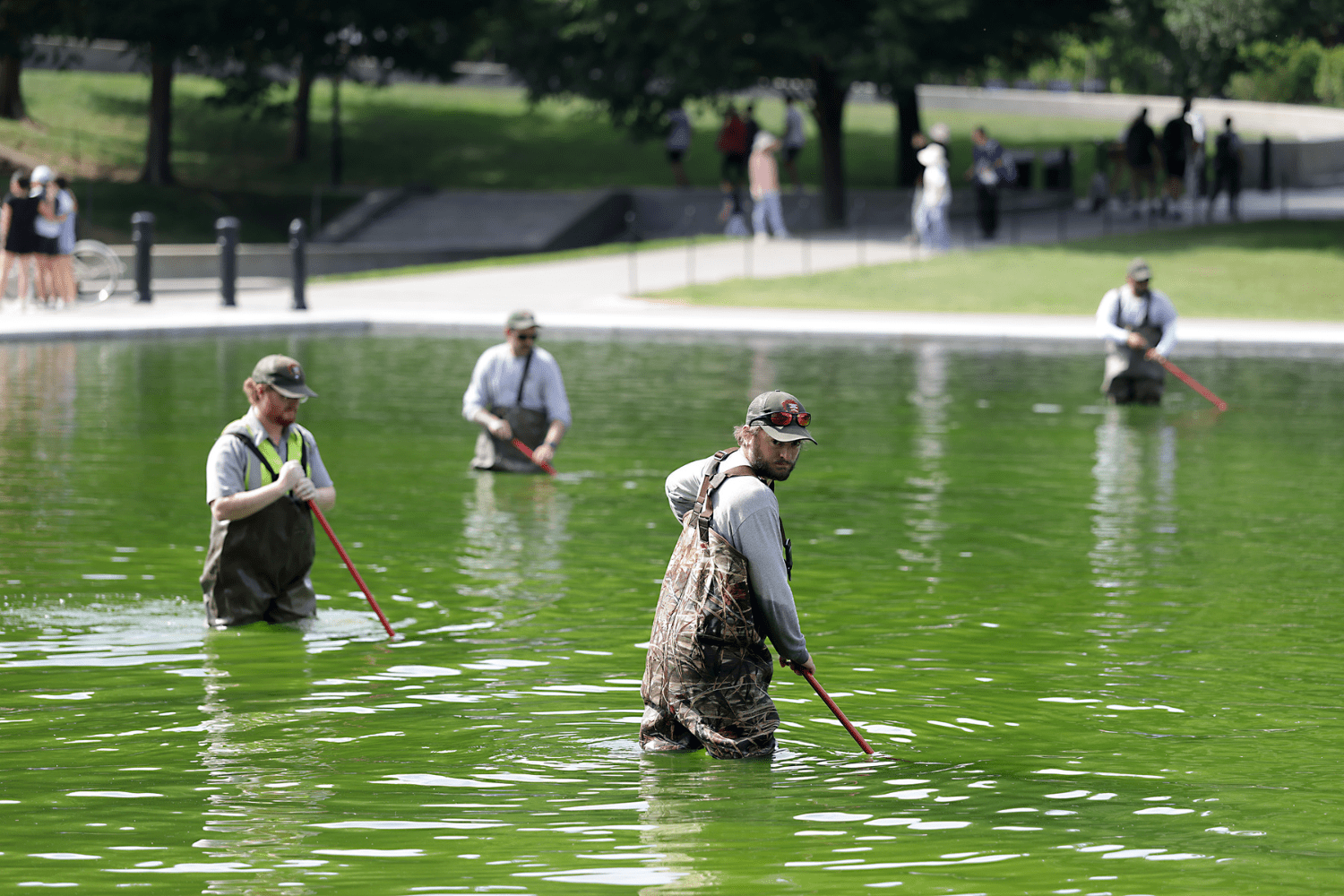
The Lincoln Memorial Reflecting Pool underwent a multimillion-dollar renovation aimed at giving the landmark a deeper “American flag blue” finish. However, an unintended consequence has emerged: the water now appears green.
Recent images reveal algae spreading across the pool’s surface shortly after it was refilled. This raises questions about whether the redesign has created conditions that favor rapid blooms.
The renovation was ordered by President Donald Trump as part of efforts to revamp the National Mall for the U.S. 250th anniversary. The century-old pool was resurfaced with a dark blue coating to improve its appearance and seal leaks. Though Trump initially suggested project costs between $1.5 million and $2 million, federal records show contracts reaching approximately $14 million.
The work was awarded through a no-bid contract, raising scrutiny and leading to a lawsuit from The Cultural Landscape Foundation. The foundation argues the changes were made without the necessary historic review.
A Historic Pool with Persistent Algae Issues
Stretching over 2,000 feet between the Lincoln Memorial and the Washington Monument, the reflecting pool has been a significant feature of Washington, D.C. since 1923. Algae blooms have historically been a challenge due to the shallow, slow-moving water, often appearing green during summer due to heat, sunlight, and stagnant conditions.
Despite major upgrades, the issue persists. In 2012, a $34 million renovation saw algae return within weeks, prompting crews to clean it again and recalibrate the water treatment system. Algae rapidly returned post-renovation.
Reasons for Algae Appearances
1. Residual Algae from Renovation
An Interior Department spokesperson reported that the current algae is “residual”, due to supply lines sitting dormant for eight weeks during construction. This suggests part of the bloom might be a post-renovation effect rather than a new issue.
2. Darker Coating Impact
The darker blue coating, applied days before refill, is under debate. Dark surfaces absorb more sunlight and heat, potentially raising temperatures and promoting algae reproduction. Alla Silkina, an expert in algal biotechnology, noted dark surfaces might contribute to conditions favoring growth, though nutrient availability and water dynamics play crucial roles.
“Dark surfaces can absorb solar radiation and increase local water temperatures,” Silkina stated, which might create favorable growth conditions, given the right nutrients and species composition.
3. Weather Influence
Weather conditions may also impact growth. Warm temperatures, strong sunlight, and still conditions encourage algae growth, particularly in shallow waters like the reflecting pool.
“Light serves photosynthesis energy while temperature affects metabolic and growth rates,” Silkina continued. Enhanced light penetration and warmer temperatures in shallow water typically promote faster growth, assuming nutrients are available.
4. Water Flow and Infrastructure
Reports also mention longstanding infrastructure challenges beneath the pool, particularly with circulation and aging pipes. Reduced water movement or filtration heightens stagnation, aiding algae accumulation.
“Water circulation can reduce bloom development,” Silkina emphasized. Continuous mixing prevents algae buildup; visible blooms are less likely in well-circulated waters.
Green Appearance Explained
Chlorophyll, the pigment algae uses for photosynthesis, causes the green color. As algae multiply, they change how light is absorbed and reflected, overpowering the blue coating to appear green.
Silkina noted that the visual change can occur rapidly under suitable conditions. “Algal populations can double within hours to days,” she said. Blooms may become visible within days to one or two weeks, depending on environmental factors.
Speculation and Unproven Claims
Some social media users speculate, without proof, the situation may involve purposeful interference. These claims lack support.
Figures like radio host Grant Stinchfield suggested possible sabotage by Democrats. Author Juanita Broaddrick commented on social media about supposed sabotage. However, there is no public evidence supporting these claims or any foul play indicated by officials.