
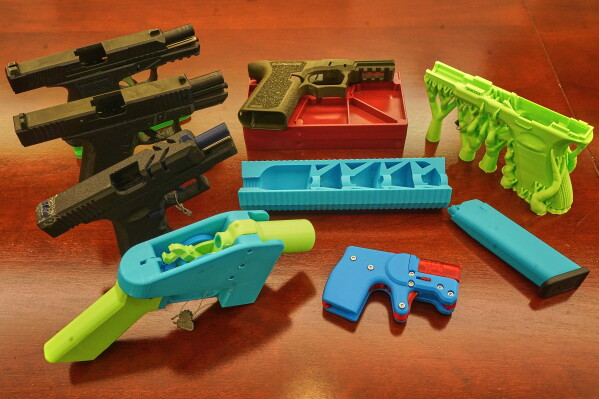
A groundbreaking law in New York may require 3D printers sold for residential and commercial use to include technology that prevents them from creating firearms. This initiative, also under review in California, aims to combat the production of untraceable ‘ghost guns’ involved in criminal activities. However, there is skepticism about the technology’s effectiveness and potential impacts on privacy and constitutional rights.
Approximately one-third of U.S. states have already implemented measures to ban or regulate DIY firearms without serial numbers that bypass federal background checks. The distinctive aspect of New York’s law is that it focuses on the equipment for manufacturing firearms, not the individuals who make them. By advocating for blocking technology in two of the country’s largest states, new standards for 3D printers could be established. This move might inspire other Democratic-led states to enhance their gun regulations, which often include bans on certain semiautomatic weapons and measures for temporarily confiscating guns from those deemed a threat.
Increase in 3D Printer Usage in Crimes
The use of three-dimensional printers has grown over the years. Since 2012, the global number of 3D printers surged from around 30,000 to over 3 million, with industry value increasing from about $2 billion to $26 billion annually, according to Bill Decker of the Association of 3D Printing. Although high-end models are expensive, some 3D printers are available for a few hundred dollars. These devices can produce toys, prosthetic limbs, airplane components, and firearms or parts required for assembly using online digital designs.
Firearms crafted with 3D printers are increasingly linked to criminal activities, as noted by a U.S. Department of Justice report from the previous year. The number of privately made guns recovered in crimes jumped from around 1,600 in 2017 to nearly 27,500 in 2023. While the report does not specify the number from 3D printers, a high-profile New York case involved the suspected use of a 3D-printed gun to kill UnitedHealthcare’s CEO in 2024.
Preventing Gun Production with Printer Technology
A New York law enacted recently and a pending California bill would assign expert panels to develop standards for firearm blueprint detection algorithms. These would scan all 3D printer designs and compare them to a firearm parts database, rejecting those that match. Although the study process starts now, the requirement for printers to include this technology would begin in 2029 or later in New York, depending on the feasibility.
This concept resembles a smartphone app that identifies plants from images, explained Solomon Diamond, an engineering professor at Dartmouth College. A possible solution involves geometric analysis of shapes, dimensions, and structural features to reject designs resembling firearm parts. According to Julian Chultarsky of Physna, geometric search technology is mature and ready for application in this area.
Challenges in Implementing the Technology
The Association of 3D Printing supports the legislation but doubts its efficacy. Skeptics like Bill Decker believe criminals will find alternative methods to produce guns, such as altering designs or using different machines. Rory Mir of the Electronic Frontier Foundation highlights potential issues with over-blocking, suggesting that benign items could be misidentified as gun parts. Privacy concerns also arise with cloud-based AI search processing of print instructions, risking exposure of personal and proprietary creations.
Debate on Right to Manufacture Firearms
Gun safety advocates argue that 3D printers provide a means for those prohibited from legally purchasing firearms, like minors or felons, to obtain them. According to Everytown for Gun Safety, 11 states have outlawed 3D-printed guns, while six others demand serial numbers. Blocking their production could deter violations of such laws.
Samuel Levy from Everytown regards 3D printing as a crucial area in combating ghost guns. The NRA, however, opposes the policy, dismissing claims over homemade firearms and citing historical American traditions. John Commerford of the NRA warns that these measures hinder law-abiding citizens from participating in constitutionally sanctioned activities.