
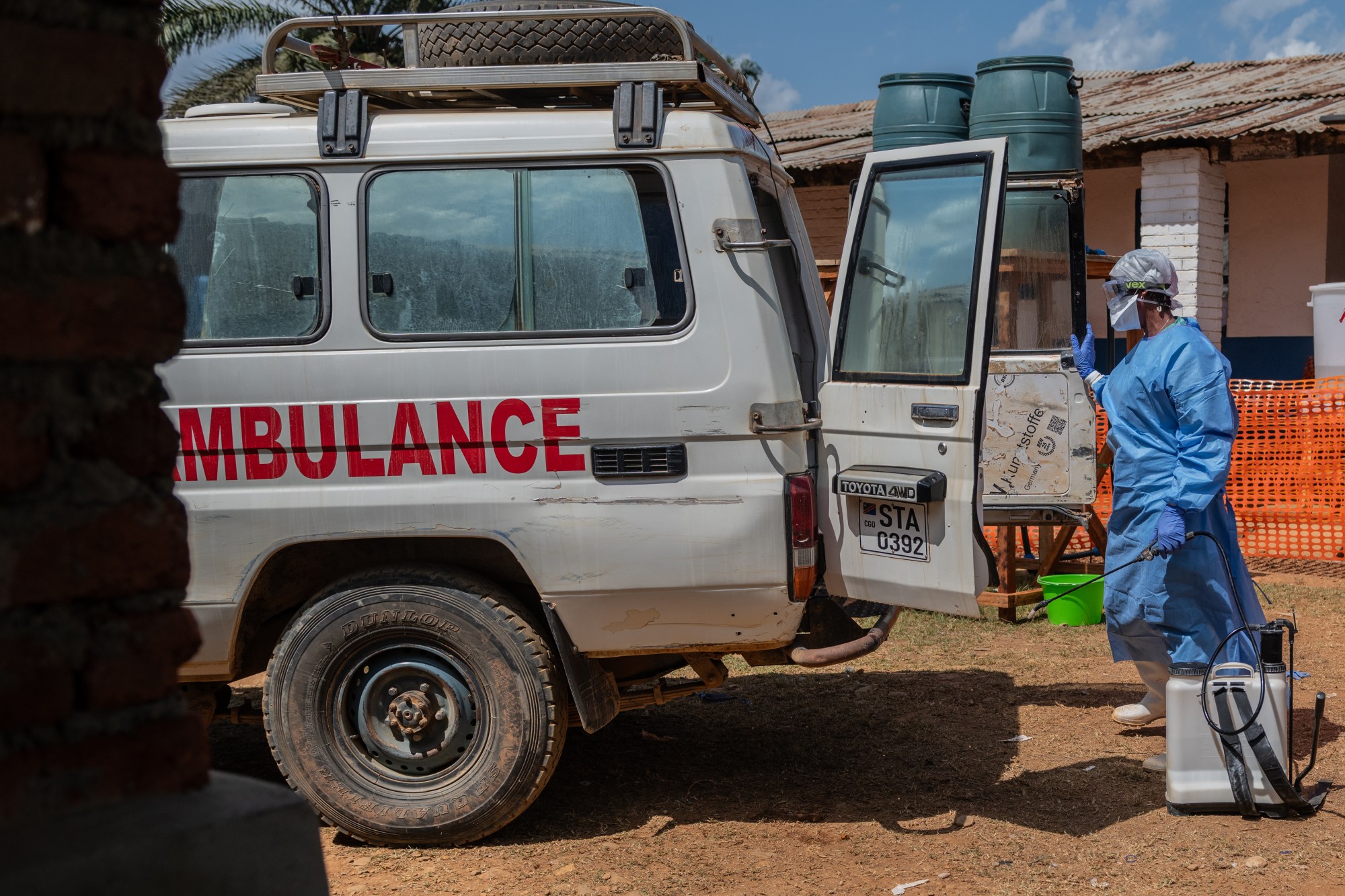
A health worker disinfects an ambulance at the Mongbwalu treatment center that transported a suspected Ebola patient in Congo.
The Democratic Republic of the Congo and Uganda are currently dealing with an Ebola outbreak caused by the Bundibugyo virus. To date, there have been 617 confirmed cases resulting in 117 deaths. The Trump administration’s proposal for a quarantine and treatment facility at a U.S. military base in Kenya for American citizens exposed to the virus is controversial.
Healthcare experts in the U.S. express concerns about the policy, stating it involves complex clinical, ethical, operational, and legal issues. The situation recalls the West African outbreak from 2014 to 2016, where there were over 28,000 cases and 11,000 deaths, marking a fatality rate of 39%.
Previously, during the 2014 outbreak, the federal government implemented screening at international airports to prevent the spread in the U.S., which was effective in containing the spread. There were four confirmed cases in the U.S. at that time, resulting in one death. Advanced medical facilities established then remain available to manage and treat infected individuals today.
Currently, the U.S. public health system faces challenges due to a reduction in aid and dismantling of infrastructure over the past year and a half. The U.S. Agency for International Development has reduced operations in the Congo, and the Centers for Disease Control and Prevention (CDC) faces budget and oversight constraints.
Infectious diseases can spread globally, and containment at the source is crucial. While the CDC has staff in Congo, efforts are less comprehensive compared to a decade ago. The U.S. has also withdrawn from the World Health Organization, impacting global health efforts.
The ongoing Ebola outbreak poses a risk, potentially spreading beyond central Africa due to global travel. Events like the FIFA World Cup increase this risk. Airport screening alone is insufficient, as suppressing symptoms might allow infected individuals to travel.
Critical to addressing the outbreak are containment efforts at its origin. The disease’s transmission requires physical contact, and while airborne risk is negligible, it is not zero. Mitigation strategies focus on stopping the virus at its source.
Risk-based security illustrates how resources should target significant risks. Containing Ebola where it originates protects global health effectively. Responding to the outbreak requires identifying risks and directing resources to reduce their impact.
Sheldon H. Jacobson, Ph.D., is a Computer Science professor at the University of Illinois Urbana-Champaign, specializing in risk-based aviation security. Janet A. Jokela, MD, MPH, is a public health physician and clinical professor at the Carle Illinois College of Medicine, serving on the Illinois Immunization Advisory Committee.