
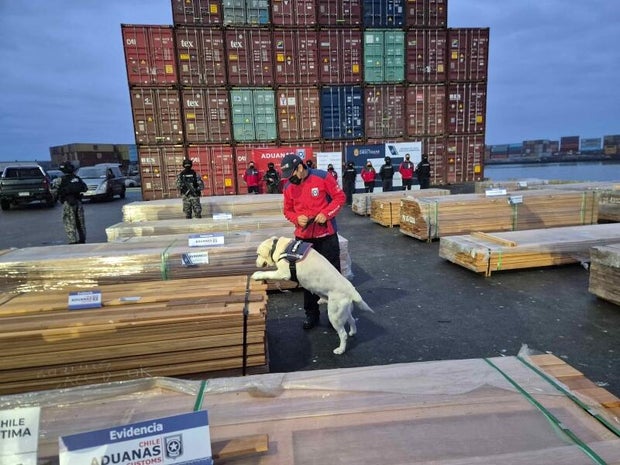
On Monday, Chilean authorities announced a significant interception of over 1,000 tons of drugs concealed within lumber shipments bound for Europe. The success of this operation was largely attributed to the effective efforts of canine teams, marking a monumental achievement for the nation.
The Customs Bureau released a statement highlighting the collaborative efforts of the prosecutor’s office, maritime police, and customs. Together, they seized 1,080 tons of wood contaminated with various drugs. This operation represents a significant blow to organized crime within Chile.
The confiscated drugs comprised mostly of cocaine and ketamine. They hold an estimated street value of $8.3 billion in European markets. Vice Adm. Arturo Oxley noted the significance by stating that this value rivals a century of the country’s budget.
The bureau explained that these illicit substances are often destined for over a dozen international markets, including the United States. The discovery was credited to canine teams and advanced technologies. The agency shared images of sniffer dogs beside the seized timber.
In a statement, National Director of Customs Alejandra Arriaza emphasized the continuous training of the staff and the critical role played by the canine units throughout the nation. She acknowledged the resources and tools provided by Customs and other institutions as key to achieving such results.
The operation stemmed from a six-month investigation. Authorities pinpointed 45 containers arriving from Bolivia with the contaminated lumber. Had the cargo reached its destinations, extracting the drugs would have required advanced chemical processes in specialized laboratories.
Customs officials indicated that the total cash might increase as further suspicious containers undergo examination.
As a point of comparison, in April, Brazilian police in Rio de Janeiro also seized a record 48 tons of drugs, discovered incidentally by a sniffer dog named Hulk.
Key Topics: Chile, Drug Trafficking, Cocaine