
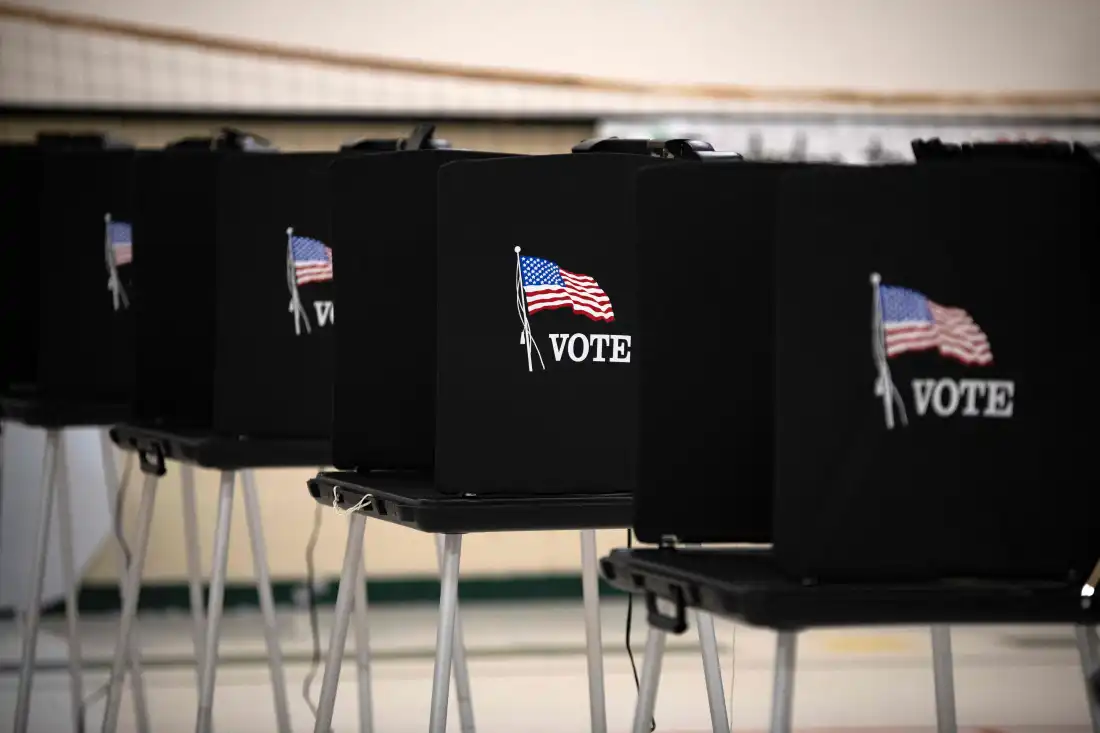
Voting booths were visible at Glass Elementary School’s polling location in Eagle Pass, Texas, on November 8, 2022, as recorded by Mark Felix for Getty Images. Efforts continue to modify how the president is elected in the United States. A national initiative aims to ensure that the winner of the popular vote gains the presidency.
The National Popular Vote Interstate Compact could expand significantly soon. Strong Democratic outcomes in recent midterm elections influence this advancement. Next year, five states under complete Democratic control might join this compact. The agreement obligates states to allocate their presidential electoral votes to whoever wins the popular vote nationwide.
Currently, 18 Democratic-led states and Washington, D.C., are part of this compact. Should these additional states join, the initiative will likely surpass the 270 electoral votes needed to override the Electoral College. Republican states have yet to participate, and opinions differ within the party on this issue.
Challenges remain, both political and legal. However, proponents are hopeful these barriers will clear, possibly before the next presidential election. Patrick Rosenstiel, a senior consultant with National Popular Vote, expressed confidence. Citing Pew polling, he remarked, “I’ve never been more confident that 63% of American voters can get what they want in the 2028 presidential election.”
Presently, the compact holds 222 electoral votes. Arizona, Pennsylvania, Michigan, Nevada, and Wisconsin will soon be under complete Democratic control, collectively contributing 61 electoral votes. Governors in Pennsylvania and Nevada are open to the compact, while other states remain undecided.
Some states face decisions about losing influence in presidential elections if they proceed with joining the compact, particularly as they are key battlegrounds.
Legal concerns arise over the compact’s compliance with the Constitution’s compact clause. Professor Norman Miller from Willamette University highlights practical issues, emphasizing the decentralized nature of U.S. presidential elections. Each state uniquely manages voting processes. Enforcing uniformity could provoke tension among states.
Miller suggests a constitutional amendment might better address these reforms than bypassing the Electoral College, arguing essential systemic changes should involve broad processes. He stresses the importance of legal amendments to handle challenges in implementing a national popular vote.
Past efforts to amend the Constitution in 1969 to eliminate the Electoral College failed. Successful amendments are rare. Rosenstiel comments that many Americans see Electoral College as problematic and seek innovative solutions. A national popular vote could encourage candidates to appeal broadly, moving beyond selective battleground states. It might also enhance voters’ sense of participation in the electoral process.
Rosenstiel states, “We should have a system where every American citizen feels valued and is valued when they cast their vote.” A national popular vote, he supports, is the way to achieve this.