
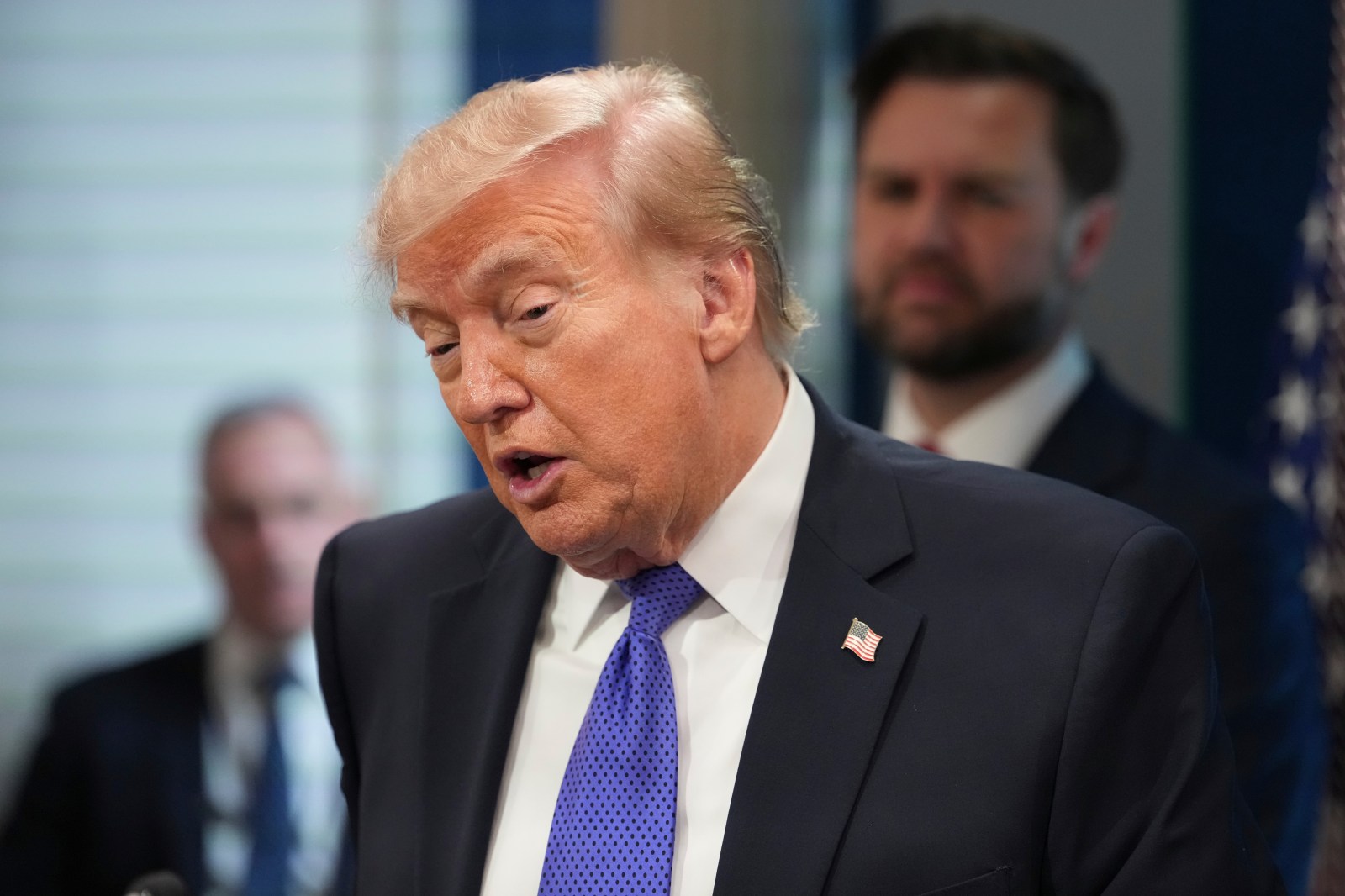
President Donald Trump mentioned Friday that his administration could achieve more after Democrats take control of Congress in January. Trump spoke at a press conference shortly after returning from a four-day visit to Asia, where he met with leaders including Chinese President Xi Jinping and Russian President Vladimir Putin and participated in the Asia-Pacific Economic Cooperation summit. In addition to discussing the trip, he addressed domestic politics, the incoming Democratic-controlled Congress, recent technology issues, and other topics concerning his administration.
Although Trump has previously expressed disappointment over Republican midterm losses and claimed the party would have won had he been on the ballot, he has indicated readiness to collaborate with Democrats once they assume control. When questioned about the incoming Democratic leadership, with U.S. Representative Hakeem Jeffries expected to become House speaker and Senators Chuck Schumer and Chris Van Hollen contending to lead Senate Democrats, Trump stated he has been communicating with Democrats ahead of the transition.
Despite the potential for two years of a divided government, Trump suggested that the change in congressional power could foster more negotiations. He remarked his ability to veto Democratic bills might eventually lead both parties to work together. “So, they’re going to send things my way, and I’m going to veto them,” Trump said. “And they’re going to send more things and I’m going to veto them. They could go two years and one month, because that’s what we have, but I think, after a month or so, they’re going to send things, and I’m going to say I’m going to veto unless you want to do this and this and this.”
Trump praised both Jeffries and Schumer as intelligent individuals. Newsweek reached out to Jeffries’ and Schumer’s offices for comments on Friday afternoon. “If they want to get things done, I want to get things done, too,” Trump said regarding the Democratic majority. “There are those that say we might get more done because we had some Republicans that were just impossible to deal with.”
Trump specifically highlighted disagreements with Thomas Massie, the Kentucky Republican who often opposed the administration before losing this year’s Republican primary to a Trump-endorsed candidate, Ed Gallrein. However, Massie was not the sole Republican who disagreed with Trump. GOP legislators have occasionally conflicted with the president on matters like judicial nominations and requests for more transparency regarding files linked to convicted sex offender Jeffrey Epstein, underlining some of the intraparty tensions Trump encountered even when Republicans managed Congress. Most recently, Republican Senator John Cornyn of Texas blocked one of Trump’s judicial nominees, emphasizing the occasional conflicts within the GOP.
Despite these splits, Trump sounded hopeful that the change in congressional leadership could allow for new talks and potentially enable his administration to reach agreements with Democrats. “Because of the power of the veto, there’s a real chance that we’re going to accomplish a lot, especially in healthcare,” Trump noted. “I’m open to robust healthcare. Can it be what they want? No. But it could be a mix of what we all wish for, and we could end up with a successful healthcare system in our country.”
Healthcare is anticipated to be a priority for the incoming Democratic majority. Jeffries has stated that Democrats perceive affordable healthcare as a right and plan to focus on reducing costs, safeguarding access to coverage, and fortifying the healthcare system. This issue was also a key theme for Democratic candidates in competitive House races during the midterm elections.
One area where Trump has observed bipartisan support is the Motion Picture, Television, and Entertainment Revitalization Act, a bipartisan proposal aiming to provide a federal tax incentive to stimulate film and television production in the United States. The legislation was introduced by a bipartisan group comprising Democratic Senator Adam Schiff of California and Republican Senator Tim Scott of South Carolina. “I am witnessing substantial bipartisan backing,” Trump commented.
Immigration could serve as another test for Trump’s willingness to form compromises with the incoming Democratic majority. Despite prioritizing immigration enforcement as a central issue of his presidency, Trump has lately shown a willingness to collaborate with Democrats on broader immigration legislation, including a possible agreement for some undocumented immigrants who have resided and worked in the U.S. for years.
What Happens Next
Democrats still need to complete several steps before taking Congress in January, such as finalizing their leadership teams as Schumer and Van Hollen vie to lead the new Senate majority. Once the new Congress convenes, it remains uncertain if Trump’s optimism about bipartisan negotiations will result in agreements on issues like healthcare and immigration or lead to two years of legislative standstill.