
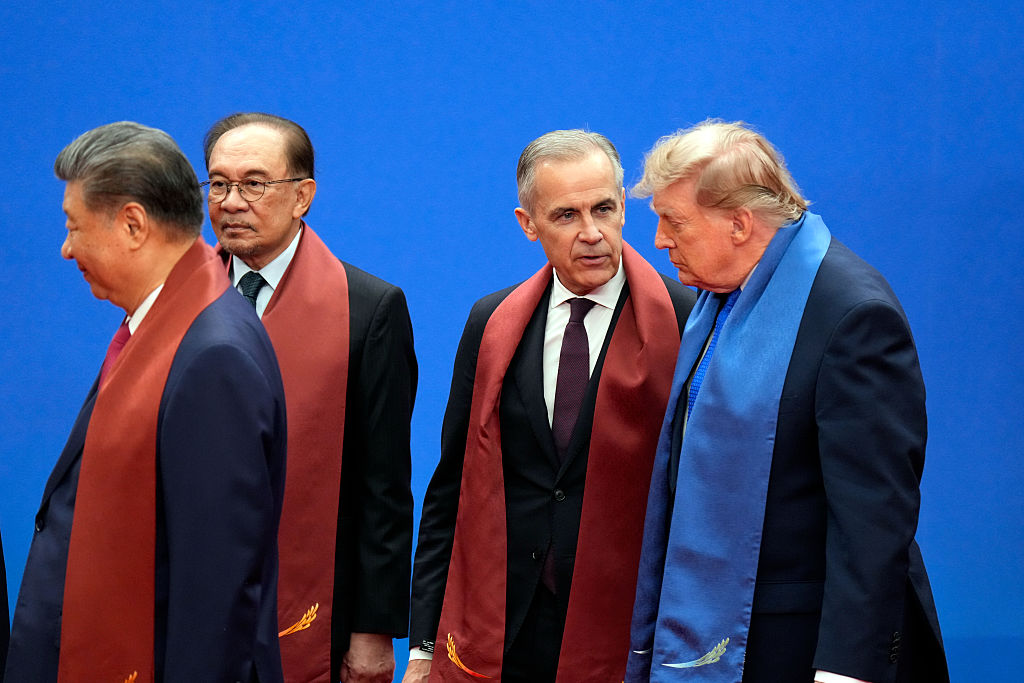
Canadian Prime Minister Mark Carney is focusing on enhancing trade relations with China to lessen dependence on the U.S. This comes during a prolonged trade conflict with the U.S. Carney emphasizes Canada’s position as an attractive trading partner, stating, “Our cards are that everyone else in the world wants to deal with us.” He made these remarks during a remote interview from Shenzhen, China, at the Asia-Pacific Economic Cooperation (APEC) summit.
The comments follow U.S. President Donald Trump’s claim that the U.S. holds the advantage in trade talks after negotiations failed in August, resulting in heavy tariffs from both sides. Carney met with Trump during the APEC summit. Although they agreed to continue negotiations, no progress was noted. In contrast, Carney described his meeting with China’s President Xi Jinping positively, highlighting a new trade pact that provides tariff relief for Canadian exports to China. In return, Canada extended tariff exemptions for some Chinese steel and aluminum products by two years.
Carney’s “Canada Strong” platform aims to strengthen domestic economic resilience. The expanded trade arrangement with China promises “greater certainty and prosperity for all Canadians.” He praised the negotiation process with China as professional and direct. Carney’s trip took him from a European summit in Ireland to the Philippines, Cambodia, and finally China for the APEC gathering, as part of his strategy to reduce economic reliance on the U.S.
Experts indicate that Canada’s growing economic ties with China could challenge Trump’s assertion of U.S. dominance in trade negotiations.”Lori Turnbull, a professor at Dalhousie University, remarked, “China represents a very big market and the potential of a really big trading partner.”
Carney’s initiative to reinforce trade ties with Beijing is part of a larger effort to renew Canada-China relations. In January, he met with Xi to establish a “new strategic partnership,” which led to lower tariffs on Canadian agricultural products like canola seeds.
While Canada’s closer relationship with China might boost its negotiating position, it could also backfire. Turnbull notes that agreements like tariff exemptions on Chinese steel and aluminum might cause friction with Washington. Steel and aluminum tariffs were significant points of contention when U.S.-Canada trade talks collapsed in August.
Despite concerns, Carney downplayed issues over Canada’s ties with China, stating after meeting with Trump, “In his hierarchy of issues, it’s not the top issue at all.” Some Canadian officials expressed caution. Ontario Premier Doug Ford warned against increasing Chinese EV imports, emphasizing protection for Canadian auto workers.
In 2025, Ottawa identified China as a major source of foreign interference and espionage against Canada. Carney said he addressed concerns about foreign interference with Xi during his Asia trip, stressing the importance of non-interference. Canada’s trade with China mainly involves commodities rather than sensitive technologies like semiconductors.
Experts suggest Canada could deepen cooperation with other international partners in areas where a closer relationship with China would be challenging, such as defense and advanced technology. In September, the European Union proposed making Canada an “associate member” of the bloc, offering potential collaborations in AI, energy, and other critical sectors.
Carney’s push to diversify Canada’s economic partnerships was evident during the Association of Southeast Asian Nations (ASEAN) summit in Manila. There, Carney announced two free trade agreements: one with the ASEAN bloc and another with the Philippines, aimed at increasing exports up to three times by 2035.
Carney has consistently stated Canada will reject any U.S. deal that undermines its auto industry. He highlighted China’s competitive edge in electric vehicles during an interview, indicating a willingness to consider Chinese automakers if U.S. negotiations falter. While he acknowledges challenges in shifting supply chains, Carney maintains the importance of exploring all trade opportunities.
Experts warn of practical challenges if Canada partners with Chinese automakers due to the deeply integrated North American automobile industry. Carney noted the significant integration as auto parts cross the U.S.-Canada border multiple times before final assembly.
Some Washington officials, including White House trade adviser Peter Navarro, criticized Carney’s openness to Chinese automakers. Despite the criticism, experts believe Canada considering Chinese manufacturers could offer negotiation leverage with Washington, emphasizing U.S. concerns about Chinese competition. “If the U.S. wants to keep China out, partnering with Canada is a way to do that,” said Lori Turnbull.