
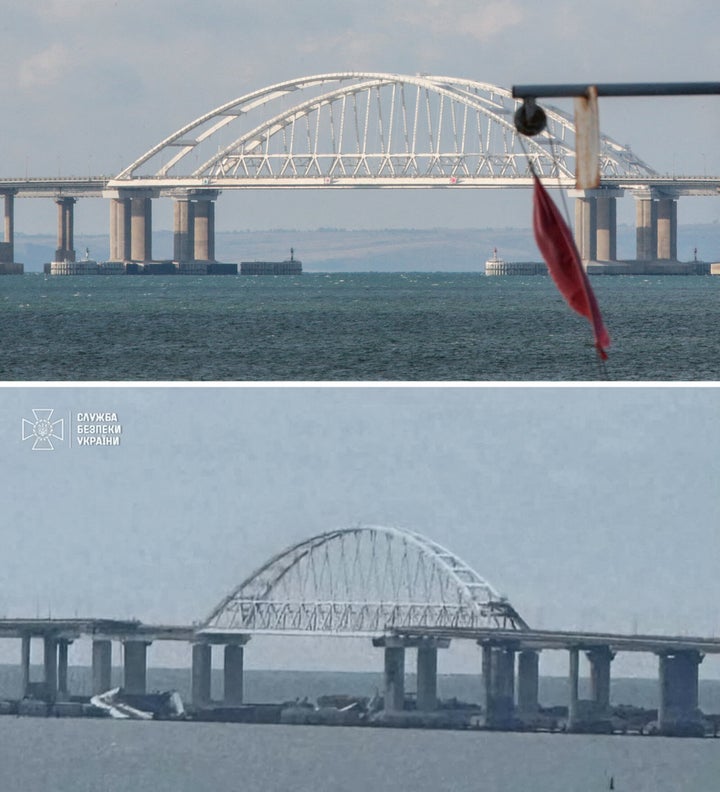
On Tuesday, Ukrainian drones and missiles destroyed the central road section of the bridge connecting Russia with Crimea. This attack marked a significant military and symbolic action against President Vladimir Putin, occurring just two days before his scheduled meeting with Chinese and US leaders.
The bridge’s main road section crumbled into the sea, leaving a gap. Ukrainian President Volodymyr Zelenskiy shared images and videos showing the damage. He remarked on Russia’s continuous targeting of Ukrainian infrastructure, including bridges, and emphasized that the war tends to return to its origins.
The bridge spans 19 kilometers (12 miles) and was a major project for Russia, inaugurated by Putin in 2018. It symbolizes Russia’s claims over Crimea, which it annexed from Ukraine in 2014. The timing of the attack was problematic for Putin as he prepared for discussions on the Ukraine war with the US and China’s leadership in Shenzhen.
Zelenskiy mentioned the strike followed a comprehensive operation that dismantled Russian defenses, including air defense systems and electronic warfare capabilities.
Sergei Aksyonov, the Russian-appointed governor of Crimea, reported two casualties and a suspension of road traffic. Rail services resumed partially after a brief halt.
In his response, Putin’s spokesperson Dmitry Peskov stated there would be a repair plan to reconstruct the bridge stronger than before. However, Russian military analysts suggested that repairing the bridge during the ongoing conflict might be challenging due to Ukraine’s capacity for further assaults.
The bridge was a crucial supply route for Russian forces in Ukraine. Now, the military depends more on a land corridor through parts of eastern and southern Ukraine captured after starting a full-scale war in 2022. Russian Deputy Prime Minister Marat Khusnullin noted that a government commission had convened to assess the damage, initiate repairs, and plan alternative transport routes to Crimea.
Impact on Shipping
The bridge crosses a channel critical for commercial shipping, especially grain exports from the Sea of Azov region. While Black Sea grain shipments have mostly halted due to escalating drone attacks, export infrastructure remains relatively undamaged, allowing for quick resumption if security stabilizes.
According to Andrey Sizov of consultancy Sovecon, the bridge’s collapse could significantly delay shipping resumptions from the Sea of Azov, as debris in the channel would need clearing.
Ukraine has targeted the bridge multiple times during the conflict. A truck bomb in October 2022 resulted in four deaths, restricting the bridge’s capacity for several months. In July 2023, another section was destroyed, killing a couple crossing the bridge.
Largest Drone Attack
Russian state media reported the overnight attack as Ukraine’s largest drone assault yet. Russia claimed to have shot down 1,441 drones across 22 regions, surpassing a previous record. Air defenses thwarted a significant drone strike on the industrial areas of Ufa and Salavat in Bashkortostan, a region with multiple oil refineries. Ukraine announced it had targeted a refinery and petrochemical plant in Salavat.
Moscow’s Mayor Sergei Sobyanin noted that approximately 800 Ukrainian drones targeted the Moscow region, with 321 downed on their way.
The frequency and size of Ukrainian drone attacks increased as both nations have focused on a war of attrition, targeting each other’s strategic infrastructure.
Despite US-brokered peace discussions in Abu Dhabi—the first in nine months—and separate meetings between US representatives and the leaders of Russia and Ukraine, the conflict continues. Last week’s talks resulted in an agreement on a major prisoner exchange, but substantial issues like territorial disputes saw no resolution. Russia continues to hold about a fifth of Ukrainian territory, although the front lines have mostly remained unchanged.
Attacks on Kyiv Bridges
In Kyiv, witnesses reported loud explosions overnight. The city’s mayor, Vitali Klitschko, confirmed that Russian strikes targeted North and South bridges, a claim later verified by Moscow. These attacks also damaged the metro system, resulting in power and water outages, as well as transport restrictions.
Russian overnight strikes on Ukrainian energy infrastructure left regions without power in eight areas, according to Deputy Energy Minister Artem Nekrasov.
Russia stated that its forces attacked multiple targets including transportation, military, and energy facilities in Kyiv, Zaporizhzhia, Cherkasy, and Dnipropetrovsk, as well as port infrastructure and a cargo ship. Reuters could not independently verify these reports, and both sides deny deliberately targeting civilians.