
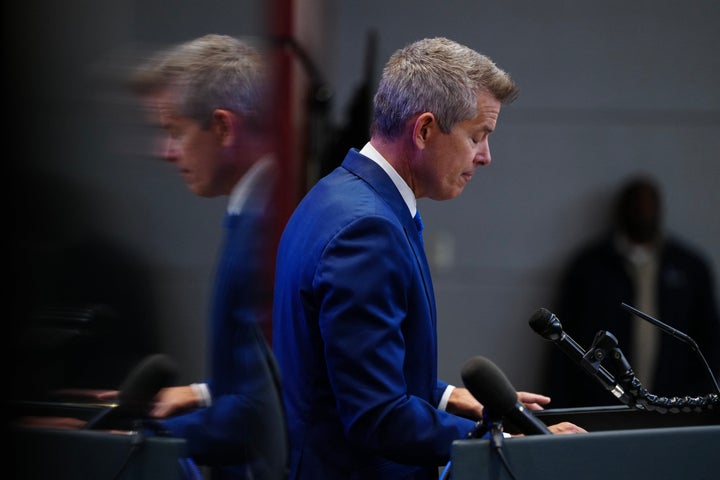
Transportation Secretary Sean Duffy is under scrutiny following his handling of a recent nationwide ground stoppage. In an interview on CNBC’s “Squawk Box,” Duffy deflected a question about his vote against a transportation funding bill that would have allocated $10 billion to the Federal Aviation Administration (FAA) back in 2019.
When asked about the vote, Duffy responded, “I’ve seen those articles. I supported all FAA funding reauthorizations.” He clarified that the 2019 vote was part of a broader proposal, not solely for the FAA.
The bill, known as the Transportation, Housing and Urban Development, and Related Agencies Appropriations Act, had cleared the House but didn’t pass in the Senate. It aimed to fund the FAA’s research, development, and air traffic organization activities. Duffy, who did vote for FAA funding reauthorizations in 2011, 2014, and 2018, has not publicly explained his stance on the 2019 bill.
The secretary’s recent handling of an airspace shutdown has attracted criticism. The incident led to massive flight cancellations and stranded passengers, which Duffy attributed to an error during an upgrade at an air traffic location in El Dorado, Arkansas.
Instead of addressing the current issues directly, Duffy has blamed outdated systems from the previous administration. He is advocating for $50 billion to modernize the FAA’s infrastructure. However, Democrats argue that a recent legislation already provides $12.5 billion over three years for upgrades, with $4.75 billion earmarked for telecommunications infrastructure improvements.
Duffy revealed that a third of the modernization budget has been spent. This has led top Democrats overseeing aviation to request a detailed explanation of the financial needs for further funding.
“Congress approved $12.5 billion for essential safety upgrades to air traffic control systems. The administration obligated $4.3 billion but spent only $1 billion, leaving $8 billion unobligated and $11 billion unspent,” the statement read.
Duffy, along with FAA and DOT employees, was scheduled to brief Congress, addressing these financial concerns. The situation underscores the ongoing debate over the allocation and effectiveness of funding for the aviation sector’s infrastructure and safety improvements.