
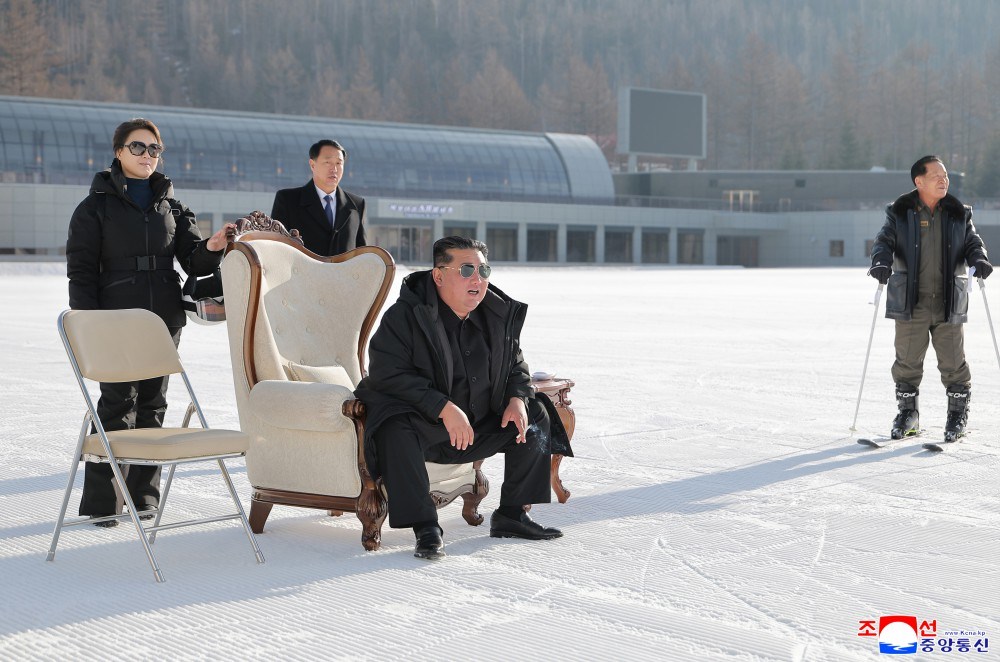
Shortly after U.S. President Donald Trump’s departure for Asia, North Korean state media showcased photos of Kim Jong Un enjoying time at a ski resort close to the Chinese border. These images portrayed Kim in a leather armchair, cigarette in hand, as he watched his daughter, Ju Ae, ski downhill without protective gear. This family outing, labeled as a visit to a new tourist site, could potentially be cut short.
Trump has hinted that Kim might participate in the upcoming APEC summit in Shenzhen, although he noted this decision is “up to President Xi.” By the following day, Russia indicated that President Vladimir Putin might engage with Kim if he attended.
“Tough subject because it’s very hard for any of us to say we’ll get rid of our nukes, right?”
However, the new North Korean resort lies far from Shenzhen. A researcher from a Seoul think tank reported no indications of summit preparation. South Korean Foreign Minister Cho Hyun also minimized prospects of a Kim-Trump summit.
Still, there are signals Kim might appear. If he does, nuclear weapons will likely dominate discussions between him and Trump. Historically, Trump nicknamed Kim “Little Rocket Man” due to North Korea’s nuclear advancements. According to Mike Pompeo, the former Secretary of State, Kim had previously objected to the term “Little,” preferring “Rocket Man.”
The Stockholm International Peace Research Institute (SIPRI) estimates Kim has assembled about 60 nuclear warheads. He possesses sufficient fissile material for at least 30 more and is accelerating production. Trump’s strategy needs revision. Instead of aiming for complete denuclearization, a realistic goal could be an interim verifiable nuclear deal limiting Kim’s arsenal growth.
Negotiating a Nuclear Pact
Currently, Washington extends invitations for discussions “without any preconditions,” yet the goal remains complete denuclearization. Secretary of State Marco Rubio reiterated this in talks with South Korea and Japan. Realistically, many acknowledge complete disarmament as a long-term goal.
President Kim has indicated willingness to negotiate if the U.S. halts demands for his disarmament. South Korea’s strategy aligns with this perspective, notwithstanding its official stance. Pursuing immediate denuclearization hinders dialogue.
Victor Cha, an influential former Bush administration official, supports a “cold peace” approach, postponing disarmament. Even Rubio, a prior critic of Pyongyang, suggests Kim seeks regime stability. A limited nuclear agreement won’t necessitate Kim surrendering warheads. Key elements like freezing fissile-material production would be integral.
This approach envisions inspectors revisiting Yongbyon and entering Kangson, alongside a declaration of all nuclear sites. A long-range missile launch ban and nuclear test prohibition further reinforce this framework.
Potential Risks
Some critics argue that recognizing Kim’s nuclear capabilities risks emboldening him. Former South Korean ambassador to Washington, Ahn Ho-young, warned it could be perceived as validating this ambition.
Nevertheless, negotiation remains viable. Acknowledging an arsenal doesn’t equate to endorsing it. The Non-Proliferation Treaty continues to recognize only five nuclear states. U.N. resolutions require North Korean disarmament.
Michiru Nishida of Nagasaki University suggests balancing public denuclearization advocacy with practical negotiations. This strategy’s core is a freeze on fissile material, benefiting Seoul, already under the threat of Kim’s short-range missiles.
The Path Forward
Limited sanctions relief accompanies verified steps toward a deal. This serves as the initial stage of a gradual freeze-reduce-dismantle strategy. In the 2019 Hanoi summit, Kim proposed dismantling Yongbyon facilities in exchange for sanction relief, which Trump rejected, seeking more precise terms for each concession.
Precision is crucial. Each diplomatic move requires clear stipulations. Undue sanction relief shouldn’t reward incomplete compliance.
Ultimately, Trump’s rapport with Kim presents both opportunity and risk. The administration must ensure meaningful progress beyond symbolic gestures. Properly structured agreements could restrict North Korea’s nuclear capabilities and enhance regional stability.