
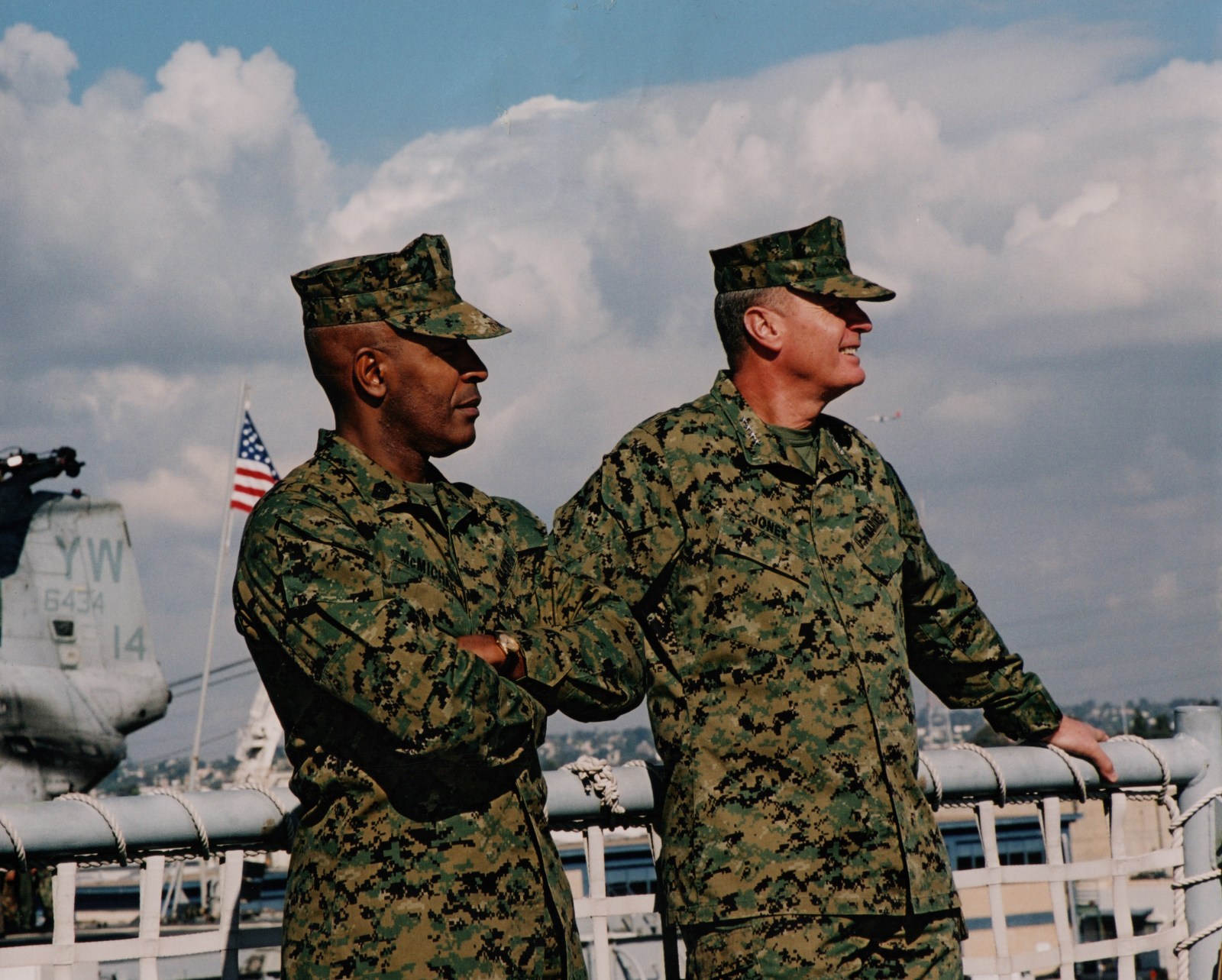
In 1999, Sergeant Major Alford L. McMichael had an unexpected encounter. After his morning run, his boss informed him that General Jones would call soon. Rather than wait, McMichael took a shower, missing the call. Upon returning, he received a life-changing offer from General Jim Jones: become the 14th sergeant major of the Marine Corps. McMichael accepted immediately, realizing a dream held by every enlisted Marine.
General James L. Jones, recently nominated as the 32nd commandant of the Marine Corps, had selected McMichael after interviewing multiple candidates. Reflecting on his choice, Jones regarded it as one of his best decisions. Both men later discussed their tenure with Newsweek during the Marine Corps’ 251st birthday and Veterans Day.
During their leadership, Jones and McMichael focused on listening to the voices of younger noncommissioned officers (NCOs). They initiated efforts to bring these NCOs to Washington, urging them to share insights on potential fixes within the Corps. Jones emphasized that changes inspired by enlisted Marines often endure beyond any commandant’s term.
Jones discovered early in his career the value of enlisted Marines. When he took over a Vietnam rifle platoon in 1967, he learned extensively from its NCOs. He stated that enlisted Marines were fundamental in training officers. According to Jones, leaders might deceive superiors, but not their troops. McMichael viewed his own role as a vital link, conveying messages between the highest and lowest ranks.
Together with Jones, McMichael organized a symposium for young NCOs. He wanted them to know their leaders understood their path and aimed to improve their conditions. This initiative encouraged Marines to voice long-standing issues, enhancing the Corps’ ability to address them.
Important issues raised by McMichael to Jones included family support programs, housing concerns, cost-effective uniforms, and educational opportunities. While they might not involve weaponry, these matters impact the readiness and morale of Marines. Jones understood the strategic value of such initiatives.
If a commandant imposes ineffective orders, once they leave office, such policies fade. Sustainable change requires input from all ranks.
The collaboration between Jones and McMichael extended beyond their Marine Corps roles. At Camp Lejeune, they observed close officer-enlisted relations. When generals sought feedback, enlisted Marines responded without reservation.
Both men also worked with Veteran Strong, a program devised by NewDay USA, a lender supporting veterans in acquiring homes. Veteran Strong aims to map veterans’ needs from youth to retirement. It encourages transitioning service members to harness benefits for financial stability and educational advancement, offering practical support rather than mere gratitude.
Previously, in January 2003, Jones left his role as commandant to become NATO’s supreme allied commander, a first for a Marine. NATO, at that time, was incorporating former Warsaw Pact nations where NCOs were undervalued. Due to this, Jones brought McMichael into a new senior enlisted adviser role in Belgium, where McMichael developed a cooperative network among NATO members.
McMichael attributes his career successes to two key calls from Jones. Despite the changes, his commitment remained strong. Before leading, he learned to follow under competent guidance, a lesson that shaped his esteemed career.