
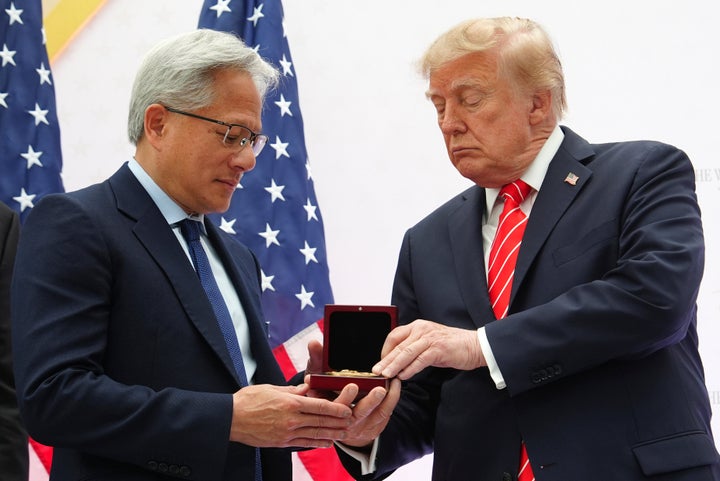
WASHINGTON ― President Donald Trump allowed Jensen Huang, CEO of a leading chip manufacturer, to engage in talks with China. U.S. intelligence had flagged Huang’s potential connections with a Chinese spy. Despite this, Trump approved the sale of advanced chips to China, asserting the urgency “to beat” China in AI dominance.
Trump’s decision may signify a significant pay-to-play incident during his second term. Huang’s company contributed $25 million to Trump’s ballroom project. Yet, Nvidia initiated an internal investigation after Huang revealed an affair with a Malaysian data center executive.
“I think he’s an honorable guy,” Trump remarked following a South Florida golf weekend. He downplayed the affair’s significance, implying such incidents occur frequently.
Trump continued, “I haven’t heard he’s done anything wrong. He dealt with somebody but, you know, so does everybody else.” He suggested Huang’s presence in an upcoming meeting with Chinese leader Xi Jinping, adding, “I’d certainly take him.” Trump acknowledged knowing about Huang’s entanglement with a woman believed to be a Chinese government operative. “I think he probably has an excuse,” Trump commented.
During an impromptu press event, Trump reiterated his support for Huang. “I believe he’s suffering greatly. I read his statement, and I believe he’s suffering greatly,” Trump said. “He said he had absolutely no idea that the person in question was a spy. I asked him that question. ‘Did you have any idea that she was a spy?’ He said, ‘I had no idea that she was a spy.’ And I really believe him.” Trump claimed he learned about the issue recently, despite a spring-circulated memo. Trump admitted, “Certainly, it didn’t make much of an impact on me.”
The scandal influences multiple facets, touching Nvidia’s stock performance, Trump’s donor-driven policies, and national security. Trump’s management of Huang’s situation contradicts his “beat China” stance pivotal to his AI policies.
“We’re in a race with China,” Trump reiterated on CBS’ “60 Minutes.” He emphasized winning the AI battle against China, highlighting the strategic importance. “If we don’t have it, China’s gonna have it. That would put us at an unbelievable disadvantage. It’s all between us and China. There’s nobody else.”
Experts question how such a situation evolved, given its national security implications. “The questions are arising a lot faster than any answers,” remarked John Bolton, Trump’s former national security adviser.
Robert Kagan, a former Reagan administration official, suggested Huang’s donations to Trump’s ballroom might explain it. “There is no foreign policy. There are only opportunities for enrichment,” he stated. Kagan noted this approach extends to Russia, the Middle East, and Asia. “It’s all about money for Trump and his family.”
Former Mayor Rahm Emanuel, considering a 2028 presidential run, pointed out Trump’s Nvidia stock acquisitions. “The questions are simple,” Emanuel wrote. “Who in the Trump Administration knew? When did they know it? And knowing it, why did they keep letting Huang make his case?” The White House and National Security Council did not comment.
Trump’s stance on sending sophisticated computer chips to China contrasts with his AI leadership rhetoric. “We want to beat China at the industry… We want to lead in AI, we want, and we’re leading China by a lot in AI,” Trump stated on April 25.
“We have AI. We’re dominating AI. We’re leading everybody, including China,” Trump told embassy staff in Dublin, Ireland, on September 12, before traveling with Huang to Beijing. After a White House AI summit on September 29, Trump emphasized maintaining a significant lead over China in AI.
Despite these assertions, Trump approved Huang’s requests for his company to export its H200 chip to Chinese companies.
Senators Elizabeth Warren (D-Mass.) and Jim Banks (R-Ind.) previously urged the Commerce Department to suspend Nvidia’s chip export licenses to China for national security reasons. The spy revelation heightens the need for congressional investigation.
“Nvidia CEO Jensen Huang’s confirmation of a relationship with a suspected spy for China’s intelligence service makes these national security concerns even more urgent and raises important questions Nvidia must answer about the extent to which these activities were related,” they stated.