
Updated on: November 2, 2026 / 6:50 AM EST / AP
An intriguing discovery has emerged from the shadows of history, offering a fresh perspective on the age-old mystery of a notorious pirate who vanished centuries ago. Amateur historian James Bailey has uncovered startling evidence involving Thomas Jones, namesake of the popular Jones Beach in New York, revealing his possible role in aiding the infamous pirate Capt. Henry Every.
Years ago, Bailey gained recognition for discovering ancient coins linked to Captain Henry Every. Now, colonial-era documents hint that Every, known as the ‘King of the Pirates,’ and his crew may have received assistance from Thomas Jones. Bailey notes, “Millions visit this beach, yet few know of Jones’ pivotal role in perhaps the largest piracy in history.”
Bailey’s investigations delve into the 1695 raid of the Ganj-i-Sawai ship on the Red Sea, a brutal event that prompted the first global manhunt in history. Every’s crew inflicted horror, leading to worldwide outrage. Though some pirates were captured and executed, many, including Every, disappeared, rumored to have fled to Europe and the American colonies.
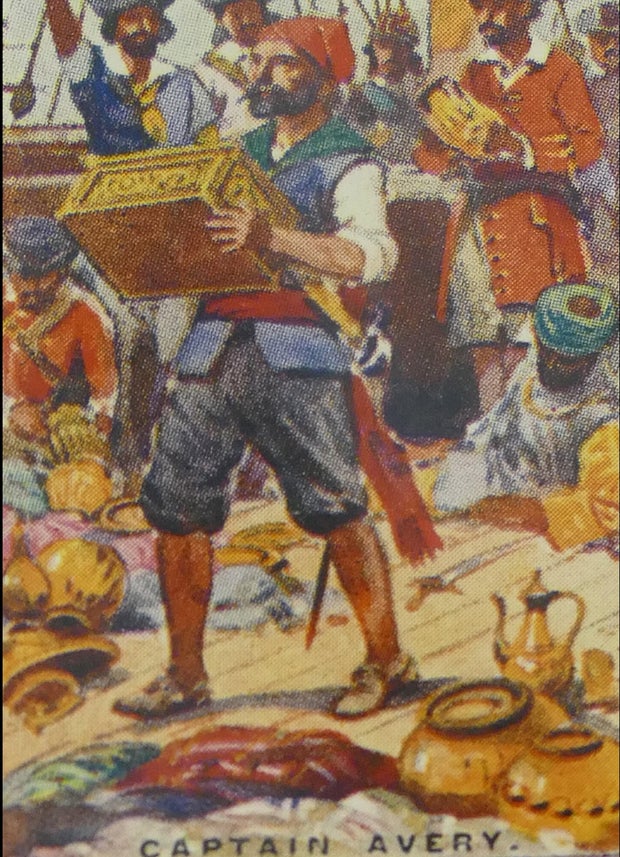
Lambert & Butler via Getty Images depicts a cigarette card showing Henry Every, sometimes erroneously referred to as John Every, acknowledging his piracy in the Atlantic and Indian oceans during the mid-1690s.
Bailey’s findings from documents and depositions suggest Jones was pivotal in aiding Every by helping the pirates escape with vast sums of gold and silver. New York’s governor later investigated Jones, suspecting his ties with piracy even as Jones emerged as a wealthy whaling entrepreneur on Long Island.
Bailey hopes to publish his research, which exposes a portion of Jones’ checkered past, never fully explored in local history books. John Hanc, author of “Jones Beach: An Illustrated History,” confirms Jones’ military background and his eventual establishment in New York as a significant businessman.
After moving to the American colonies, Jones acquired expansive land on Long Island. But rumors persisted about his fortunes derived from piracy, even after his death in 1713. Before its demolition, Jones’ mansion was rumored to be haunted, with his grave being repeatedly disturbed by treasure hunters.
Thomas Floyd-Jones, a descendant, in 1906 dismissed pirate tales about Jones as malicious slander. Yet Bailey’s emerging evidence presents a more profound truth about Jones’ ties to piracy.
Considering Jones’ background as a privateer, Meagan Schulman from Fordham University highlights the blurred lines between privateers and pirates. She explains that while privateers like Jones operated under government sanction during wartime, post-war acts branded them pirates.
After aiding Every and the pirates’ escape, records show Jones briefly returned to Rhode Island before receiving land in Long Island from his father-in-law, which marked a fresh beginning for him amidst continuing pirate hunts.
Bailey notes that Jones’ pirate past accompanied him despite his establishing a homestead on Long Island. In 1698, New York’s colonial governor, Richard Coote, drafted evidence seeking to link Jones to piracy, describing an elusive “barrel of money” traced to Jones’ property.
Kevin McDonald, a history professor, argues the foundational wealth piracy often supplied to early American colonial families, demonstrating how many respected figures had undisclosed piracy connections. Richard Blakemore, a maritime historian, agrees, reflecting how intertwined piracy was with colonial society and economy.
The emerging narratives about Jones highlight the forgotten connection between piracy and prosperous colonial families, providing new insights into the social and economic history of early British colonies in America.