
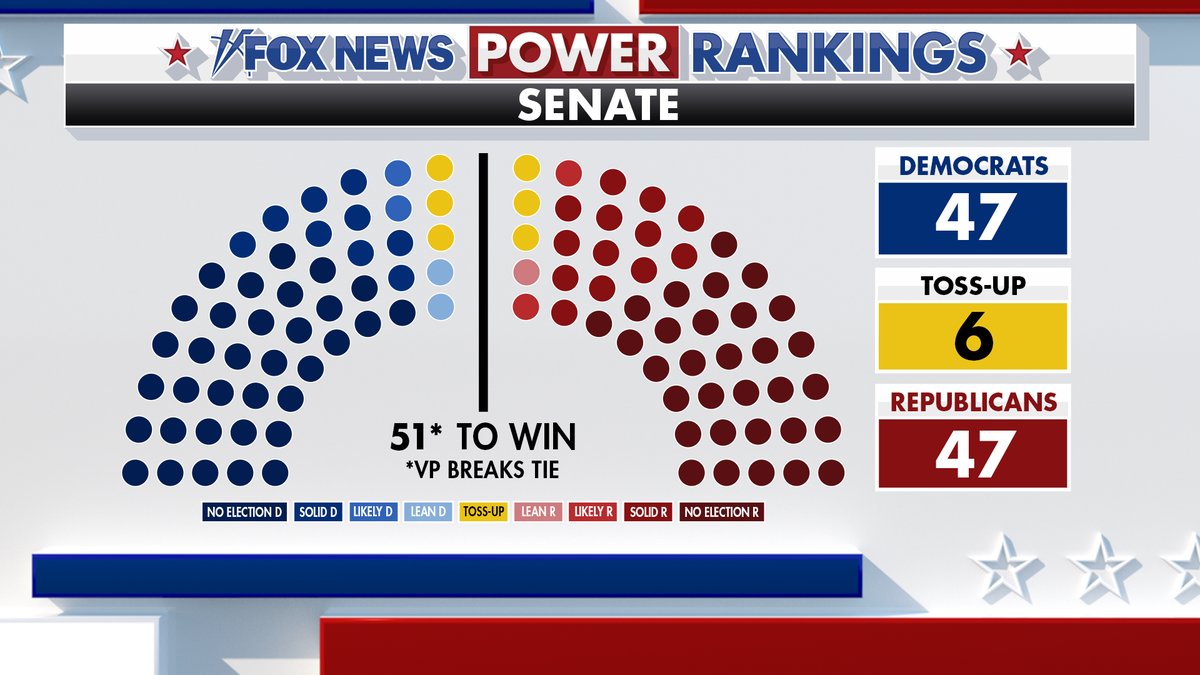
Senator Tim Scott recently joined anchor John Roberts to discuss the critical battle for Senate control as the midterm elections approach. The conversation explored power rankings, key toss-up races, and significant economic issues like the cost of living. With nineteen days remaining, Scott shared the strategies Republicans are employing to secure a majority.
Democrats are looking to expand their narrow path to reclaiming the Senate majority, aiming for victory in several competitive races. Analysts predict a potential outcome where Democrats gain 52 or 53 seats if a strong blue wave occurs. Alternatively, if Republicans perform well, they could maintain their current majority of 53-47.
The current political landscape shows both parties potentially taking 47 seats each, leaving six races as true toss-ups according to the latest power rankings. These six toss-up races, along with three leaner races, will likely determine the Senate majority. Democrats need a net gain of four seats to win control, while Republicans work to hold their current majority.
“Nine races will determine control of the Senate, and on the polling alone, you could call any of them toss-ups,” noted Remy Numa, a Fox News contributor who guides the network’s Power Rankings.
Republicans face a challenging environment due to historical trends, persistent inflation, high gas prices, and negative approval ratings for President Donald Trump. Of the nine competitive races, Republicans are defending seats in six states: Alaska, Iowa, Maine, Ohio, Texas, and Michigan.
- Alaska: Sen. Dan Sullivan seeks re-election against Democrat Mary Peltola.
- Iowa: Rep. Ashley Hinson attempts to keep Sen. Joni Ernst’s seat in Republican hands against Democrat Josh Turek.
- Maine: Sen. Susan Collins faces Democrat Troy Jackson in her re-election bid.
- Ohio: GOP Sen. Jon Husted competes against former Democratic Sen. Sherrod Brown.
- Texas: State Attorney General Ken Paxton contests Democratic state Rep. James Talarico.
Democrats are also in defense mode in several states. In Michigan, nominee Abdul El-Sayed faces former GOP Rep. Mike Rogers in the fight for retiring Sen. Gary Peters’ seat. New Hampshire sees Rep. Chris Pappas aiming to retain Sen. Jeanne Shaheen’s seat against former GOP Sen. John E. Sununu. Minnesota’s Democratic Lt. Gov. Peggy Flanagan attempts to keep Sen. Tina Smith’s seat, though recent shifts favor Republicans.
In Kansas, Republican Sen. Roger Marshall faces a tight re-election contest against Democrat Adam Hamilton. Two states appear increasingly secure for Democrats: Georgia, where Sen. Jon Ossoff leads GOP challenger Mike Collins, and North Carolina, where former Gov. Roy Cooper leads Republican Mike Whatley.
If Democrats retain control in Georgia, Michigan, Minnesota, and New Hampshire, while flipping North Carolina and three additional GOP-held toss-up states, they can achieve a Senate majority. Sen. Kirsten Gillibrand emphasized the positive outlook for Senate Democrats in a recent statement.
Conversely, Republicans can maintain control by defending at least three toss-up races. A 50-50 Senate would remain under GOP control with Vice President JD Vance’s tie-breaking vote.
Sen. Tim Scott, Chair of the National Republican Senatorial Committee, expressed optimism about Republican momentum in a Fox News interview. He sees potential gains in Michigan and indicates confidence in Michele Tafoya’s campaign in Minnesota.