
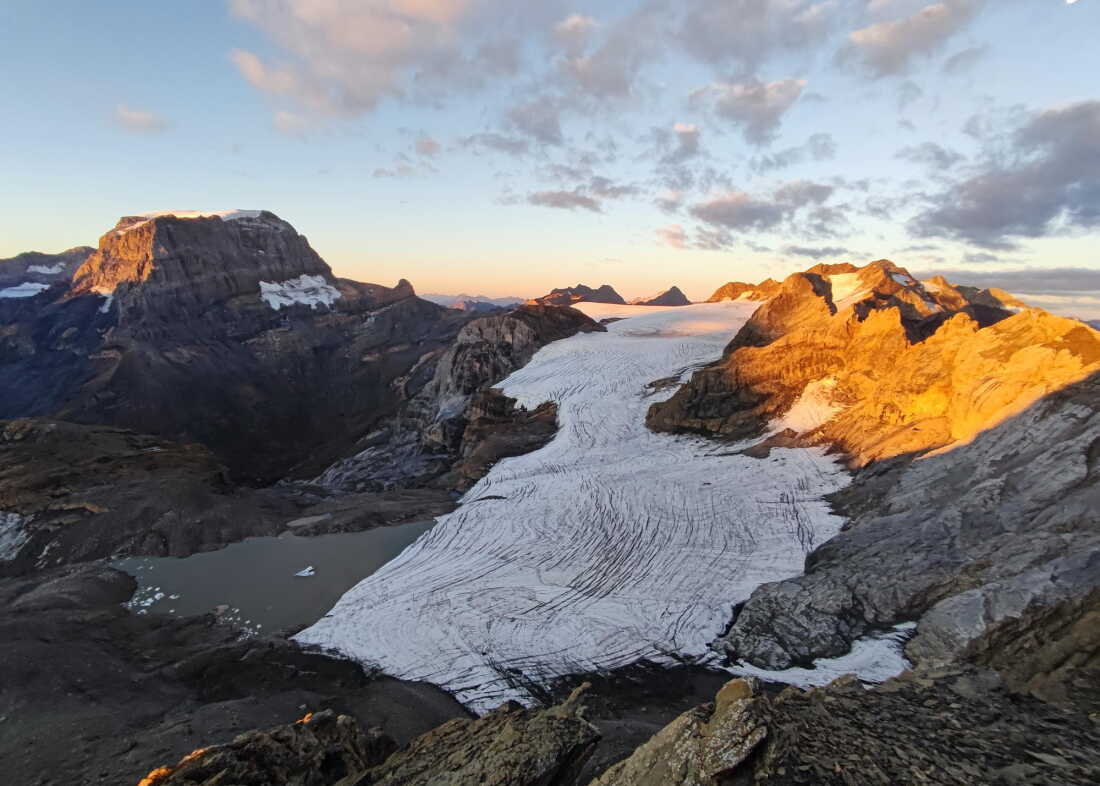
Glacier Loss in Switzerland
Switzerland’s glaciers have seen a troubling decline in ice, losing over 5% of their mass in 2026. This reflects a global trend where glaciers are shrinking rapidly, driven by global warming.
Monitoring Glacier Changes
Matthias Huss, who leads Switzerland’s glacier monitoring network GLAMOS, conducts extensive research. He discovered a record peak of ice loss in 2022, with 6% gone in just one year. Returning after the hot summer of 2026, he observed numerous glaciers almost lacking ice.
“It’s a moon landscape that is dry and dead. There are some little remnants, some ice blocks still lying around and melting there on the hot rocks,” Huss said.
Alpine plants now begin to inhabit areas once covered by thick glaciers.
Glaciers as Europe’s Water Towers
Larger glaciers like Rhône and Aletsch, facing record loss, are crucial as they release stored winter snow slowly, replenishing Europe’s main rivers such as the Rhine and the Danube. These rivers are vital for transportation and food supply. As rivers dried up this summer, transport halted, and nuclear plants suffered temporary shutdowns.
The melting glaciers could lead to droughts threatening farmers and elevate risks like landslides due to loss of mountain stability.
The Risk of Landslides and Floods
Glaciers and permafrost stabilize the mountains, but their absence increases landslide risk. Last year, the Swiss village of Blatten faced destruction from a glacier collapse, causing significant loss. An evacuation prevented fatalities, but residents remain displaced.
A glacier collapse near Tibet resulted in floods claiming 1,400 lives. Huss cautions against straightforward links to climate change but acknowledges it as a potential trigger for such disasters.
Urgency for Climate Action
Despite risks, Huss emphasizes the clarity of evidence. “Look at them, it’s not a hoax. The evidence is clear, and it’s been clear for decades. And I think many people have understood that it’s time to act now,” he argues.
Continued warming risks disappearing all Swiss glaciers by the century’s end, drastically changing Europe’s alpine landscape.